

💛 A Familiar Feeling: When the School Calls
If your heart drops when the school number pops up on your phone, you’re not alone. I remember those days all too well. We need autism parent-school anxiety support
As an autism Level 2 parent, I used to panic every time the phone rang. Was Jacob hurt? In trouble? Overwhelmed? Those calls brought waves of fear, guilt, and confusion.
Back then, I didn’t understand why the calls kept coming or how to help him succeed. Now, after being both the mom sitting at the IEP table and the special education teacher writing the IEP, I see both sides clearly.
Here are the three real feelings I experienced and what I learned about creating support, structure, and calm for both child and teacher.
😟 1. Fear: “Is He Safe?”
The first emotion that hit was fear.
I’d instantly picture Jacob getting hurt or lost, because as a child on the autism spectrum, safety awareness wasn’t his strong suit. He’d walk right into the middle of something or tune out completely when overwhelmed.
That fear wasn’t just about accidents , it was about not knowing what was happening.
I later realized Jacob’s unsafe moments often came when he felt anxious or confused about transitions. Without structure, his world felt unpredictable, and his body followed that anxiety. Can Medications for Children on the Autism Spectrum Help? Pros, and Cons
✨ What Actually Helped:
Morning Preparation Became Our Superpower
Before Jacob left for school, we started doing a simple 5-minute visual walkthrough of his day. I’d show him pictures of:
- The bus
- His classroom
- Lunch
- Recess
- Coming home
We’d literally point and say, “First bus, then classroom, then snack…” This wasn’t fancy — I used printed photos in a small binder that went in his backpack.
The CALM Connection: This is C — Consistent Action Forward. When your child knows what’s coming, their nervous system can relax. Safety isn’t just about physical boundaries; it’s about emotional predictability.
Try This Today: Take 3 photos on your phone right now — your child’s classroom door, the cafeteria, and your car. Tonight, show them in order and say, “Tomorrow: classroom, lunch, home.” Start simple. How a Visual Schedule for Autism Gave My Son Independence 📅✨
😩 2. Frustration: “Why Are They Calling Again?”
Once Jacob started school, my fear turned into frustration.
He was first placed in a general special education classroom that wasn’t designed for autism. The teachers were kind, but they didn’t yet understand that behavior is communication. Without structure, Jacob’s anxiety came out through yelling, refusing, or crying — and that’s when my phone would ring.
At that time, we didn’t have a diagnosis yet. I didn’t know about visual schedules or how powerful predictability could be for him. When Jacob finally transitioned into an autism classroom, everything began to change. His teacher used a visual schedule so he could see what was coming next and that simple tool lowered his anxiety and gave him stability.
✨ What Actually Helped:
I Started Speaking Their Language
Instead of waiting for the school to call me, I started reaching out first. Every Monday morning, I’d send a quick email:
“Hi! This weekend Jacob was dysregulated because we had family over. He might need extra processing time today. His calming strategy is drawing — he has his notebook in his bag.”
This did two things: It gave teachers context, and it reminded them Jacob wasn’t being “difficult” , he was communicating.
The CALM Connection: This is A — Always Celebrate Wins, but also Always Advocate with clarity. When you give teachers practical tools and context, you’re setting your child up to be understood, not just managed. 3 Practical Tips For Parents To Boost Schoolwork Motivation Using Effective Schedules
Try This Today: Send one email to your child’s teacher this week. Keep it short:
- One thing that might affect their day (good or hard)
- One strategy that helps them calm down
- One win you noticed at home recently
You’re not oversharing — you’re partnering.
😔 3. Defeat : “Why Do I Even Bother Taking Him?”
Some mornings, I’d barely make it home before the phone rang again.
“Can you come pick him up?”
I’d think, Why do I even bother?
It’s a helpless feeling and one that many autism parents know too well. You want your child to belong and succeed, but the system isn’t built for one-on-one attention. I finally realized that even the most dedicated teacher can’t give every anxious child the individualized time they need in a full classroom.
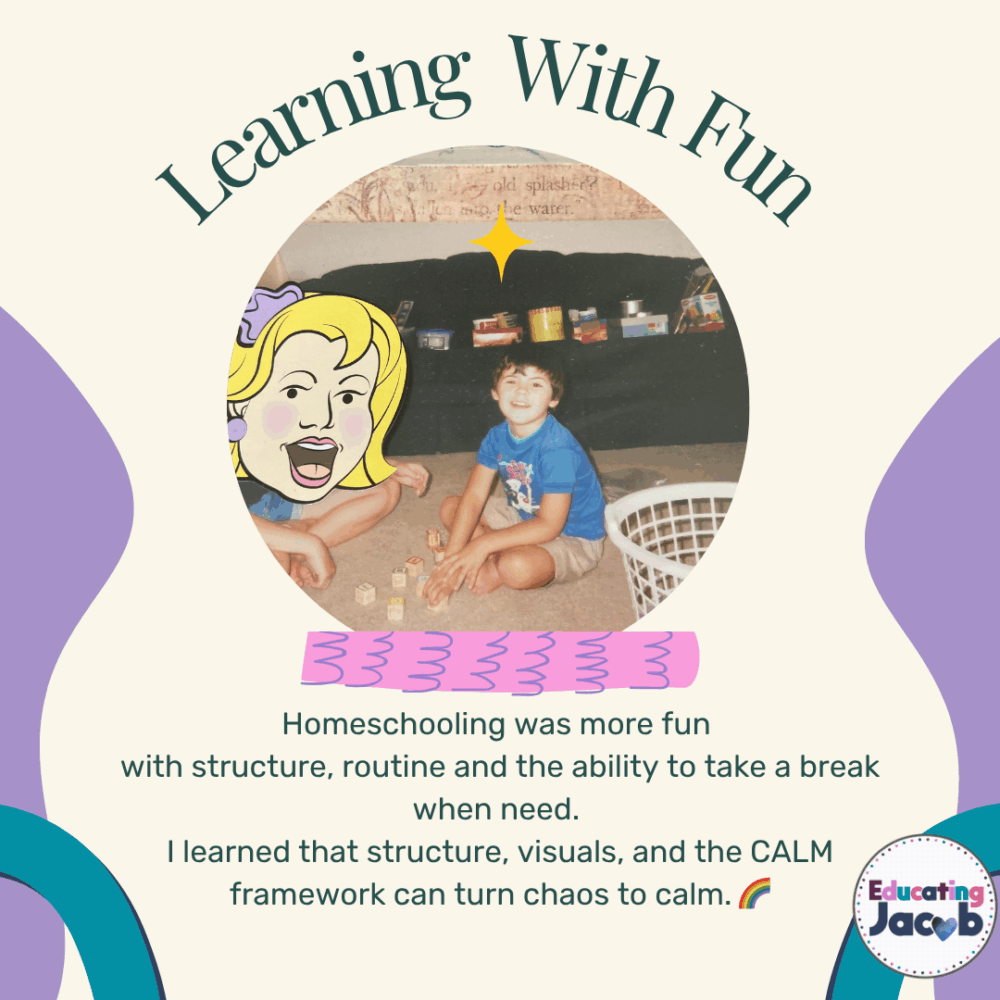
That realization led me to homeschool Jacob, using the same strategies I later applied as a special education teacher. Visual schedules, routines, and a calm environment became the foundation of our success and eventually inspired the CALM Framework that I teach other autism parents today.
✨ What Actually Helped:
I Stopped Waiting for School to Be “Enough”
This was the hardest lesson: School wasn’t going to fix everything. And that wasn’t the school’s fault or mine it was just reality.
So I started building structure at home that matched what school was trying to do. I created:
- A visual schedule on our fridge (breakfast, brush teeth, backpack, bus)
- A calm-down corner in our living room with a weighted blanket and fidgets
- A “first-then” card I’d use for everything: “First shoes, then tablet”
When Jacob came home, he knew what to expect. That consistency helped him hold it together at school because he wasn’t running on empty by 10 a.m.
The CALM Connection: This is L — Learning to Create Schedules. You can’t control what happens at school, but you can build a foundation at home that gives your child the regulation tools they need to succeed anywhere.
Try This Today: Pick one part of your morning or afternoon routine that’s chaotic. Make it visual. Draw it, print pictures, use clipart — whatever works. Put it where your child can see it. Do that same routine the same way for one week. Watch what happens.
💬 What I’ve Learned from Both Sides of the IEP Table
I’ve been the worried mom in the meeting and the teacher explaining why the calls happen.
Here’s what I know now: When teachers call, it’s rarely about blame. It’s about support. They’re asking for partnership, because when a child’s anxiety disrupts learning, no one wins.
But here’s what I also know: You don’t have to have all the answers when they call. You just need to know your child and be willing to try something new. https://debpreston.com/autism-tantrums-behavioral-strategies/
The Questions I Started Asking (That Changed Everything):
When the school called, instead of spiraling, I’d ask:
- “What happened right before the meltdown?” (This helped me spot patterns)
- “What usually calms him down at school?” (So I could reinforce it at home)
- “Can we try [specific visual or routine] tomorrow and see if it helps?” (Partnership, not defensiveness)
The CALM Connection: This is M — Mindset. The call isn’t a verdict on your parenting. It’s data. It’s feedback. It’s a chance to collaborate and figure out what your child needs next.
Try This Today: Write down these three questions and keep them by your phone. Next time the school calls, take a breath, and ask them. You’ll feel more in control, and the conversation will shift from crisis to problem-solving.
🌈 From Chaos to Calm
If you’re living in that anxious space waiting for the next school call take heart. You’re not failing. You’re learning.
Jacob and I have been there, and what changed everything wasn’t a magic solution. It was preparation, structure, and connection. Visual schedules gave him confidence. Routines gave him peace. And the CALM Framework gave us both a way forward.
You don’t need to fix everything today. Pick one small thing from this post and try it this week. Send that email. Make that visual. Ask those questions.
Because here’s the truth: The school calls won’t stop overnight. But your response to them can change. And when you’re calmer, your child feels it too. We need everyone on the team.
Let’s replace chaos with calm and help our children thrive at home, at school, and everywhere in between. 💛
P.S. If you’re ready to dive deeper into building these routines and creating real calm at home, the CALM Framework walks you through every step. You don’t have to figure this out alone. 💙