
How a Visual Schedule for Autism Gave My Son Independence 📅✨

Visual Schedule for Autism=Independence 📅
When Jacob was little, our house felt like a pressure cooker ready to explode at any moment. Every morning started with me mentally preparing for battle, would today bring three meltdowns or five? Would I be able to get him dressed, fed, and out the door without both of us in tears?
Parenting a child with level 2–3 autism means routines matter but no one tells you how much structure your child actually craves until you’re drowning in meltdowns and overwhelm. I remember standing in my kitchen at 7 AM, Jacob screaming because I’d put his toast on the wrong plate, and thinking, “There has to be a better way.” Looking for a better way? Visual Schedules reduce Chaos!
The smallest changes sent our world spinning. If we ran out of his favorite cereal, if his usual shirt was in the wash, if we had to take a different route to school—chaos. Language was too much for him to process. Transitions triggered anxiety that rippled through our entire day. New experiences led to meltdowns that left us both exhausted and defeated.
I felt like I was failing him. I felt like I was failing myself. We were all running on empty, and I was desperate for something—anything—that would help my son feel safe in his own world.
That’s when I discovered the power of a visual schedule for autism—and it truly changed everything for our family.
Why Visual Schedules Work When Language Doesn’t
Here’s what I wish someone had told me earlier: Jacob’s brain wasn’t broken. It was just wired differently. He struggles with processing delays and speech-language challenges that make verbal instructions feel like trying to catch water with your hands. Even the simplest directions—”Jacob, time to get dressed”—felt like too much information coming at him too fast.
But when I showed him his day in pictures, something amazing happened. It was like watching a light switch flip on.
✅ He understood what was coming next
✅ He felt safer and less anxious
✅ He started transitioning without meltdowns
✅ He began seeking out his schedule independently
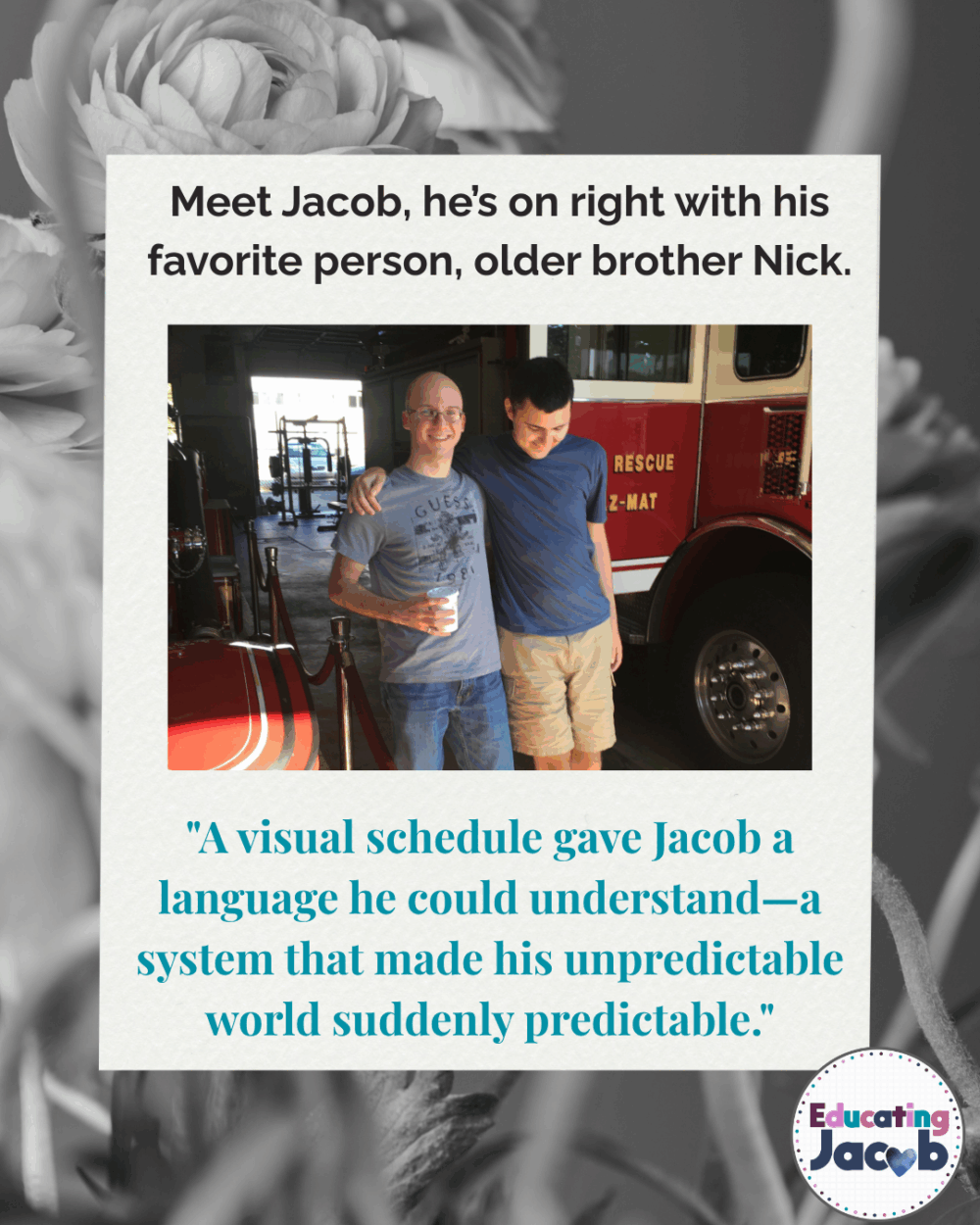
A visual schedule gave Jacob a language he could understand—a system that made his unpredictable world suddenly predictable. For the first time, he could see his entire day laid out in front of him, and that visibility brought him peace.
The science backs this up too. Children with autism often process visual information more effectively than auditory information. When we remove the language barrier and communicate through pictures, we’re literally speaking their brain’s preferred language.

It’s More Than Just Pictures—It’s Power
Once we started using a visual schedule for autism, I could finally communicate Jacob’s day without overwhelm—for either of us. But here’s what surprised me most: it wasn’t just about reducing meltdowns. It was about giving Jacob power over his own life.
We added everything to the schedule, and I mean everything:
- 🧩 Schoolwork (using labeled zipper bags with visual task cards)
- 🧼 Chores (with step-by-step picture checklists he could follow independently)
- 🧺 Laundry routines (with garment bags and sorting visuals)
- 💊 Medications (organized by day with a color-coded pill box)
- 🎮 Free time (his favorite activities clearly depicted)
- 🧃 Mealtimes and snacks (with options he could choose from)
- 🛍️ Store trips and errands (with social stories about what to expect)
- 🛁 Self-care routines (brushing teeth, washing hands, getting dressed)
Every part of the day became clear and simple. But most importantly—Jacob had choice. He could see his options laid out visually and feel in control of his decisions. That built confidence and independence in ways I never expected.
I watched him start making choices about the order of his activities. He’d move his schedule cards around, deciding whether to do math before or after his snack. He began taking ownership of his day instead of just surviving it.
Visual Schedules = Confidence and Calm
Using a visual schedule gave us so much more than peace—it gave Jacob:
✨ Independence – He could complete routines without constant prompting
✨ Predictability – His world finally made sense
✨ A role within the family – He became an active participant, not just a passenger
✨ A way to understand new routines – Changes became manageable instead of catastrophic
✨ Self-advocacy skills – He learned to communicate his needs through the schedule
We even used the schedule to prep for upcoming changes like doctor visits, family outings, or holiday disruptions. It became our tool to reduce anxiety and build success before challenges even arose. When Jacob could see exactly what would happen at the dentist’s office—from checking in to sitting in the chair to getting his sticker—the unknown became known.
And you know what? I got something too.
✅ I got my sanity back. ✅ I got to take a shower without planning a crisis management team. ✅ I got calm in the chaos. ✅ I got to be Jacob’s mom again, not just his crisis manager. Parenting a Child with Autism Level 2-3 Can Be Ra Ra Rough! Stay CALM
For the first time in years, I could breathe. I could plan. I could even enjoy moments with my son instead of constantly bracing for the next meltdown. https://themonterabbi.com/help-nonverbal-autistic-kid-speak/
You Don’t Need to Be Perfect—You Just Need to Start
Here’s the thing, friend. If you’re reading this at 2 AM after another difficult day, feeling like you’re drowning in the overwhelm of autism parenting, I see you. I’ve been exactly where you are.
And here’s what I want you to know: it doesn’t have to be complicated.
You don’t need fancy laminated cards or Pinterest-perfect organizational systems. Start with sticky notes. Use printed photos from your phone or simple symbols drawn on index cards. Take pictures of your child doing their actual routines in your actual house—those work better than generic stock photos anyway.
Don’t wait for the perfect system—start with what your child can understand today. Maybe it’s just three pictures: breakfast, play, nap. Maybe it’s showing them what comes after their current activity. Small steps count.
Visual schedules for autism aren’t about perfection. They’re about giving your child a lifeline—and giving yourself room to breathe.
At educatingjacob.com, we teach parents exactly how to create these life-changing visual systems. We show you how to identify what your child needs, how to create schedules that actually work, and how to build independence step by step. Because every child deserves to feel confident and every parent deserves to feel calm. Stop Morning Chaos: How to start using Visual Schedule for Autism and CALM
Remember: Every visual schedule you create is another step toward independence for your child, less anxiety in their daily life, and more peace for your entire family. We’re cheering you on! 💙
💬 Tell Me: Have You Tried a Visual Schedule?
Drop a comment or DM me @educatingjacob. I’d love to know what’s worked for your child—and what hasn’t. What part of your day feels most chaotic right now? Let’s build this village together, one calm routine at a time. 💛
Because you’re not alone in this journey, and your child’s success is worth every small step you take today.