autism meltdown prevention

  • 3 Practical Tips For Parents To Boost Schoolwork Motivation Using Effective Schedules

    Monday_Friday_Work_Schedule_Pouches
    This is a picture of Jacob’s Monday-Friday zippered pouches that hold his work!

    Hello Autism Island Parents,

    Let’s talk about a battle we all face, boosting autism homework schedules.

    On Autism Island, getting through schoolwork can feel like climbing a mountain with flip-flops on. 😅 The tears, the resistance, the “I don’t want to do it!”—sound familiar? https://pmc.ncbi.nlm.nih.gov/articles/PMC2926912/

    But here’s what we’ve learned with Jacob: the secret isn’t forcing the work, it’s building a schedule that makes schoolwork feel doable, predictable, and even motivating.

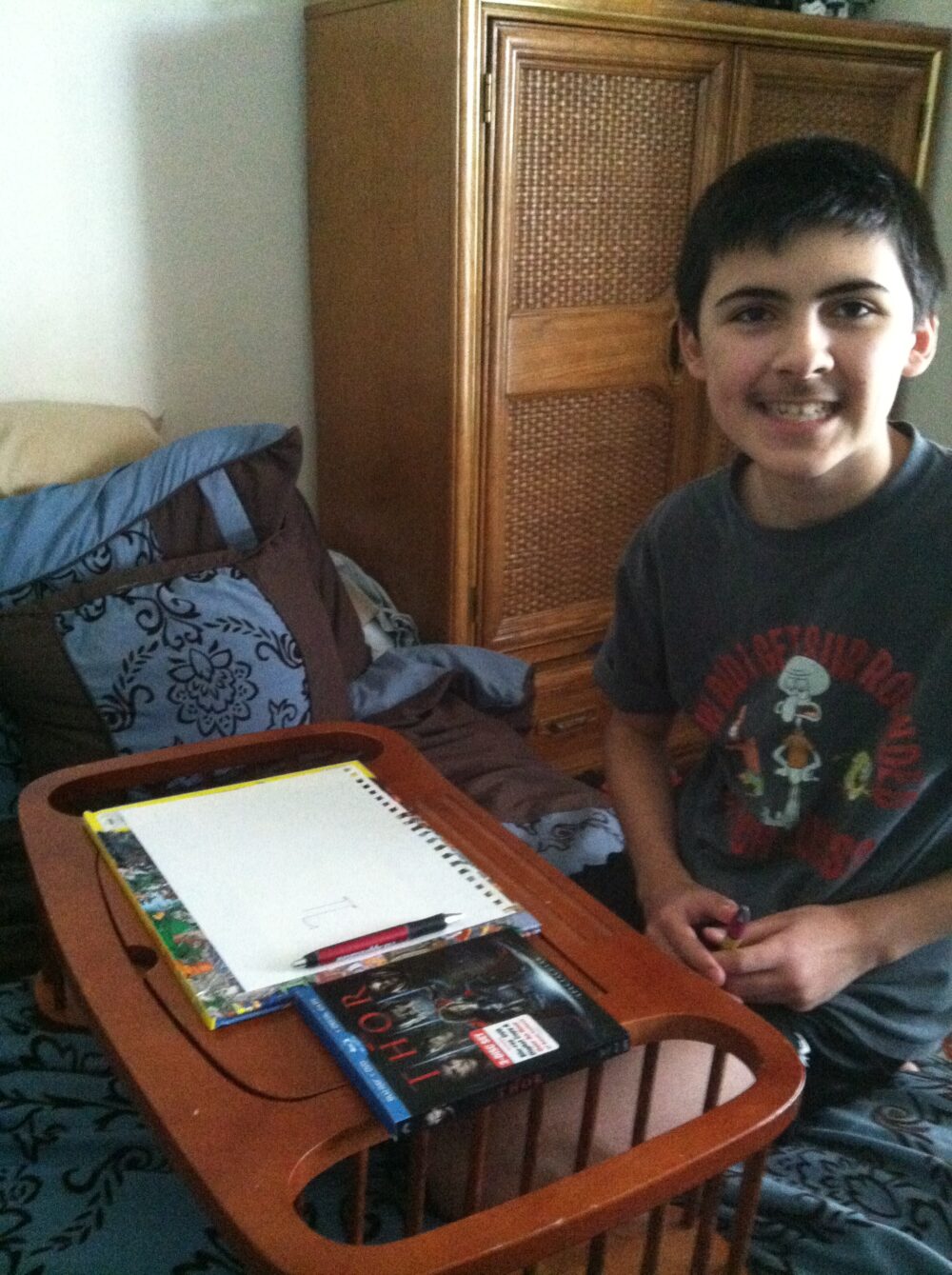
    Here are 3 practical tips for boosting autism homework schedules that have worked in our home, powered by our CALM Framework.In the picture below Jacob is drawing after completing a work assignment, the first assignment was math and not that enjoyable but the next thing on this schedule was free time for drawing or watching a movie of his choice. How a Visual Schedule for Autism Gave My Son Independence 📅✨
    movies_drawing_fum
    This is Jacob drawing something from a movie cover after homework is complete!

    1. ✏️ Engaging and Personalized Schedule Creation

    Children on the spectrum thrive when they can see and predict what’s coming. That’s why creating a visual schedule together makes all the difference.

    When Jacob was younger, we used first-then schedules—a math worksheet icon followed by a picture of play-doh or his favorite DVD cover for break time. Seeing the reward built in made the harder work less overwhelming.

    Even today, I still let him choose. He may start with math (not his favorite), but he knows drawing or movie time comes right after. That balance keeps him motivated.

    💡 CALM Strategy – C: Consistent Action Forward
    Schedules don’t have to be perfect—they just need to move forward. Jacob knows that every assignment is followed by something he enjoys, which keeps him from stalling out completely. Looking for a better way? Visual Schedules reduce Chaos!

    schedule-fun-jacob-is-the-hulk-barnes-and-noble
    Jacob having fun at Barnes and Noble after a week of completed work!

    2. 🎉 Reward and Recognition System

    Schedules alone aren’t magic—celebrating wins is what makes them powerful.

    In our home, rewards have looked different over the years:

    • 🍕 A trip to Panera or his favorite pizza place
    • 📚 A trip to Barnes & Noble to pick a new book
    • 🖍️ Extra time drawing or watching a favorite movie

    Just recently, after finishing a week’s worth of work bags, Jacob earned his bookstore trip. He walked in with the biggest smile—that moment was worth every bit of planning.

    💡 CALM Strategy – A: Always Celebrate Wins
    Jacob doesn’t always love the process, but he thrives when we celebrate his progress. These rewards remind him that effort matters. Even small wins deserve big celebrations. Inside Our Day: A Calm Autism Routine That Works
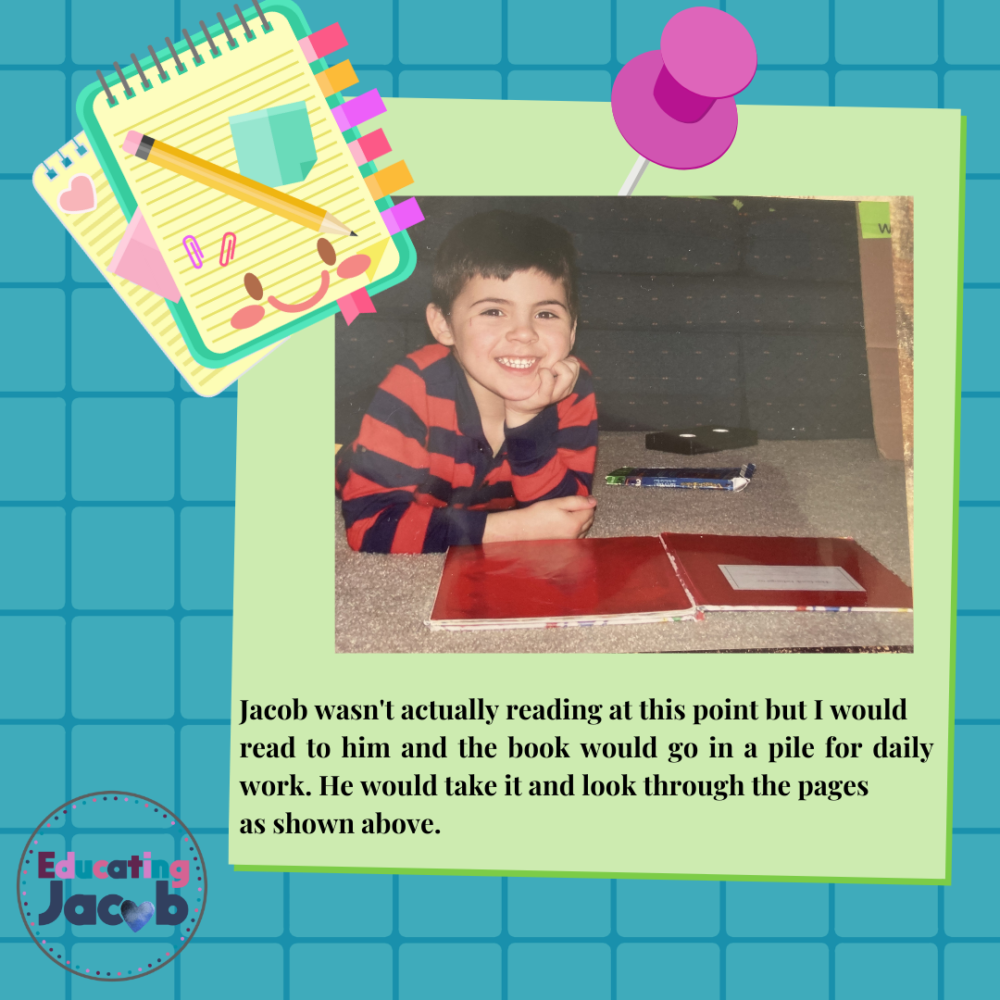
    Jacob_reading_when_he_first_started_using_schedules
    This is Jacob reading a story book that was in his first_then work schedule!

    3. 🤝 Consistent Support and Encouragement

    Homework is not a solo journey it’s teamwork.

    There were days Jacob fought every bit of the schedule. But instead of turning it into a power struggle, I sat with him. I offered support, reminders, and reassurance: “You can do this, I believe in you.”

    Consistency matters. By showing up and keeping the schedule steady, Jacob learned that:

    • Work time is temporary
    • Breaks are coming
    • Mom is calm (well, most of the time 😅)

    💡 CALM Strategy – L: Learn to Create Schedules & M: Mindset
    Jacob thrives when the schedule is steady and when I stay calm. The mindset shift for me was realizing it’s not about forcing schoolwork—it’s about teaching him that he’s capable, even when the task feels hard.

    📖 Why Schedules Work for Autism Motivation

    Motivation in children can be intrinsic (they love the subject) or extrinsic (they’re working for a reward). For many kids on the spectrum, schoolwork falls into the “extrinsic” camp at first.

    That’s okay! With consistent schedules, praise, and structure, your child can build confidence and even discover moments of intrinsic motivation.

    When Jacob was little, his first-then picture schedules gave him the courage to finish math and move on to something fun like play-doh. Over time, he began to expect success, not failure, which grew his willingness to try.

    🌟 Final Thoughts from Autism Island

    Boosting autism homework schedules isn’t about perfection. It’s about giving your child predictability, balance, and small wins that add up to big confidence.

    Every time Jacob finishes his work bags without frustration—or earns his bookstore trip—I’m reminded: the schedule isn’t just about schoolwork. It’s about teaching him life skills, building resilience, and creating calm for our whole family.

    So mama, grab those markers, build that visual schedule, and don’t forget to celebrate the small victories. Because every checkmark, every smile, every calm moment—those are the steps to long-term success. 💙

    Read More

  • 3 Ways Labor Day, Thanksgiving, and Christmas All Have Issues on Autism Island!

    The Holidays Are Coming… and So Is Chaos (Unless You Plan!)

    Let’s talk about autism holiday routine tips: Labor Day, Thanksgiving, and Christmas are meant to be joyful, restful, even sacred.

    But if you’re parenting a child on the autism spectrum, especially a Level 2 or Level 3, then you already know: holidays often bring the perfect storm of disruption.

    I call it Autism Island Weather. 🌪️ One minute it’s sunshine and visual schedules, the next, you’re elbow-deep in meltdown management.

    Whether it’s Labor Day’s long weekend, Thanksgiving’s full house, or Christmas’s gift-wrap sensory overload, here are three reasons holidays are hard—and how our CALM Framework keeps our home grounded. Looking for a better way? Visual Schedules reduce Chaos!

    1. 🗓️ Routine and Schedules? What Are Those?

    Our kids thrive on structure. Jacob lives by his visual schedule—and when holidays hit, that reliable rhythm? Out the window.

    Just this past Labor Day weekend, things looked promising. Nicholas, everyone’s favorite big brother, came home Saturday yay! But even good change is still change on Autism Island. We had it on the calendar. We talked it through. Jacob was ready.

    But then I got sick. Sinus, allergies, migraine—the whole trifecta. By Sunday, I was in bed, vomiting, texting my husband David to come home from work because I couldn’t feed Jacob. Nicholas had to head back to Raleigh. The plan was off track.

    The only thing that saved us? Everything else was in place.

    • ✅ Jacob’s work bags were ready for the week
    • ✅ His visual schedule was still visible
    • ✅ Favorite meals like pizza and burgers were already cooked
    • ✅ He could see what to expect—even when I wasn’t functioning

    💡 CALM Strategy – C: Consistent Action Forward
    Even when the plan shifted, the structure didn’t. We had consistently built routines he could fall back on. That consistency helped him navigate the weekend without falling apart even when I was.

    Autism holiday routine tips
    Chloe sticks close to make sure I’m feeling better! Having routines helps when I’m sick!

    2. 🤧 Someone’s Always Sick (Usually Me)

    If you’re a parent, you know this story: the minute you take time off for rest, your immune system collapses. For me, this long weekend meant a migraine from the underworld that knocked me flat.

    And let’s be real: when you’re raising a child with autism, being sick isn’t just inconvenient it’s dangerous to the delicate balance of your household.

    Jacob was expecting Panera Bread on Sunday, like always. That’s our thing. Our outing. A marker in his routine. And when I didn’t get out of bed, you could see the wheels turning—“This is different.”

    But he didn’t panic. He didn’t scream or melt down.

    Why?

    Because his schedule still had anchors. Panera didn’t happen—but burgers did. David heated up the food. The evening played out like the visual cues suggested.

    💡 CALM Strategy – L: Learn to Create Schedules
    Years ago, missing Panera would’ve sent us all into a spiral. But we’ve learned to build schedules that don’t rely on me being Supermom every second. That structure—visual, repeatable, consistent—isn’t just for Jacob. It’s for me, too. It keeps all of us afloat.

    autism-parenting-be-prepared
    Sick = Chaos if you’re not prepared. It makes a bad day worse!

    3. 🎉 Anticipation Doesn’t Cancel Out Anxiety

    Jacob adores Nicholas. He counted down the days to see his big brother. But excitement and anxiety walk hand-in-hand on Autism Island.

    This is true for every holiday. Christmas might mean presents, but it also means wrapping paper, different food, visitors, noise, and surprises. Thanksgiving might mean pumpkin pie, but it also means smells, textures, unfamiliar faces, and overstimulation.

    Even with the best of intentions, holiday joy can feel like chaos.

    Jacob was happy Nicholas was coming, but he still needed:

    • 🔁 Prep talk after prep talk
    • 📆 The calendar visual
    • 📦 His safe snacks and routines intact
    • 💺 A space where he could retreat if it got overwhelming

    And guess what? He did amazing.

    No meltdown. No shutdown. Just calm—even when the plan had holes.

    💡 CALM Strategy – M: Mindset for You and Your Child
    You have to shift the mindset: your child might look forward to the holiday, but they still need support to handle it. Just because they love their brother doesn’t mean they can emotionally process all that change without help.

    And you need grace, too. It’s okay to mourn the perfect moment you imagined. We didn’t get family movie night. I was asleep. But we got peace—and sometimes that’s the win worth celebrating. This too shall pass, how we changed our mindset on autism island!

    💡 What You Can Do Before the Next Holiday:

    • Build visual countdowns to holidays, starting several days out
    • Prep favorite meals or snacks early—your child’s comfort food matters!
    • Keep some routines the same, even if others shift
    • Set realistic expectations for yourself and your family
    • Celebrate the small wins—a meltdown-free morning is a victory!

    If you’re on Autism Island, just know you’re not alone.
    You’re not doing it wrong. The holidays are just hard. But you don’t have to let them sink your ship. Here’s an article I found if you are new to autism, check back on my older blog posts too.  https://www.merakilane.com/how-to-cope-9-parenting-tips-for-overwhelmed-autism-moms/

    With the CALM Framework, even the biggest disruptions can be softened into manageable transitions. And the good news? Your child doesn’t need perfect. They just need you—CALM, prepared, and present.


    Read More

  • Parenting a Child with Autism Level 2-3 Can Be Ra Ra Rough! Stay CALM

    Autism's level 2-3's can be rough on parenting
    Parent with CALM!

    Autism Level 2-3 Can Be Rough!

    Living on Autism Island? Then you already know what I’m about to tell you…

    If you’re parenting a child with autism level 2-3, this post won’t shock you—but it will encourage you. This one’s for the exhausted parents who need a peek behind the curtain and some practical strategies for not just surviving, but actually thriving on Autism Island. How I made it through the holidays without chaos and anxiety on autism island.

    You know the drill: unpredictable days that start before dawn, public meltdowns that make strangers stare, and that constant feeling of treading water while everyone else seems to be swimming laps.

    Jim Gaffigan nailed it when he said: “We try to be good parents… not that you’d be able to tell. Like if you met one of my sons, you’d think, ‘Oh wow, Jim decided not to parent this one.'”

    Hilarious? Yes. Painfully relatable? Absolutely.

    More than once, I’ve caught those looks—the ones that silently ask, “Is she even trying to parent this child?” The truth is, parenting my son Jacob (now 27, autism level 2-3) has taught me more than any book, class, or degree ever could. But getting here wasn’t easy.

    The Daily Struggle Was Real

    I used to feel like a complete failure—overwhelmed, defeated, and desperate to figure out how to help my son have just one good day, let alone a good life.

    Our mornings looked like this:

    • Getting dressed? A 45-minute battle that left us both in tears
    • Grocery shopping? Forget it—unless I wanted a full-scale meltdown in aisle 3
    • Family gatherings or therapy appointments? Pure anxiety for days beforehand

    I never knew what would set him off. The heartbreaking part? Neither did he. That’s the reality of parenting a child with autism level 2-3—you’re both trying to navigate a world that doesn’t make sense. Autism Awareness Month! Parenting on the spectrum, no judgment here?🏝️

    Use Structure for Autism Levels 2-3
    CALM Framework is all about — four key habits that changed everything for our family.

    The Turning Point: When Everything Changed

    What finally turned the corner for us wasn’t a miracle cure or expensive therapy. It was something beautifully simple: visual schedules.

    A mentor from UNC TEACCH at Chapel Hill introduced me to structured supports that actually made sense to Jacob’s brain. Little by little, with unwavering consistency, we began to see his anxiety decrease. Jacob started feeling more in control of his world.

    And I? I began to breathe again.

    Here’s the thing—we still use visual schedules today. Even as a young adult, Jacob needs that structure to understand his day and feel safe in it. And you know what? There’s absolutely nothing wrong with that.

    CALM: The Framework That Saved Our Sanity

    Parenting a child with autism level 2-3 means accepting that support is needed long-term. It also means learning to create your own version of calm in the chaos.

    That’s where our CALM Framework comes in—four key habits that transformed our family’s daily life:

    C – Consistent Action Forward

    Stop trying to fix everything at once. You’ll burn out faster than a birthday candle in a hurricane.

    Instead, choose one thing that’s disrupting your peace and create a simple schedule around it. Start ridiculously small. Repeat it daily. Build momentum like you’re training for a marathon, not sprinting to the finish line.

    Those tiny wins? They stack up and create a ripple effect for both you and your child.

    A – Always Celebrate Wins

    Every. Single. Win. Counts.

    • Got dressed without a meltdown? 🎉 Victory dance time!
    • Used a visual cue to ask for help? 🎉 That’s communication gold!
    • Made it through Target with only one minor incident? 🎉 You deserve a medal!

    When you focus on what’s working and celebrate it (even if it feels small), you’re rewiring your brain to notice progress. Your child feels that pride and confidence too—and starts believing in their own capabilities.

    L – Learning to Create Schedules

    Visual schedules aren’t just for classrooms or little kids. They’re for anyone who needs predictability, independence, and reduced anxiety. (So basically, all of us.)

    Start with 2-3 simple tasks your child already knows how to do. Build in something they love. Add one small challenge. Follow it with another preferred activity.

    The magic formula: Familiar + Preferred + Challenge + Preferred = Success

    This isn’t about rigid control—it’s about guidance, ownership, and helping your child feel safe in their own skin.

    And no, you don’t need a special education degree to do this. I didn’t have one when I started! I eventually got my degree because I wanted to understand Jacob better, but what really taught me was the daily experience of parenting him.

    M – Mindset

    Here’s the truth bomb: You can do this.

    But your mindset has to shift from reactive to proactive:

    • Reactive = chaos, burnout, feeling like you’re always putting out fires
    • Proactive = preparation, structure, and actual peace in your home

    Your calm becomes their calm. Your belief that they can succeed (with the right support) is what helps them actually succeed.

    You’re Not Failing—You’re Learning

    If you’re parenting a child with autism level 2-3, I need you to hear this:

    💛 You’re not a bad parent. You’re learning to parent differently.
    💛 Your child is not broken. They’re wired differently and need different supports.
    💛 You absolutely can have calm and happiness, even on Autism Island.

    Is it always easy? Not even close. But can you build peace, structure, and genuine joy into your days? Absolutely yes. Here’s a post from someone else you might like: https://marvelouslysetapart.com/2018/08/24/10-positives-of-autism/

    Your Next Step Starts Now

    Ready to begin your CALM journey? Here’s what you do:

    1. Choose one challenge that’s disrupting your peace
    2. Build one simple visual schedule around it
    3. Celebrate one win when you see progress

    That’s it. Start there. Build momentum. Trust the process.

    Want more support on this journey? Join the Autism Thrive Tribe—my membership community where parents use the CALM framework to bring real peace and purpose into daily life. We share wins, support each other through the tough days, and celebrate every step forward together.

    Because parenting a child with autism level 2-3 doesn’t have to mean constant chaos. Let’s build CALM—and a future full of possibility.

    Remember: Every visual schedule you create is another step toward independence for your child, less anxiety in their daily life, and more peace for your entire family. We’re cheering you on! 💙

    Read More

  • Why Most Visual Schedules Fail (And How to Fix Yours)

    Visual schedules aren’t just tools — they’re lifelines. Discover the 3 common mistakes I made (and how we fixed them!) 💪 #ParentingAutism #AutismSupport
    Learning to create schedules! Keep it Simple and Have Fun.

    Are you drowning in unpredictability, meltdowns, and constant chaos that seems to come with parenting a child with autism? I see you. I was you. https://autismadhdconnection.com/5-tips-for-explaining-an-autism-diagnosis-to-others/

    When Jacob was younger, I felt like I was failing. I lost confidence in my parenting and had no clue how to make our days work without everything spiraling into tears (his and mine 😅). That’s when I began learning to create visual schedules for autism  and friend, they changed everything. 💙

    But I didn’t get it right at first. In fact, I got it very wrong. Let me share the three biggest mistakes I made with visual schedules and how you can avoid them for your child’s success. Stop Morning Chaos: How to start using Visual Schedule for Autism and CALM

    Learning to Create Schedules:

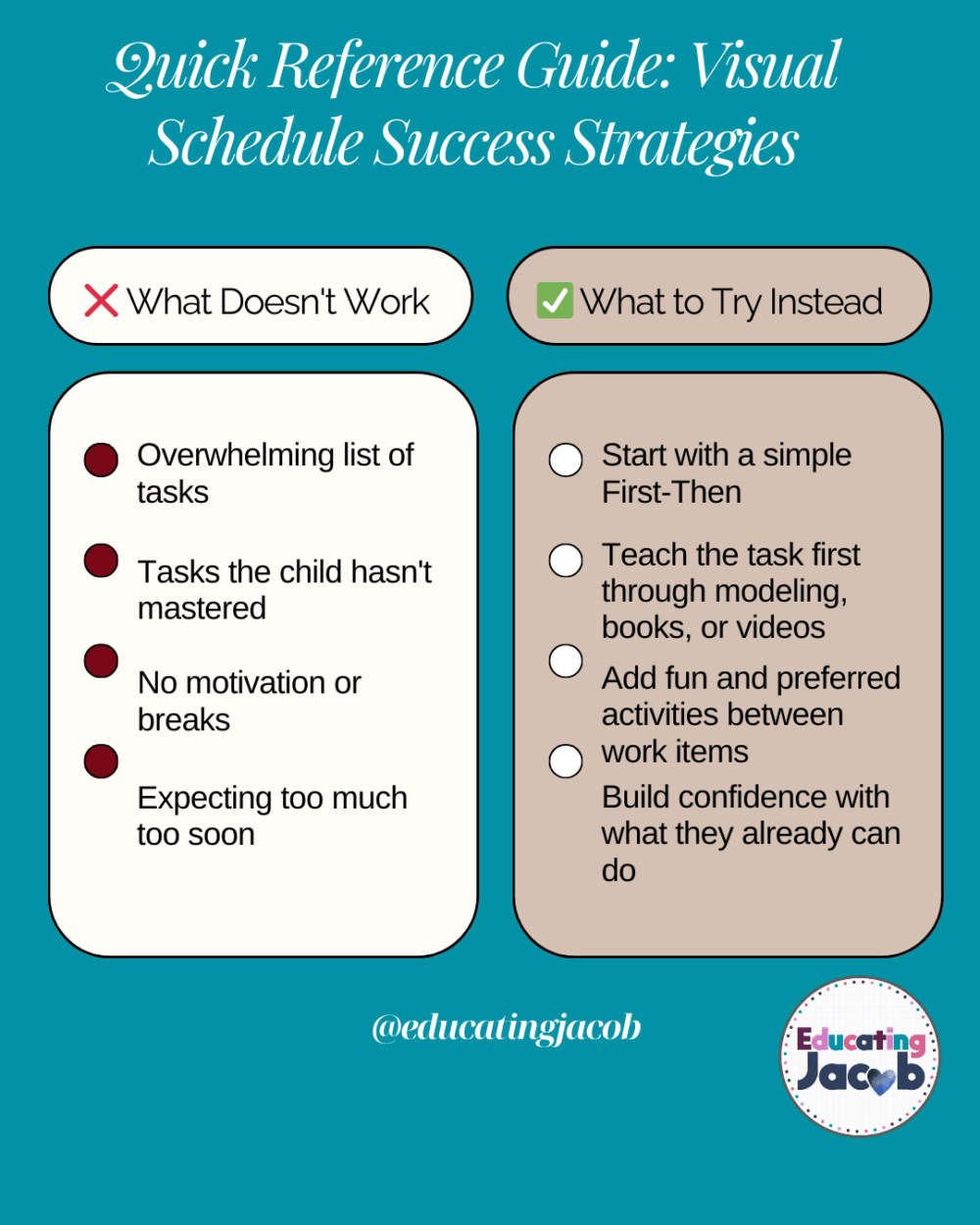
    ❌ Mistake #1: Making the Schedule Too Long

    When we first started, I loaded Jacob’s visual schedule with 10 pictures in a row — all the things I wanted him to do that day. Guess what he did? He skipped right to his favorites and ignored the rest. Smart kid. But also? A total flop. 😩

    ✅ Fix: Start with a First-Then: Board

    We simplified. I chose just two pictures:

    • Something he needed to do (like brushing teeth 🪥)
    • Something he loved (like snack time 🍎 or a favorite show 📺)

    This tiny change was powerful. It gave Jacob predictability and motivation. Once he understood that the schedule wasn’t just me bossing him around all day  but him being part of the plan  everything shifted.

    ❌ Mistake #2: Adding Tasks Before They’re Mastered

    Early on, I made the mistake of putting tasks on the schedule that Jacob didn’t yet know how to complete independently. This backfired hard. Seeing something unfamiliar  like getting dressed or a new math activity  only spiked his anxiety and resistance.

    ✅ Fix: Teach First, Then Schedule

    I learned to teach the task before putting it on the visual schedule. We’d read stories about it 📚, watch short videos 🎥, or use simple modeling and signs. Once he could do it with confidence, then  and only then  it went on the schedule.

    Remember, this is not about testing. It’s about setting up your child for independence and success. Learning to Create schedules for autism are not magic. They’re a bridge between your child and the world around them. That bridge has to be built with care.

    ❌ Mistake #3: Leaving Out the Fun Stuff

    Yes, structure is good. Yes, we need routines. But guess what I forgot in the beginning? Fun. I was so focused on “getting things done” that I forgot schedules should also be joyful and engaging.

    ✅ Fix: The Work-Break-Work Sandwich

    We call this the work-break-work sandwich:

    • Math 🧠
    • Snack break 🍌
    • Reading time 📖
    • Walk outside 🚶
    • Writing ✏️
    • Dance party 💃

    This structure keeps momentum going. Your child will begin to understand that effort leads to reward  a life skill that pays off again and again.

    Just because it’s a schedule doesn’t mean it’s all chores! Don’t forget the FUN items!
    Learn to create Schedules but don’t forget the FUN items!

    How Visual Schedules for Autism Grow with Your Child

    Jacob is 27 now. And guess what? He still craves routine. Visual schedules give him independence, comfort, and a sense of control over his day. And I’m not following him around narrating his every move! 🙌 Autism mom support, what happens when being a hands on doesn’t stop at 18?

    But here’s what I wish someone had told me earlier:

    “The schedule is not the goal, independence is.”

    It’s not about checking boxes. Learning to Create Schedules is having a plan for success!  It’s about helping your child feel secure, understood, and empowered. You’re not just making a chart. You’re building a bridge. 🌉

     Visual Schedule Success Strategies


    Quick-Reference-Guide-Visual-Schedule-Success-Strategies
    Create Visual Schedules, Let’s build them together one step at a time. 💙

    Pillar 3: L – Learning to Create Schedules

    At Educating Jacob, we call this Pillar 3: L – Learning to Create Schedules because it’s one of the most transformational pieces of the CALM framework. Effective visual schedules for autism reduce chaos, create confidence, and foster independence — for both you and your child.

    Remember, every visual schedule you create is another step toward independence for your child, less anxiety in their daily life, and more peace and happiness for your entire home. We’re cheering you on!💙

    Ready to Get Started?📌 Don’t Miss This! Download our free CALM Visual Schedule Starter Kit — it’s packed with templates and real-life examples from Jacob and me.Or join us inside Autism Thrive Tribe, where you’ll get step-by-step help and the encouragement you’ve been craving from parents who understand exactly what you’re going through.What’s been your experience with visual schedules? Share in the comments below!

    Read More