

What Answers the Problem of Moving Out of Chaos With Autism Spectrum?
Moving Out of Chaos With Autism Spectrum
If your home feels like it’s always on the edge of falling apart — the meltdowns, the unpredictability, the exhaustion that follows you into the grocery store, the school pickup line, and every single transition of the day — I want you to know something first: you are not failing your child.
Chaos in autism is real. It’s not a parenting problem. It’s a communication gap. And the answer I finally found didn’t come in a therapy brochure or a cure. It came quietly, in a laminated picture strip hanging on our refrigerator.
Why Autism Brings Chaos Into Every Corner of Your Life
Autism spectrum disorder doesn’t stay home when your child leaves for school. It doesn’t pause at the grocery store or take a break at a birthday party. The chaos follows — and it follows your child too.
Here’s what I’ve come to understand after years of living this as an autism mom and working in it as a special education teacher: the behaviors we see in our children are rarely just one thing. They’re a combination of so many layers — language and communication differences, sensory needs around clothing, food, and environment, medical and health considerations, and the very real anxiety that comes from a world that often feels unpredictable and overwhelming.
I’m not going to pretend one tool fixes all of that. It doesn’t.
But here’s what I have found: when we address the parenting and teaching side of the equation — when we give our children a way to understand what’s happening and what’s expected — so much of the chaos begins to settle. That’s the communication gap I’m talking about.
Visual schedules, done well, aren’t just a picture strip on a wall. The way you build them matters. The activities you include can be hands-on and sensory-friendly. You can weave in sensory considerations — preferred textures, foods, calming choices. You can build in language supports. You can design a schedule that sees the whole child, not just the behavior you’re trying to change.
That’s where we’re starting. Not because it’s the only piece — but because for most families, it’s the piece that makes everything else possible.
The Exhausting Search for a Cure
When Jacob was young, I spent so much time looking for answers in the wrong places.
I read everything. I attended seminars. I tried treatments. I was searching for something that would fix the problem — and underneath that search was a quiet hope that maybe we could cure autism, or at minimum understand what had happened to my son.
What I didn’t realize then was that while I was searching, Jacob was getting older. Time was passing. And we still had big problems. The chaos at home hadn’t eased. The meltdowns hadn’t stopped. And I was burning out.
If you’re in that place right now — searching, hoping, exhausted — I want to be honest with you. I understand that search. I lived that search. And I also want to tell you what I wish someone had told me sooner.
What Actually Helped: The Power of Visual Communication
It wasn’t a cure that changed things. It was connection.
Some of the most helpful professionals in Jacob’s life pointed me toward something practical: visual schedules and hands-on, visually clear activities. Things Jacob could look at and immediately understand. Items where he could see the pieces, recognize what needed to be done, and track his own progress.
I want to be clear about what I understood going in: these weren’t going to cure autism. They weren’t going to answer my deeper questions about Jacob’s diagnosis. But they gave us something we desperately needed — moments of peace.
How a Simple Visual Schedule Changed Our Home
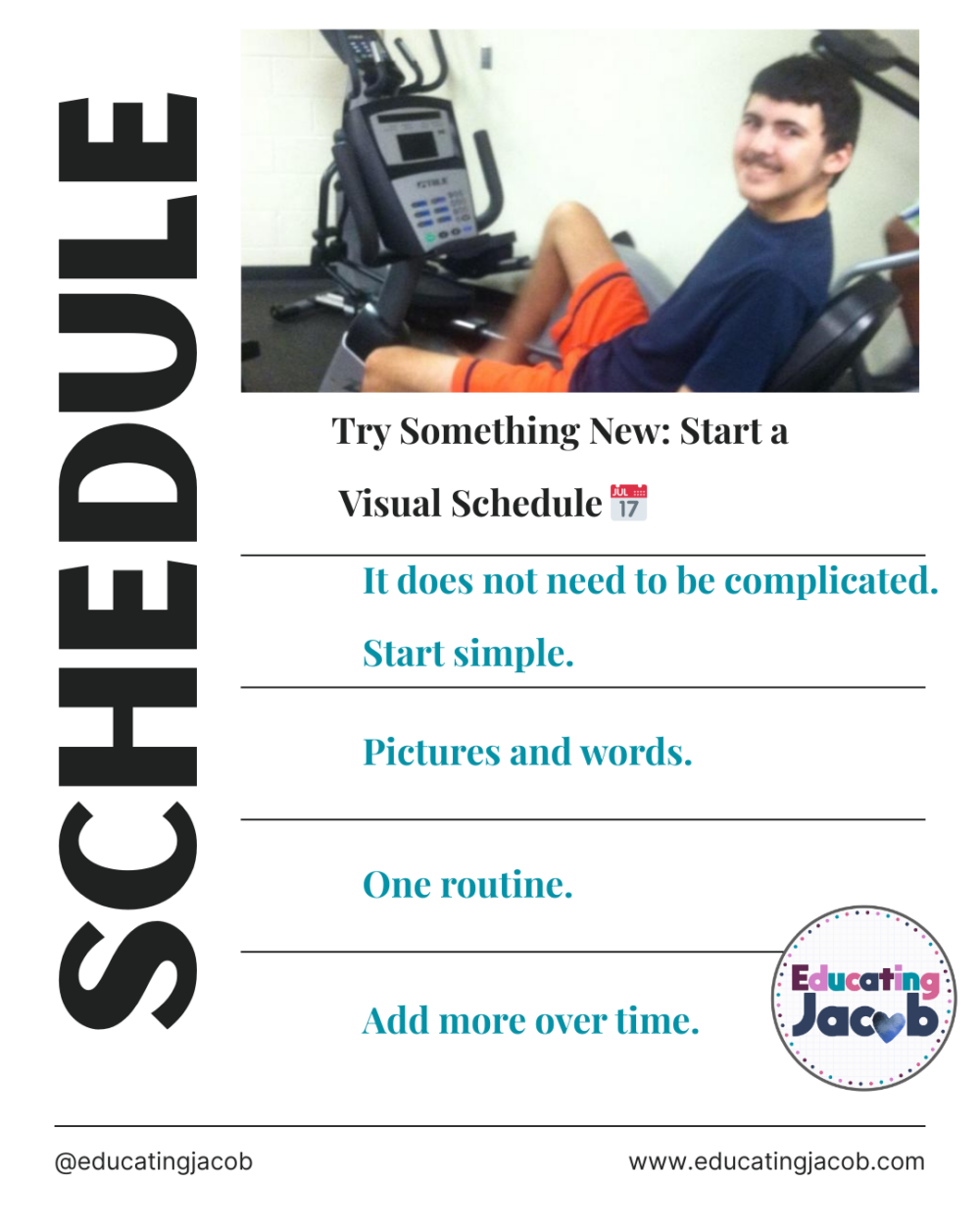
I started small. A visual schedule showing our morning routine. Breakfast, getting dressed, the walk to the bus stop. Nothing that took hours to make. Nothing complicated.
But the results were anything but simple.
Jacob started to understand what I was asking of him — not because my words suddenly made more sense, but because he could see it. He could see what was next. He could see when he’d have free time, when he’d get a preferred activity, when choices were coming.
The meltdowns when transitioning between activities? They started to fade. Not because Jacob changed — but because the anxiety driving those meltdowns finally had an answer. He knew what was happening.
For Jacob, the visual schedule became a communication tool. A way for us to connect without the friction of a sensory-heavy world getting in the way. For me, it gave back something I hadn’t had in a long time: time, and calm. Visual Schedules and autism, we’ve got you! Don’t figure this out alone!
The Small Things That Add Up to Big Peace
Here’s something I’ve learned that no one tells you at the beginning: there isn’t one answer to chaos. There are dozens of small ones.
Visual schedules were our foundation. But alongside them, I collected little tools — tiny redirects, phrases, routines — that filled in the gaps a schedule can’t reach.
One of our favorites? Movie quotes.
When Jacob’s emotions start to climb, sometimes the best thing I can do isn’t address the situation head-on. It’s redirect. And nothing redirects like a phrase from something he loves. Jacob has a favorite: “What in the World?”
I honestly couldn’t tell you exactly how it started. But somewhere along the way, we discovered that those four words could flip a switch. Happy moment? “What in the World?” Sad or overwhelmed? “What in the World?” Something’s going sideways fast? “What in the World?” — and suddenly there’s a tiny crack of light where the tension used to be.
It sounds small. It is small. That’s the point.
On Autism Island, the small things are often the most powerful. A familiar phrase. A preferred activity slipped into the schedule at just the right moment. A visual cue that says you know what’s coming, and it’s okay. These aren’t workarounds. They’re the actual work.
The CALM Framework I’ve built our life around isn’t a rigid system — it’s a peaceful structure and procedure that works for our whole family. Jacob. Me. My husband David. Our whole life on Autism Island runs on these foundations, and they make room for the small things too. The movie quotes. The redirects. The “What in the World?” moments that turn a potential meltdown into a shared laugh.
Structure and joy aren’t opposites. In our home, they’re the same thing.
From Chaos to CALM: What Visual Schedules Actually Give You
Here’s what I’ve come to understand after years of using visual schedules both as an autism mom and as a special education teacher:
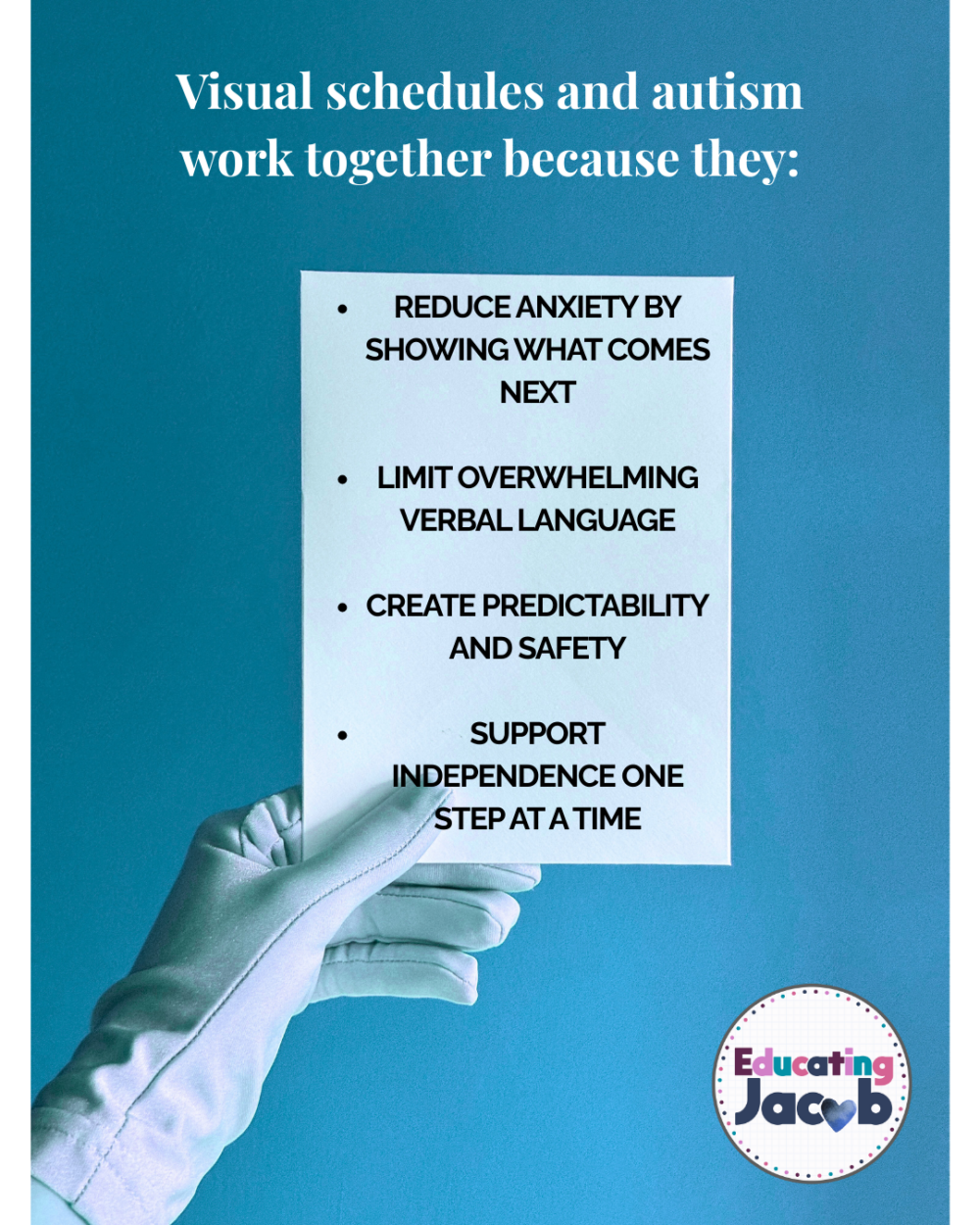
Visual schedules work because they meet autistic children exactly where they are. They reduce the cognitive load of uncertainty. They hand children the one thing anxiety steals most — predictability. How to Let Go of the Guilt and Find Peace as an Autism Mom, CALM Hacks!
When a child can look at their schedule and see:
- What’s happening right now
- What comes next
- When they’ll get something fun or a preferred choice
…the world becomes manageable. And when the world becomes manageable for them, it becomes more manageable for you.
This is the foundation of what I call the CALM Framework — the approach I’ve built everything in my work around. Visual schedules are the “L” — Learning to Create Schedules — and they are, for so many families, the first real turning point.
You Don’t Have to Stay in the Chaos
If you’re reading this and your home still feels like it’s in survival mode, I want you to hear this: there is a way through. Not a cure. Not a magic fix. But a practical, doable shift that changes how your child experiences the world — and how you experience your days.
It starts with something as simple as pictures on a refrigerator.
I created a free Visual Schedule Starter Kit specifically for autism parents who are new to this tool. It walks you through exactly how to get started without overwhelm, and it’s designed for real life — not a perfect Pinterest classroom.
→ Grab your free eBook “less chaos with autism” here
And if you want to connect with other autism parents who are figuring this out together, come join us in the Autism Thrive Tribe — our free Facebook community where we talk about exactly these kinds of practical strategies every week.
A Final Word From One Autism Parent to Another
Something simple brought peace, structure, and calm to the chaos we had been living. I didn’t expect it. I almost didn’t try it because I was so focused on finding a bigger answer.
But this was the answer. Not the only answer — but the one that changed our daily life more than anything else I had tried.
I hope it does the same for you.
Melissa