

Growing older and the long days of caring for child with autism.
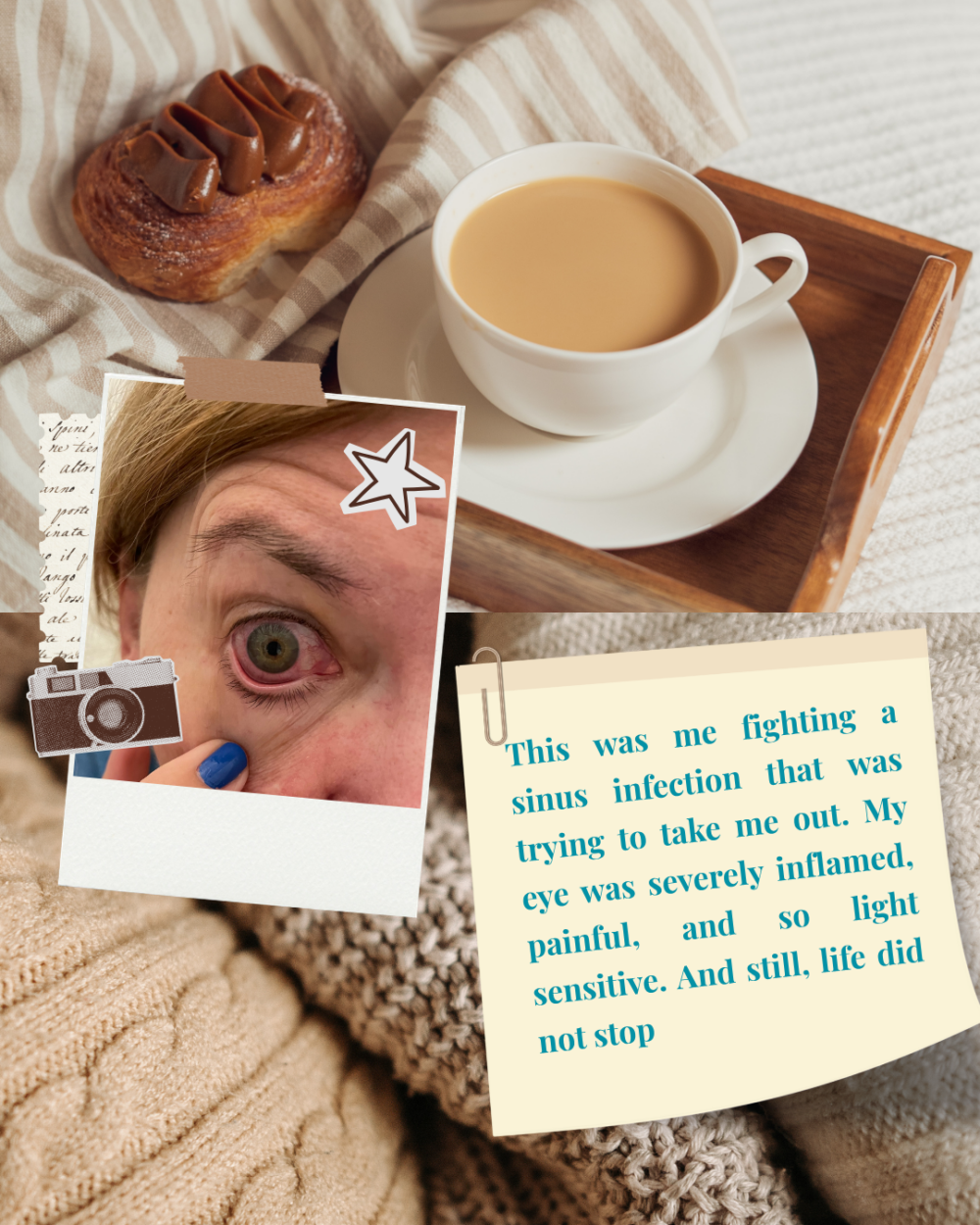
Long Days of Caring for a Child with Autism
I looked in the mirror and didn’t like what I saw.
Not the tired eyes — I’ve lived with those for years. Not the lines that weren’t there a decade ago. What stopped me cold was the corner of my eye, red in a way that could not be ignored. Not a little pink. Angry. Swollen. The kind of red that says you waited too long.
And I had.
I’d been feeling it coming for a week — the achiness, the pressure building in my head, the kind of fatigue that goes deeper than missing sleep. I knew what it probably was. I’ve had sinus infections before. I’m a special education teacher. I’m around kids all day. I knew.
But I put it off, the way autism moms do.
When Did We Stop Taking Care of Ourselves?
It wasn’t a dramatic decision. There was no moment where I consciously chose to ignore my own health. It just happened the way it always does — there were students to prepare for, Jacob’s schedule to maintain, the rhythm of our household to hold together. Spring break ended. The alarm went off. I went back to work.
I told myself it wasn’t that bad.
That first day back, I chalked the exhaustion up to the adjustment of early mornings again. The pressure in my head? Probably just allergies. The ache in my body? Fifty-something is different than thirty-something, and I know that.
But here’s what I’ve learned after years of this life: autism parents are experts at minimizing their own needs. We’ve had to be. When you are the person who holds the structure together — the schedules, the routines, the communication supports, the safety — you learn to function through things that would send other people straight to the doctor.
We wear that like a badge sometimes. I know I have.
The Day My Body Said Enough
By day two after spring break, the red in my eye had spread. All of it. I was pulling my students throughout the school day, and I kept finding myself walking in the shade, squinting against the light, instinctively closing that eye when we went outside.
I had started my antibiotics the night before. It was supposed to be getting better.
It wasn’t.
By lunch, I was hurting too much to stay. I went home, sent Jacob’s worker home since I was there, and told myself I just needed to rest in a dark room for a while. Jacob was fine. He’d had lunch. He could keep himself busy.
I couldn’t really rest.
I tried a cold compress. Then a warm bath. A cloth over my eyes. Nothing touched it. And then I made the mistake — or maybe the grace — of looking in the mirror again.
My pupil was smaller than the other one.
That’s when fear walked into the room.
I called the eye doctor. And then I did something I almost never do. In 37 years of marriage, through everything, I called my husband David at work and asked him to come home.
Not because I was sick. I’ve been sick before.
Because Jacob needed to be safe while I went to get help. And for the first time, I couldn’t do both.
David told me later that my call scared him more than the news about my eye. He said he knew something was really wrong because I never call. I never ask him to come home. I handle things. That’s just who I am.
But my body had finally demanded to be handled too.
The Truth About Growing Older as an Autism Parent
Here is the thing no one likes to say out loud:
Our bodies are changing. Our children’s needs are not.
I’m not just talking about sinus infections and eye complications. I’m talking about the slower recovery. The lower reserves. The way a hard week hits differently at 55 than it did at 35. The way you can’t just push through on willpower alone anymore, even when the need is still just as real, just as constant, just as present at your door every single morning.
Parents of neurotypical children — even parents who have walked genuinely hard roads — often reach a season where caregiving eases. Where their child calls them on the phone instead of needing their hands, their structure, their presence to stay safe. Where they become grandparents, spectators, supporters.
Many of us will never have that season.
Jacob is an adult. He lives with David and me, with supports in place, with Chloe by his side, with the routines we’ve spent years building together. He is loved. He is cared for. He has a good life.
And his needs are still high. And they will continue to be.
This is not a complaint. This is a fact that our community does not say loudly enough: we are aging into our caregiving, not out of it. And that comes with its own kind of grief — one that sits quietly beside all the love, not instead of it. When Migraines Hit: How This Autism Mom Survived the Day (And You Can Too)
The Fear We Don’t Say Out Loud
Let me say the thing we’re all thinking.
We are afraid of the day we aren’t here anymore.
We are afraid of what happens to our children when we are no longer the ones holding the structure together. Who will know their routines? Who will know what soothes them and what sets them off? Who will advocate for them the way we have? Who will love them the way only a parent can?
This is not a hypothetical fear for our community. It is real, and it is urgent, and it shapes every day we live — the estate plans we try to make, the siblings we quietly hope will step in, the group homes we tour with a mixture of hope and dread, the conversations we don’t know how to finish.
I’m not going to wrap this up in a neat bow, because it doesn’t have one. What I will say is this:
You are not alone in this fear. Every autism parent I know carries it. The weight of it is real, and you are not weak for feeling it. You are human, and you love your child, and you are paying attention to what’s coming.
That awareness, as hard as it is, is also an act of love.
What the CALM Framework Has Taught Me About This Season
After my eye appointment — it turned out to be iritis, inflammation of the eye, treatable but not something to mess with — I had some time to sit with what had happened. Not just the diagnosis, but the whole of it. The waiting. The calling David. The fear. Structure, Not Struggle: Calm Hack to Create Calm in Level 2 Autism Kids Daily
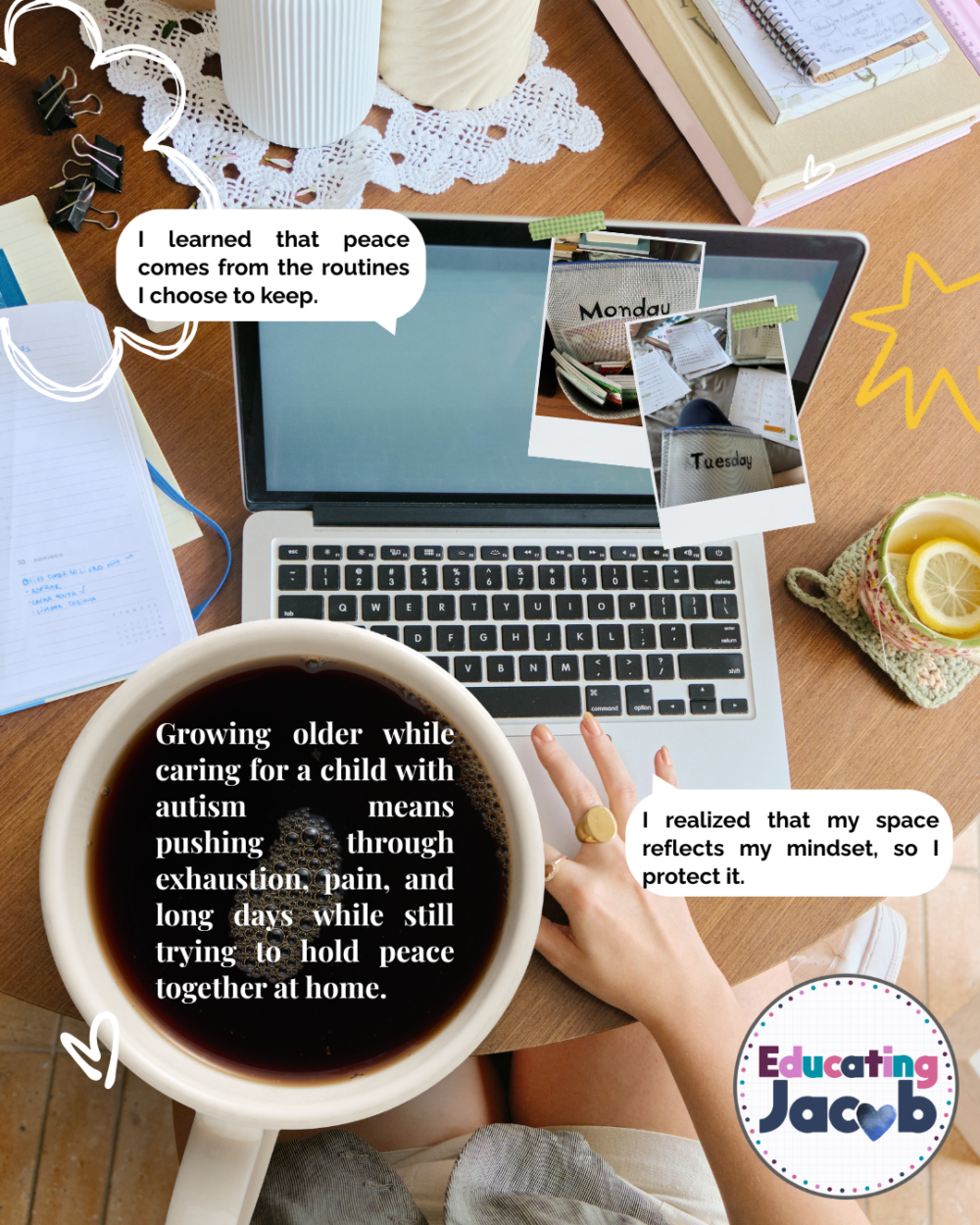
The Mindset piece of the CALM Framework has always been the one I return to most. And the mindset shift I keep coming back to in this season of life is this: caring for myself is not separate from caring for Jacob. It is part of it.
If I go down, everything goes down. That is not dramatic. That is just true.
I think about Job a lot during the hard days — not as someone whose suffering had a hidden silver lining, but as someone who was met by God in the middle of it. Not rescued from it, not spared from it, but accompanied through it. That is what I hold onto. I don’t believe faith means the hard things don’t come. I believe it means we don’t face them alone.
Consistent Action Forward
The Consistent Action Forward principle applies here too. Not dramatic overhauls. Not a complete rethinking of your life. Small, sustainable actions that keep you in the game for the long haul:
- Going to the doctor when you need to, not when you have no other choice
- Asking for help before you’re at the breaking point
- Building rhythms that include rest, not just productivity
- Letting the people who love you actually show up for you
And the Always Celebrate Wins piece? That phone call to David — the one that scared him, the one I almost didn’t make — that was a win. Asking for help is a win. Choosing yourself enough to get seen is a win. Don’t let anyone, including yourself, tell you otherwise. How We Live CALM At Home With Level 2 Autism, We Are Neuro-Spicy! 🌶️
You Are Still in the Middle of Something That Matters
I’m back at work. My eye is healing. The antibiotics did their job. Life has resumed its rhythm, the way it always does.
But I am different in a small, important way. I am a little more honest with myself about what I can carry and what I can’t. A little more willing to say I need help before my body says it for me.
If you are in this season too — watching your energy reserves change, feeling the weight of long-term caregiving in your bones, carrying a fear about the future that you don’t always know how to name — I want you to know: I see you. This community sees you.
We are not complaining. We are not giving up. We are being honest about what is real, and that honesty is the first step toward anything better.
Have you started thinking about what caregiving looks like as you get older? I’d love to hear where you are in this conversation — drop a comment below or come share it with us in the Autism Thrive Tribe.