Structure, Not Struggle: Calm Hack to Create Calm in Level 2 Autism Kids Daily
👉 CALM Hack For Autism Level 2: Create Calm in Your Home Today
If you’ve ever fallen asleep wondering, “Am I doing enough?” or woken up already overwhelmed by what the day might bring, I’ve been there too. Let’s learn together how to create calm in level 2 autism—both at home and in your heart.
Maybe you’ve cancelled plans because you weren’t sure how your child would handle the transition. Or explained to family members (again) why certain things just aren’t possible right now. Or sat in your car for five minutes before walking into your own home, just to gather the strength for what comes next.
You’re not failing. You’re surviving in a world that wasn’t designed for your child — and nobody handed you the blueprint for what to do about it. How We Live CALM At Home With Level 2 Autism, We Are Neuro-Spicy! 🌶️
When Jacob was first diagnosed with autism level 2, every day felt like a test I didn’t study for. His anxiety was high, routines were unpredictable, and I spent my energy trying to fix things — instead of building the structure that could create calm in level 2 autism. I was reacting instead of leading. I was exhausted instead of empowered.
So, I went back to school. I earned a Master’s in Special Education. And while I learned a lot about teaching, what I really learned is this: A degree doesn’t calm the storm inside your home. Structure does.
🌴 Why Structure Matters
As both an autism mom and a special education teacher, I can tell you this — structure is what makes independence possible for level 2 autism.
Our kids thrive when they know what’s expected, what comes next, and how they can succeed. Boundaries and structure don’t limit them — they free them. This is true whether you’re trying to create calm in level 2 autism at home during breakfast or in the classroom during transitions.
And here’s what nobody tells you: structure frees you too. It means you’re not the human calendar, the walking reminder system, the one who has to narrate every transition and negotiate every task. Structure does that work for you — quietly, consistently, without exhaustion.
I use the exact same strategies with Jacob at home that I use with my students in the classroom. If it works for 20 kids with varying needs, it can work in your living room too.
For Jacob, structure means peace. For me, it means rest. And for our family, it means fewer meltdowns and more moments of joy.

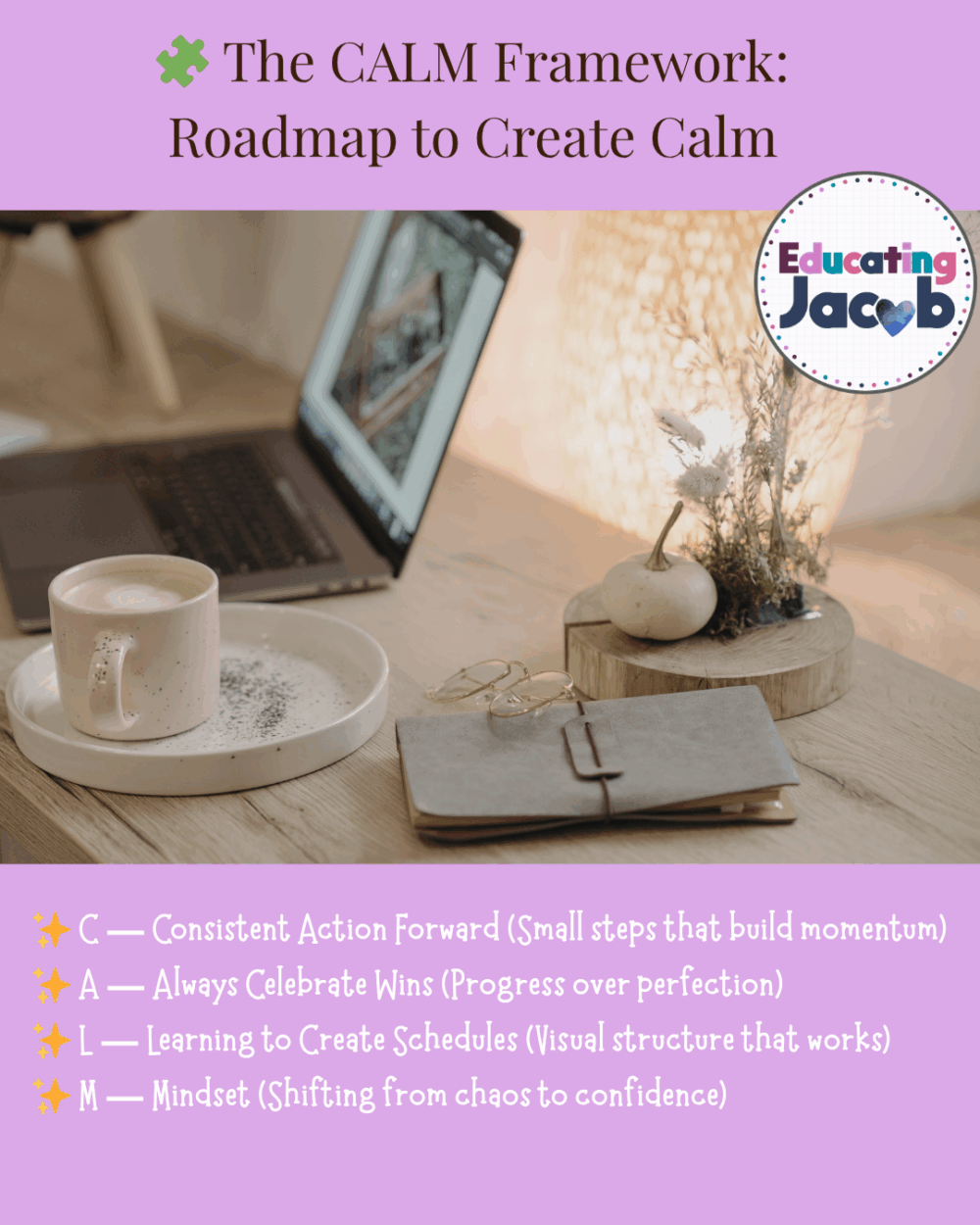
🧩 The CALM Framework: Roadmap to Create Calm
At Educating Jacob, I teach families our proven CALM Framework—the same system I’ve refined through years of autism parenting and classroom teaching. This framework helps you create calm in level 2 autism without burning out:
✨ C — Consistent Action Forward (Small steps that build momentum)
✨ A — Always Celebrate Wins (Progress over perfection)
✨ L — Learning to Create Schedules (Visual structure that works)
✨ M — Mindset (Shifting from chaos to confidence)
This is the foundation that helps parents move from chaos to peace without burnout or guilt. Give Your Child with Autism a Visual Schedule, Create CALM Days! 📅✨
Because the truth is — you don’t need another degree to parent your child with level 2 autism. You need a framework that works.
You need something you can implement on a Tuesday afternoon when you’re exhausted, not just on days when you feel “on” as a parent. You need autism level 2 strategies that work when you’re at 60% capacity — because let’s be honest, that’s most days.
These are the same practical tools I reach for when Jacob is struggling at home AND when my students need support in the classroom. They’re battle-tested in real life, not just theory from a textbook.
🗓️ Visual Schedules for Autism Level 2: Structure That Actually Works
When I first heard about visual schedules for autism, I’ll be honest — I thought, “One more thing to make. I don’t have time for that.”
I pictured elaborate laminated cards, perfect handwriting, hours of prep time I didn’t have.
But that one simple step changed everything for Jacob—and for my classroom too.
Now Jacob starts each day by checking his visual schedule for level 2 autism: ☀️ Wake up 🪥 Bathroom 👕 Get dressed 🥣 Breakfast 📚 Learning time 🕹️ Break or choice activity
He doesn’t wait for me to tell him what’s next. He knows.
That predictability gave him independence — and it gave me breathing room to actually enjoy my coffee while it’s still hot.
Even on days when things change (because they always do), we can adjust together. He sees the plan, understands the shift, and stays calm. In the classroom, I’ve watched this same tool transform students who struggled with transitions into kids who confidently move through their day.
That’s what boundaries and structure for autism level 2 kids look like in real life — calm confidence instead of confusion and chaos. And the beautiful part? Once you set it up, it runs itself. The schedule becomes the teacher, not you.
🫂 The Invisible Weight You’re Carrying (And How to Set It Down)
Can I share something? Before we had structure in place to create calm in level 2 autism, I was constantly bracing for the next meltdown. Anticipating the next struggle. Mentally preparing for resistance before I even asked Jacob to do something.
That hypervigilance? It’s exhausting. And it’s something I see in every autism parent’s eyes when we first start talking about our kids.
I’d watch other parents casually tell their kids, “Time to get ready for bed,” and just… walk away. Their kids would do it. No visual countdown. No three reminders. No negotiation about which pajamas or what order to do things.
And I’d think: What does that feel like? I could do that with my first son Nicholas but that is a distant memory for sure!
Now I know. Because structure and visual schedule gave me that gift too.
When your child with autism level 2 knows what’s expected and has the visual support to follow through, you get to exhale. You get to trust the system instead of micromanaging every moment. You get to be present instead of perpetually preparing for what might go wrong.
This shift didn’t happen because I became a better parent. It happened because I became a smarter one. I stopped working harder and started working with the right tools—the same autism level 2 strategies I’d seen transform my classroom. This too shall pass, how we changed our mindset on autism island!
💬 Real-Life Example: Boundaries That Build Trust in Level 2 Autism
Last month, Jacob and I were preparing for a grocery trip. He had his list, his schedule card, and his favorite snack packed for the car. (Yes, I use the same visual shopping list system in my classroom for our school store visits!)
Halfway through the trip, he decided he was “done.”
Old me would’ve begged, bargained, and burned out. CALM me? I reminded him of our boundary: “We finish the list, then we can leave.”
He took a deep breath (and so did I). We walked one more aisle, grabbed what we needed, and checked out.
That moment wasn’t about groceries — it was about boundaries teaching follow-through in autism level 2.
And here’s the part that matters: Jacob wasn’t upset that I held the boundary. He was relieved. Because kids with autism level 2 need to know that their world is predictable — even when their feelings aren’t.
I’ve seen this same relief wash over my students when I hold consistent boundaries in the classroom. The structure isn’t restrictive—it’s reassuring. It tells them: “The world makes sense. You are safe.”
🎯 Why Boundaries Create Calm in Autism Level 2 Kids
Boundaries do three powerful things for our kids with level 2 autism:
✅ They reduce anxiety. When expectations are clear, the world feels safe. This is especially crucial for level 2 autism where anxiety can be overwhelming.
✅ They teach responsibility. Follow-through builds independence and pride—essential skills for autism level 2 kids working toward greater autonomy.
✅ They protect peace. Clear limits reduce power struggles and meltdowns, helping you create calm in level 2 autism daily.
Jacob’s daily structure gives him freedom within safety. He gets to choose when or how he completes a task — but not if. That’s what true CALM boundaries for autism level 2 look like.
And for you, parent? Boundaries mean you get to stop being the bad guy. The structure becomes the boundary — not you. You’re not the enforcer; you’re the guide. That shift changes everything.
In my classroom, I’m not the mean teacher who says no. The visual schedule says it’s math time. The timer says choice time is over. The checklist says we need three more things done. I get to be the supportive coach, not the exhausted referee. You deserve that same role at home. https://themonterabbi.com/13-must-have-items-for-an-autism-sensory-room/
🌈 From Stress to Peace: The Transformation Autism Parents Need
I spent years chasing peace through education, research, and certifications. But the peace I wanted didn’t come from a classroom.
It came from routines that worked at home, boundaries that stuck with Jacob, and visual supports that my son could understand—the same practical autism level 2 strategies I use every single day in my special education classroom.
Now our days aren’t perfect (because perfection doesn’t exist on planet Earth). But they’re peaceful.
We have moments of calm, laughter, and rest. We’ve replaced the struggle with structure that helps us create calm in level 2 autism. And that’s where independence — for both parent and child — begins.
Some days we still have hard moments. But now they’re moments — not the entire day. Now I have energy left at 7 PM. Now I can say yes to things I used to automatically decline. Now I have the capacity to be the mom Jacob deserves, not just the exhausted manager of chaos.
That’s not just progress for Jacob. That’s survival for me. That’s life instead of just existence.
🕊️ A Message to Autism Parents Searching for Calm
You don’t need another degree to feel capable. You don’t need to work harder to create calm in level 2 autism.
You don’t need to be a better advocate, read one more book, or try one more therapy before you’re allowed to rest.
You need a plan that works for your child with level 2 autism and gives you rest too.
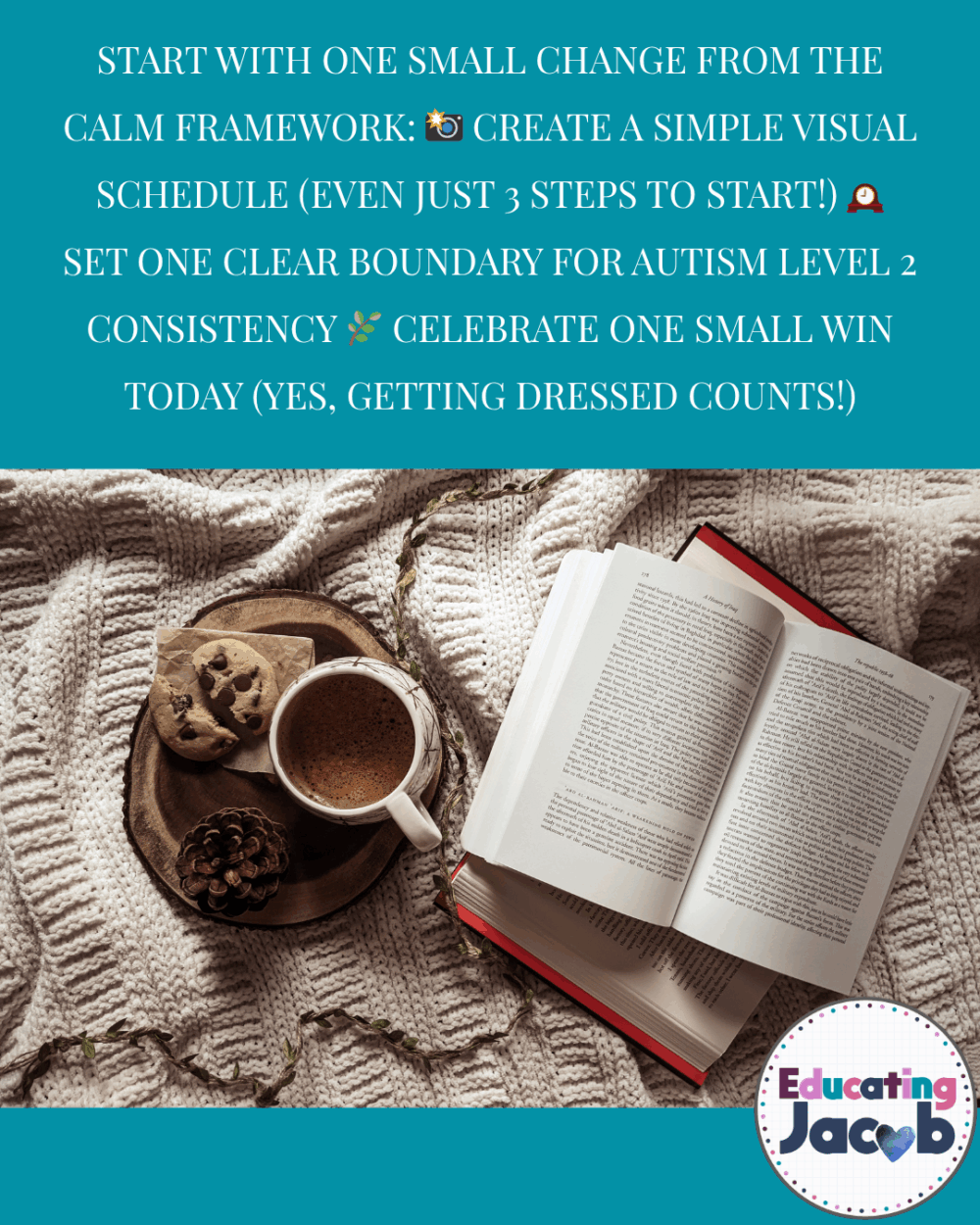
Start with one small change from the CALM Framework: 📸 Create a simple visual schedule (even just 3 steps to start!) 🕰️ Set one clear boundary for autism level 2 consistency 🌿 Celebrate one small win today (yes, getting dressed counts!)
That’s how the CALM life begins — one peaceful step at a time. That’s how we create calm in level 2 autism, both at Educating Jacob and in homes just like yours.
Because you deserve more than survival. You deserve a life where you’re not just getting through the day — you’re actually living it.
💙 Ready to bring CALM to your autism level 2 home?
Join us at Educating Jacob where I share the exact strategies I use with Jacob and my students—practical, tested, real-world tools that create calm in level 2 autism. Because you shouldn’t have to figure this out alone.