

How to Replace Chaos With Calm
By Melissa | Educating Jacob
When you’re in the thick of autism parenting and navigating meltdowns before 8 a.m., dreading every transition, bracing for the next hard moment — it can feel impossible to think past today.
I know that place well. For years, survival mode wasn’t a phase for our family. It was just Tuesday.
But over time, something shifted for me — not because life got easier, but because I stopped asking “How do we get through today?” and started asking a bigger question:
What kind of life do we want Jacob to have? And what are we building toward, right now, to get him there?
That question changed everything.
The Long Game I’m Playing With Jacob
Jacob is 28 now. He has Level 2 autism and epilepsy, our dog Chloe is always a nice distraction and social support for us. Jacob will always need support — that’s not something I’m trying to fix or ignore. Safety matters. Structure matters. Supervision matters.
But here’s what I know for certain: my goal has never been to keep Jacob dependent on us forever.
Our long game looks like this:
Jacob has an older brother, Nicholas, who will be there for him when we’re gone. That matters more than I can put into words. But I never want Jacob’s life to feel like a burden placed on someone else’s shoulders.
So we think long term. We dream about having a tiny house behind our home someday — a space where Jacob can have his own routines, his own privacy, his own slice of independence, while still being close enough for us to step in when he needs us.
Independence with support, not independence alone. That’s the goal.
And if you’re an autism parent reading this, I’d bet that’s your goal too.
Why Schedules Are a Long-Game Strategy (Not Just a Daily Survival Tool)
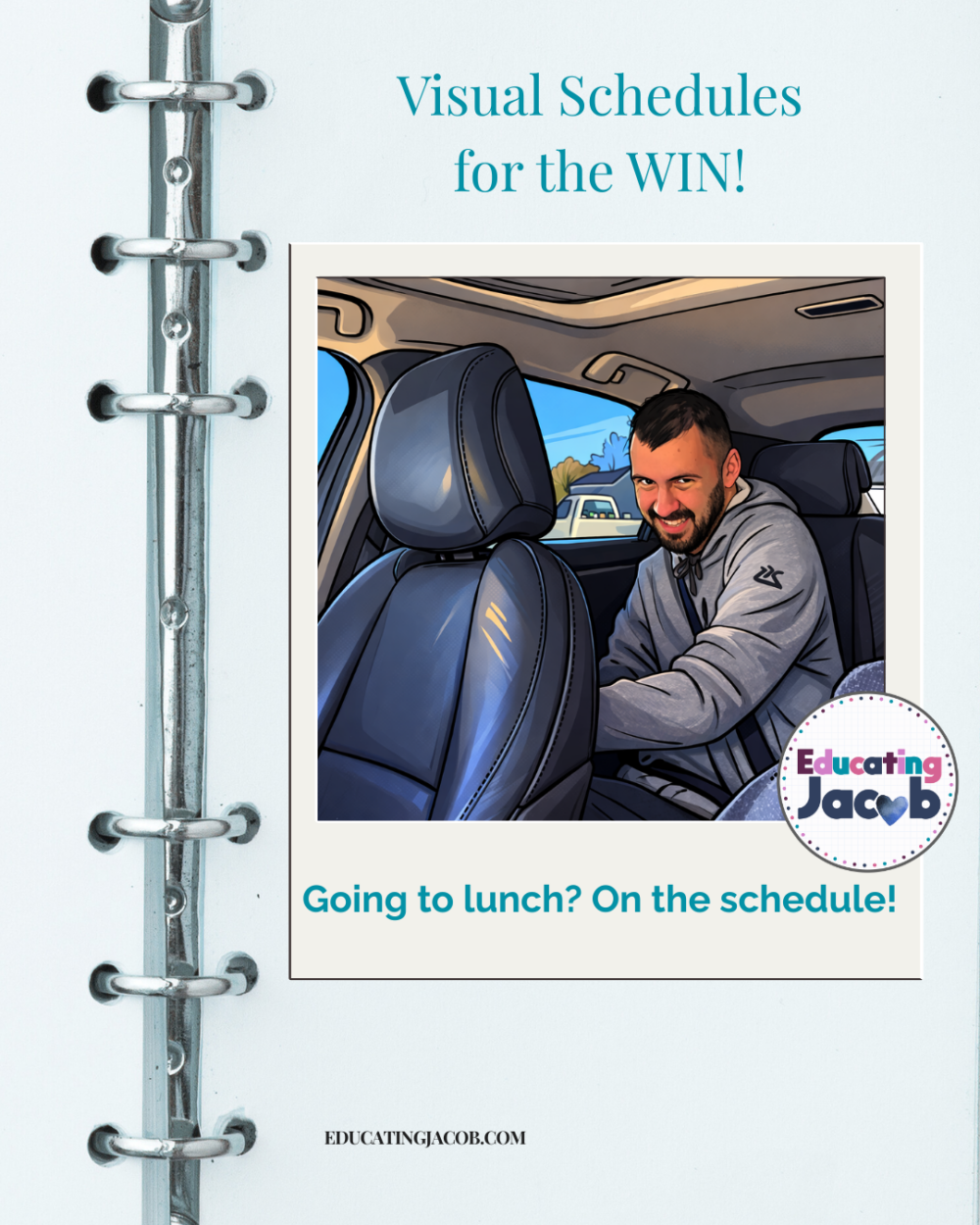
Here’s something I’ve said to countless parents over the years, both as a mom and as a special education teacher: visual schedules are not just about keeping today running smoothly. They are life skill training.
When chaos ruled our days — and it did for a long time — Jacob was constantly reactive. His anxiety was high. Every transition felt like a battle. Independence felt like a distant, maybe even impossible, dream.
Schedules changed that.
Not overnight. Not perfectly. But gradually, consistently, they gave Jacob something he desperately needed: a way to understand what comes next.
And that’s everything for a child whose brain is wired to struggle with uncertainty.
As a special ed teacher, I’ve watched this same transformation happen in classrooms over and over. The child who can’t make it through morning circle without a meltdown — once a visual schedule is in place, once they can see the shape of their day — something settles in them. The anxiety doesn’t disappear, but it has somewhere to go. How a Visual Schedule for Autism Gave My Son Independence 📅✨
Schedules gave Jacob a way to:
🗓️ Know what was coming next without having to ask or guess
✅ Practice the same skills in small, repeatable ways until they became automatic
🧠 Lower his anxiety simply by reducing uncertainty
🌱 Build toward independence one predictable routine at a time
That’s the long game.
Using the CALM Framework to Replace Chaos With Calm
Everything I do — both with Jacob at home and in the resources I create for parents — flows through my CALM Framework. Because calm doesn’t come from one good day or one perfect strategy. It comes from consistency over time. How to Let Go of the Guilt and Find Peace as an Autism Mom, CALM Hacks!
Here’s what that looks like in real life:
C — Consistent Action Forward
The long game requires you to keep showing up even when it’s hard, even when progress is invisible, even when you’re exhausted.
Consistency is what teaches your child what to expect — and what’s expected of them. When we first introduced Jacob’s morning routine schedule, it was messy. He resisted. I second-guessed myself. But we kept showing up, and slowly, it clicked.
A — Always Celebrate Wins
This one saved me more times than I can count.
When Jacob started putting his dishes in the sink without being reminded, we celebrated like he’d won an Olympic medal. Because in our world? He had.
The small wins aren’t small. They are the building blocks of the big life skills you’re working toward. Please don’t skip celebrating them.
L — Learning to Create Schedules
Schedules aren’t one-size-fits-all, and they’re not permanent.
What worked for Jacob at 8 looks nothing like what works for him at 25. The long game means your systems grow with your child. You adjust. Personalize to your child. Stay curious about what your child actually needs, not just what worked before.
M — Mindset
This is the hardest one. Hands down.
Playing the long game means letting go of comparison. It means releasing the guilt when things fall apart. It means choosing — over and over — to focus on progress, not perfection.
On the days I feel discouraged, I come back to this: calm today is preparing Jacob for tomorrow. That’s enough.
The Lie We Tell Ourselves About Autism and Independence
I want to address something directly, because I hear it from parents all the time and I felt it too for a long time:
We think that if our children always need support, they’ve somehow failed to become independent.
That’s not true. And it’s a harmful way to measure success.
Independence doesn’t mean doing everything alone. It means doing as much as possible — with the right support in place.
For Jacob, independence looks like following his daily routine without being prompted step by step. It looks like making simple choices about what to eat, what to wear, how to spend his time. It looks like feeling confident in his own space, safe within structure, and knowing that if he needs help, it’s there.
That kind of independence — independence with support — is what we’re building toward through every schedule, every routine, every consistent structure we put in place.
Why Replacing Chaos With Calm Matters So Much
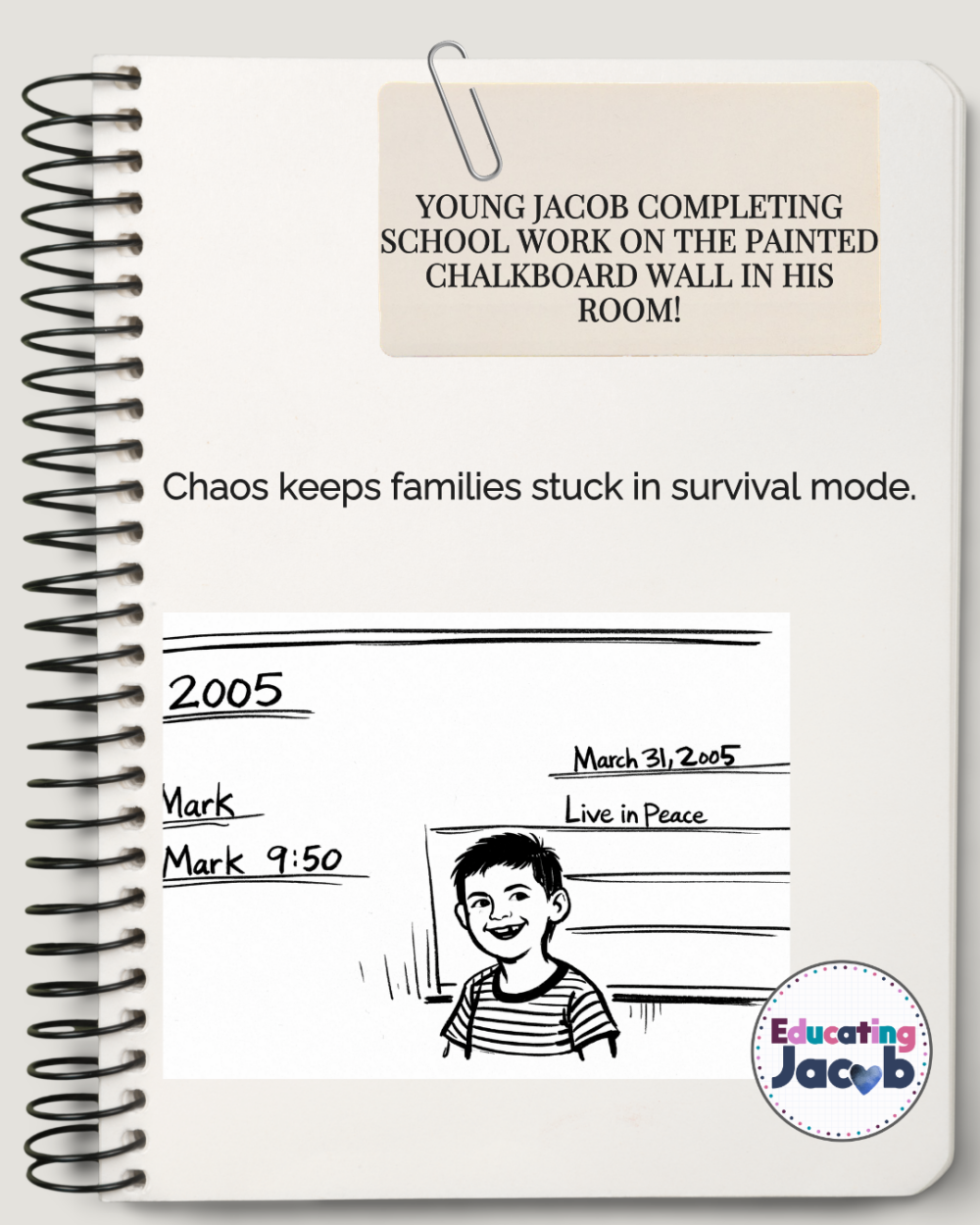
Chaos keeps families stuck in survival mode. And when you’re just surviving, there’s no room for growth — not for your child, and not for you.
When calm becomes part of your daily life — even imperfect, partial calm — something opens up:
Your child can practice skills because anxiety isn’t consuming all their bandwidth. Their confidence grows because they know what to expect. Your household stops bracing for impact and starts moving forward.
And you, the parent? You get to breathe. You get to be present instead of perpetually reactive.
That space — that exhale — is where the real work happens.
If You’re Playing the Long Game Too
If thinking about your child’s future keeps you up at night, I want you to hear this:
You are not alone.
We are still on this road with Jacob. Some days are hard. Some days are really hard. But we are not where we started, and that matters.
Replacing chaos with calm is not about being a perfect parent or having a perfect system. It’s about doing what works, being consistent, and staying in it for the long haul.
Start small. Stay consistent. Celebrate the wins. Keep the long game in mind.
Your calm today is preparing your child for tomorrow.
“I can do all things through Christ who strengthens me.” Philippians 4:13
Want support as you work to create more calm in your home? Join us in the Autism Thrive Tribe — a community of parents and caregivers who get it. [Click here to join the free Facebook group →]
📌 Save this post for later — and share it with an autism parent who needs to hear this today. https://themomkind.com/autism-vitamins-adhd/?utm_source=Pinterest&utm_medium=organic