
Why I Teach That Autism and Schedules Work Together
Why do I teach that autism and schedules work together?
Because in my lived experience with my son Jacob and in my classrooms, replacing chaos with calm has always come through structure and consistency.
If you are parenting, teaching, or loving a child on the autism spectrum and life feels chaotic, overwhelming, or isolating, I want you to hear this first:
You are not failing. And you do not have to figure this out alone.
I did not have another autism mom to call. I did not have family members who understood what our daily life truly looked like. What I had was stress, fear, and a deep desire to help my son Jacob thrive in a world that often felt too loud and unpredictable for him.
This blog post is for the parent, family member, or teacher who knows something has to change but does not yet know where to start.
I have lived this life. I am still living it. And I want to help where I can. 3 Ways You Can Stop Chaos On Autism Island. Use My Calm Home Autism Routines.

When Autism Parenting Feels Heavy and Lonely
There was a season when everything felt hard.
Transitions were difficult.
Behavior felt unpredictable.
Anxiety was constant.
Jacob lives with autism and epilepsy, and there were many days I worried about his safety, his future, and whether I was doing enough. I felt isolated and overwhelmed. That stress eventually pushed me to go back to school while working and earn a degree in special education because I needed answers.
What I did not realize at the time was this:
The biggest lessons would not come from textbooks.
They would come from Jacob. When the Guilt Hits Hard: Autism Level 2–3, Meltdowns and Mom Regret
Finding Strength in the Hard Moments
I am not a daily journaling person. But during some of our lowest seasons, I started doing two simple things.
I took pictures of real moments.
I wrote short reflections when things felt heavy.
Often, I would end those reflections with Bible verses reminding myself that God had our family and that I could take the next step even when things felt impossible.
Looking back now, I can see something clearly.
Progress did not come from fixing everything.
Progress came from not giving up.
There were bad days. Hard moments. Seasons that felt like survival. But over time, continuing forward and trying something new moved us toward calm.
Why Visual Schedules and Autism Work Together
For a long time, I thought visual schedules were just one more thing to add to my already full plate. Mentally, I did not feel like I had the capacity for another strategy.
But what I did have was a lot that was not working.
So I tried visual schedules anyway.
And then I adjusted them.
Simplified them.
Tweaked them again.
Before I knew it, the chaos in our home started to decrease. 5 ways to regain my calm when my special needs child is dancing on my last nerve!
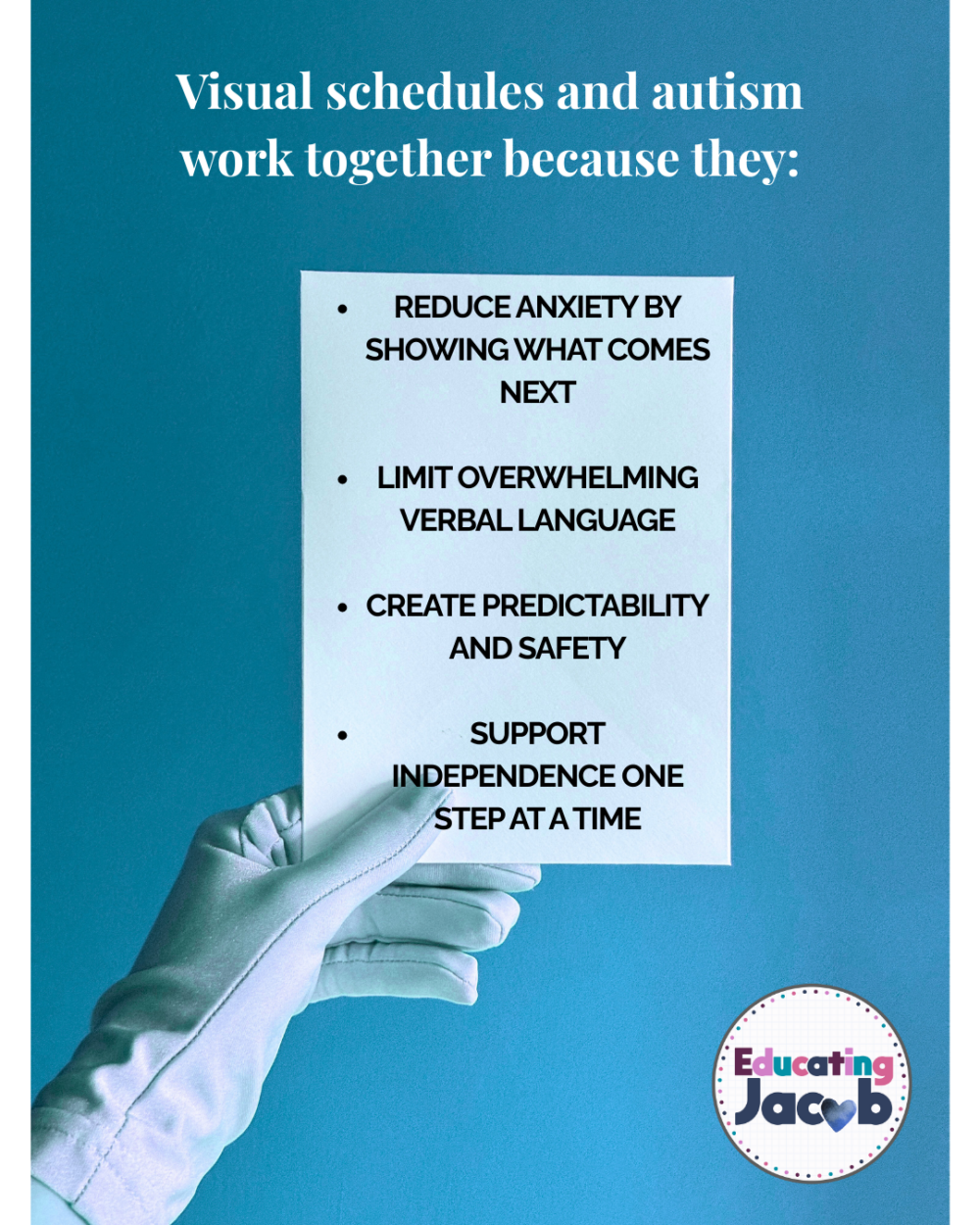
Visual schedules and autism work together because they:
- Reduce anxiety by showing what comes next
- Limit overwhelming verbal language
- Create predictability and safety
- Support independence one step at a time
When children with autism can see their day, they are not constantly guessing what is happening next.
Structure does not restrict children with autism.
Structure supports them.
How Visual Schedules Helped Jacob
When we began using visual schedules consistently, several things changed.
Jacob’s anxiety decreased.
Transitions became easier.
His independence slowly increased.
Visual schedules did not change who Jacob is.
They supported how he experiences the world.
Jacob will always need support, structure, and family to help him navigate life. Our goal has never been independence without help. Our goal is for him to thrive in every way he can.
One of our long-term hopes is to have a tiny house behind our home so Jacob can have more independence while staying connected and supported.
This is what thriving looks like for our family. https://lifewithasideoftheunexpected.com/what-not-to-do-with-an-autistic-child/?utm_source=Pinterest&utm_medium=organic
The CALM Framework That Guides Our Home
Everything we do at Educating Jacob is built on the CALM Framework, because calm does not happen overnight.
C – Consistent Action Forward
You keep moving forward, even when it is hard.
A – Always Celebrate Wins
Every win matters, no matter how small.
L – Learning to Create Schedules
Schedules are learned and adjusted, not forced.
M – Mindset
Progress over perfection. Grace over guilt.
It sounds simple. I know it is not simple in the moment. But it pays off.
Celebrate what works.
Do more of what helps.
Do less of what does not.
And be willing to try something new.

Start Small if You Are New to Visual Schedules
If you are just starting, please hear this clearly.
You do not need an all-day schedule.
Start with one routine:
- Morning routine
- After-school routine
- Bedtime routine
Use three to five steps only.
Small steps create confidence.
Confidence creates independence.
You Do Not Have to Do This Alone
If you are tired, overwhelmed, or unsure where to start, you are in the right place.
At Educating Jacob, we share real life on Autism Island and practical tools that support both the child and the family.
Here are your next steps if you need support:
- Explore the CALM Visual Schedule Starter Kit
- Join Autism Thrive Tribe for community and continued guidance
- Visit my consulting page if you want one-on-one support
- Connect with us on Facebook and be part of a community that understands
We are stronger together, and calm is possible.
“I can do all things through Christ who strengthens me.”
Philippians 4:13