Blog

  • Why Christmas Shopping Is Overwhelming When Your Child Has Level 2 Autism 🎄
    why christmas shopping is overwhelming with level 2 autism
    Jacob has very limited interests and very specific tastes.

    Why Christmas Shopping Is Overwhelming When Your Child Has Level 2 Autism 🎄

    Christmas shopping is supposed to be joyful. You picture finding the perfect gift, wrapping it with care, and watching your child light up on Christmas morning.

    But when you’re parenting a child with Level 2 autism, Christmas shopping is overwhelming in a very different way.

    It’s not just the crowds, the noise, or the chaos of holiday stores.

    It’s the deep reality that buying things for your child is genuinely hard.

    And that part doesn’t get talked about enough.

    If you’ve ever spent more time researching a discontinued coloring book than you spent buying your own Christmas gifts, welcome. You’re in the right place. 🎄😅

    Let me be clear: this isn’t about navigating Target with a dysregulated kid during peak shopping hours (though yes, we’ve all been there and have the emotional scars to prove it).

    This is about the fact that children with Level 2 autism are incredibly difficult to buy for.

    Even when you have all the time in the world. Even when you’re shopping alone. Even when you think you’ve cracked the code. Tired and Frustrated Mom! Sensory Challenges for the Autism Spectrum

    The challenge isn’t them being there. The challenge is knowing what will actually work.

    why christmas shopping is overwhelming with level 2 autism
    “Always wants the same things and sensory issues”, life with autism!

    Why Christmas Shopping Is So Hard for Autism Parents During the Holidays 🛍️

    Jacob doesn’t want what’s trending. He doesn’t want the newest toy, the updated version, or the holiday edition.

    Jacob wants what feels safe and familiar.

    He only wears clothes that are soft and plain. No tags. No stiff fabric. No surprise textures. Even something that looks identical to last year’s shirt can feel completely wrong to him.

    (And yes, I’ve learned the hard way that “100% cotton” from one brand is NOT the same as “100% cotton” from another brand. Apparently, cotton has opinions. 😅)

    He mostly wants movies from 10 to 15 years ago. The same ones he already knows. The same voices. The same scenes. Familiarity brings him comfort.

    Jacob loves to color, but not just with any coloring utensil. It has to be a very specific Sharpie, in specific colors. Fancy sets don’t impress him. New brands don’t help. Too many options actually create anxiety.

    He still enjoys certain coloring books from years ago. And if you’ve ever tried to replace something discontinued from a decade ago, you know how exhausting that search can be. 🔍😅

    My Amazon search history during December looks like I’m either a very dedicated detective or someone who’s completely lost their mind:

    “Blue coloring book Thomas The Train 2015” “Navy shirt soft no tag boys discontinued” “Sharpie fine point NOT ultra fine WHERE TO BUY”

    This is the part of Christmas shopping that feels heavy.

    You want to give your child joy, but the options feel incredibly limited.

    And here’s the kicker: you can’t just ask them what they want.

    Other parents complain about their kids’ endless Amazon wish lists. Meanwhile, you’d give anything for your child to be able to tell you what would make them happy.

    So you become a researcher, a historian of your child’s preferences, a forensic investigator of past successes and failures.

    You take notes. You photograph labels. You create spreadsheets.

    And still, sometimes you get it wrong.

    Autism-parenting-is-crying-and-laughing-at-the-same-sitcom-scene
    When you don’t whether to laugh or cry!

    The Chinese Food Container Moment Every Autism Parent Understands 🍜😂

    There’s an episode of The Big Bang Theory where Leonard’s favorite Chinese restaurant is going out of business. His roommate Sheldon has autism and eats from that same restaurant obsessively—same food, same containers, same routine.

    So Leonard does something brilliant: he buys a stack of empty Chinese food containers from the closing restaurant.

    His plan? Order from a different place and put it into the familiar containers so Sheldon won’t even notice the change.

    The first time I saw that episode, I cried.

    And then I laughed.

    Because as an autism mom, I completely understood why Leonard did that.

    That moment perfectly captures life on Autism Island. You’re not trying to trick your child. You’re trying to protect their nervous system.

    You’re desperately preserving sameness in a world that keeps discontinuing everything your child loves.

    You’re the parent refreshing eBay at midnight hoping someone still has that exact shirt from 2019.

    You’re buying three backup copies of the same movie “just in case.” He will even look at the copyright date!

    You’re literally Googling “how to fix a broken Sharpie” because throwing it away and opening a new one might cause a meltdown.

    It’s funny because it’s true.

    And sometimes, if we don’t laugh, we’ll cry. Sometimes we do both. Often in the same Target aisle. 😅

    When Good Intentions Meet Autism Reality 📚💛

    Here’s the thing about buying gifts for kids with autism: even when you get it right, it can still go sideways.

    Jacob once received a book he had wanted when he was just five years old. A familiar book. A safe book. The perfect gift.

    His well-meaning grandmother wrote a loving note in the front of it.

    Yep. You guessed it.

    Jacob did not handle that well. 😬

    What was meant as love felt like a disruption. The book was no longer exactly the way he expected it to be. It had been altered.

    In Grandma’s mind: “I’m making this extra special with a personal touch!”

    In Jacob’s mind: “THIS IS NOT THE BOOK. THIS IS A DIFFERENT BOOK. ABORT MISSION.”

    Did it ruin Christmas? No.

    Did it create a learning moment for all of us? Absolutely.

    Eventually, Jacob got over it. He learned to accept the inscription. The book became safe again.

    And that matters.

    Because I can’t give everyone a manual on exactly how Jacob will react to every loving gesture. I can’t predict every trigger. I can’t control every well-intentioned moment that goes a little sideways.

    We’re all learning as we go.

    But this is why autism parents second-guess everything during the holidays.

    Because even getting it right doesn’t guarantee it’ll be received the way you hope.

    The Emotional Weight Autism Parents Carry During the Holidays 💭

    This is where the overwhelm sneaks in quietly.

    You walk through stores filled with endless choices, and yet none of them fit your child.

    You second-guess everything.

    Will he wear this?

    Will this bring joy or frustration?

    Is it okay to buy the same thing for the third year in a row?

    Should I risk the “upgraded version” or stick with the familiar one?

    What if they discontinue this next year and I didn’t stock up?

    Other parents worry their kids want too much. Autism parents worry about finding anything that works.

    And then there’s the comparison trap.

    You see Instagram posts of kids opening giant surprise gifts with squeals of delight.

    You see Pinterest boards titled “Top 50 Gifts Kids Will LOVE This Year!”

    And then you look at your own shopping cart: three identical navy shirts, a backup copy of Ice Age 2, and a 12-pack of the correct Sharpies.

    It doesn’t exactly scream “magical Christmas morning.” 🎁😅

    The guilt creeps in: Am I doing enough? Is this special enough? Will he feel loved?

    Here’s what I’ve learned after years on Autism Island: that voice is a liar.

    You’re not being picky. You’re being attentive.

    You’re honoring sensory needs, preferences, and emotional regulation.

    You’re doing the invisible detective work of figuring out what your child actually needs when they can’t always tell you themselves.

    And that takes more effort than most people realize. This too shall pass, how we changed our mindset on autism island!

    How CALM Helps Us Navigate Christmas Shopping With Level 2 Autism 🌊

    This is where the CALM Framework keeps us from spiraling into holiday guilt and exhaustion.
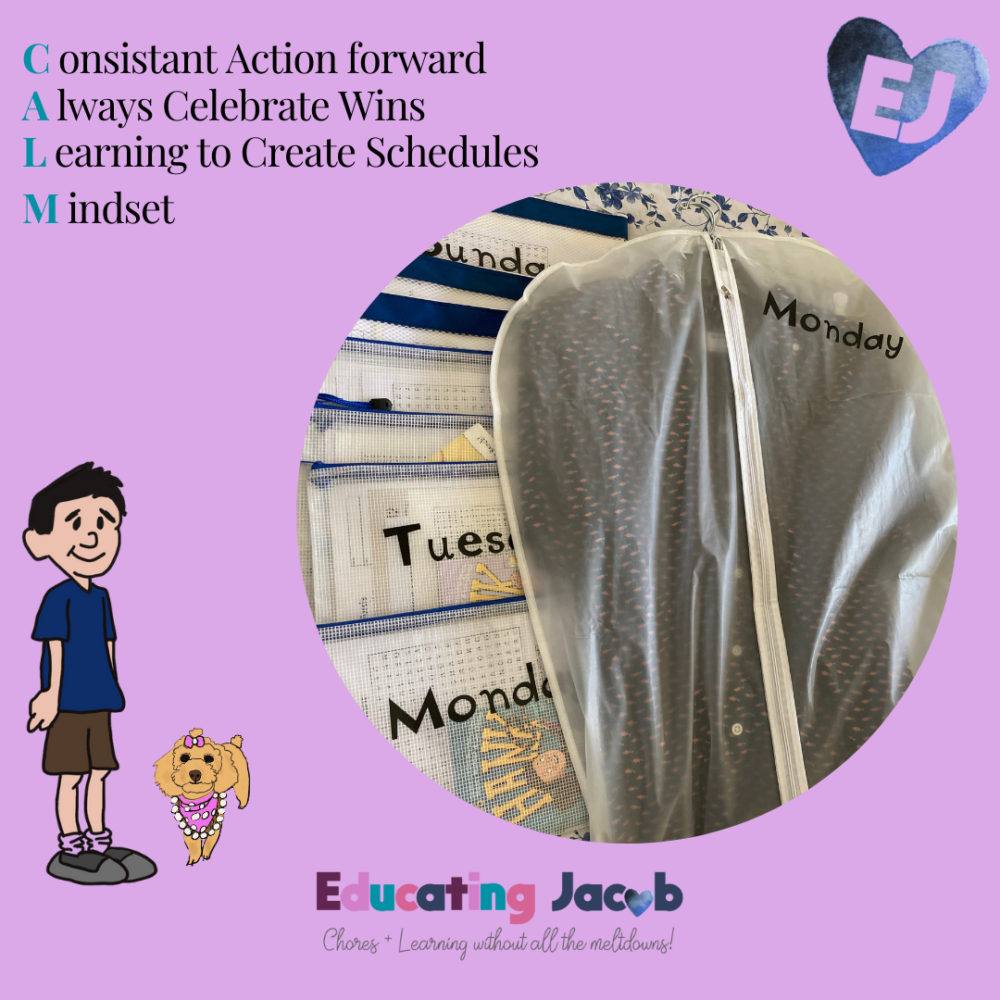
    CALM-frameworks-for-picture-with-school-work
    These zippered bags contain the days work and the garment bag holds his sensory friendly clothes! Schedules keep him grounded.

    C: Consistent Action Forward

    We stopped trying to reinvent the wheel.

    If Jacob loves a shirt, we buy it again. If he loves a movie, we get a backup copy (and maybe a third, just in case).

    We stock up on his favorite Sharpies like we’re preparing for an apocalypse. Because in our house, running out of the right marker basically is one. 😂

    Progress for us isn’t about exciting variety. It’s about meeting Jacob where he is, not where the holiday ads say he should be.

    We’ve created a running “Jacob’s Approved List” with exact brand names, item numbers, and links. When something works, we document it like archaeologists preserving ancient artifacts.

    Because six months from now when that company “improves” their formula or discontinues the line, we’ll be glad we did.

    A: Always Celebrate Wins 🎉

    Finding the right Sharpie? That’s a win.

    Tracking down a familiar coloring book on a random resale site? HUGE win.

    Choosing comfort over novelty? Win.

    Successfully ordering the same gift three years in a row without feeling guilty about it? That’s growth, friend. 🙌

    Success doesn’t have to look exciting to be meaningful.

    Every autism parent who’s ever done a victory dance because they found the discontinued item knows exactly what I’m talking about.

    We celebrate differently on Autism Island. And that’s okay.

    L: Learning to Create Schedules 🗂️

    We plan shopping around what Jacob can tolerate, not what’s convenient for everyone else.

    Short trips. Clear goals. Visual plans.

    But here’s the thing: even when Jacob isn’t with me, I’m using visual supports for myself.

    I keep a photo album on my phone of every successful gift from the past five years. I can visually reference what worked and what didn’t.

    We also create a simple visual gift list for Jacob so he knows what’s coming. Reducing surprise helps him enjoy Christmas more.

    I know some people think this “ruins the magic.”

    But you know what ruins the magic? A completely dysregulated child on Christmas morning who can’t enjoy anything because the sensory and emotional overload is too much.

    Predictability doesn’t ruin Christmas.

    It saves it.

    M: Mindset 💛

    This is the foundation that changed everything for us.

    Jacob doesn’t need new. He needs right.

    Sameness is not lazy.

    Repetition is not failure.

    Comfort is not boring.

    It is love.

    I had to grieve the Christmas morning I imagined before Jacob—the one with piles of wrapped surprises, spontaneous squeals, and a child who wanted everything the TV commercials advertised.

    And then I had to embrace the Christmas morning we actually have.

    The one where the same navy shirt brings genuine joy because it’s exactly what he wanted.

    The one where a backup copy of a beloved movie matters more than any trending toy.

    The one where my son feels calm enough, safe enough, and understood enough to actually enjoy the day.

    That shift in mindset is everything.

    Your child’s happiness doesn’t depend on variety or novelty or keeping up with what other kids want.

    It depends on you truly knowing them. And you do. Mom Guilt Ruling the Day? Have a Plan and CALM for Autism Spectrum.

    Practical Gift-Giving Tips for Children With Level 2 Autism ✨

    Here’s what actually helps when you’re shopping for a child with Level 2 autism:

    Buy duplicates (or triplicates) of preferred items. When you find something that works, buy extras. Future you will send past you a thank-you card.

    Use resale sites for discontinued favorites. eBay, Poshmark, Mercari, Abe Books—they’re goldmines. I’ve found 5-year-old coloring books and discontinued shirts. It’s like a treasure hunt, except the treasure is your child’s regulation. 😅

    Focus on comfort, not novelty. The most successful gifts fit into your child’s existing routine, not the ones that disrupt it.

    Limit new items to one or two per holiday. Everything else should be familiar and safe. Think of it as 90% comfort, 10% gentle expansion.

    Photograph tags and labels before you throw them away. Style numbers, fabric content, brand names—document everything. You never know when you’ll need to track it down again.

    Remember that sameness brings joy for many autistic kids. When Jacob opens another navy shirt and smiles because it’s soft and familiar, that’s genuine happiness. Don’t let anyone tell you otherwise.

    Keep a “success archive.” Take photos of gifts that worked. Note the year, the reaction, and where you bought it. This becomes your gift-giving bible.

    Don’t be afraid to ask directly (if your child can communicate preferences). “Do you want the red shirt or the blue shirt?” is better than a surprise that backfires.

    Prepare relatives with specific lists. Send links. Send photos. Be unapologetically specific. You’re not being controlling—you’re preventing everyone’s disappointment, including your child’s.

    Here’s the tweaked section with your edits incorporated:

    What to Say When People Don’t Understand 💬

    One of the hardest parts isn’t the shopping itself—it’s managing other people’s reactions.

    When Grandma says, “But I wanted to surprise him with something NEW!”

    “You can, but please understand it might not go well. New doesn’t always go over well with Jacob.”

    When a family member gives you a look that says, “You’re buying him the SAME thing again?”

    “Yes. Because it works. And that matters more than variety.”

    When someone suggests, “Maybe he’d like this if he just tried it!”

    “Maybe, but don’t get upset if you don’t get a great reaction. Anytime I try something new with Jacob, it doesn’t go well at first. Eventually it might catch on, or we move on. And that’s okay.”

    Here’s what we’ve learned to say:

    “Jacob does best with familiar things. If you’d like to get him a gift, here’s a list with links. I know it seems repetitive, but these are the things that truly bring him joy.”

    “Gift cards to Amazon or his favorite lunch spot are always appreciated too.”

    And if they push back?

    “I appreciate that you want to do something special. The most special thing you can do is understand that he may not react well to something new and unexpected—and that’s not a reflection of your love or thoughtfulness.”

    It’s okay to be specific. It’s okay to set boundaries.

    The people who truly love your child will understand. And the ones who don’t? That’s not your problem to manage during the holidays.
    Surviving the Holidays on Autism Island: A Humorous Guide for Parents
    Jacob helps with decorations, holiday movies and Christmas cookies!

    Christmas Can Still Be Meaningful 🎄

    If your child opens gifts that look the same as last year, Christmas isn’t less special.

    You are just more intentional.

    It means you’re the Leonard buying Chinese food containers—doing the invisible work of preserving your child’s sense of safety in a world that doesn’t always understand.

    Christmas on Autism Island may look quieter, simpler, and more repetitive than what you imagined.

    But it’s also filled with understanding, advocacy, grace, humor, and strength.

    You’re not giving your child less. You’re giving them exactly what they need to feel secure, loved, and understood.

    And in a world that’s constantly asking them to change, adapt, and mask their needs?

    That’s the greatest gift of all.

    So when you’re searching for that discontinued coloring book at 11 PM, remember: you’re not alone.

    • When you’re buying the same shirt for the third year in a row, you’re doing it right.
    • When you’re explaining to relatives why Jacob doesn’t want anything “new and exciting,” you’re advocating beautifully.
    • When you’re documenting style numbers like you work for the FBI, you’re being an incredible parent.

    This is what love looks like on Autism Island. Here is something I found on Pinterest for those of you who might need it: https://themonterabbi.com/non-verbal-autism-apps/

    And it’s enough. You’re enough. Your child’s Christmas is enough.💛

    What’s your biggest Christmas shopping challenge this year? Are you hunting down a discontinued favorite? Explaining sameness to family? Drop a comment below—I’d love to hear what you’re navigating and celebrate your wins with you. 🎄

    Read More

  • Fun Family Activities: A Parent’s Guide for a Joyful Season with Autism🎄

    making the holidays work for your autistic child
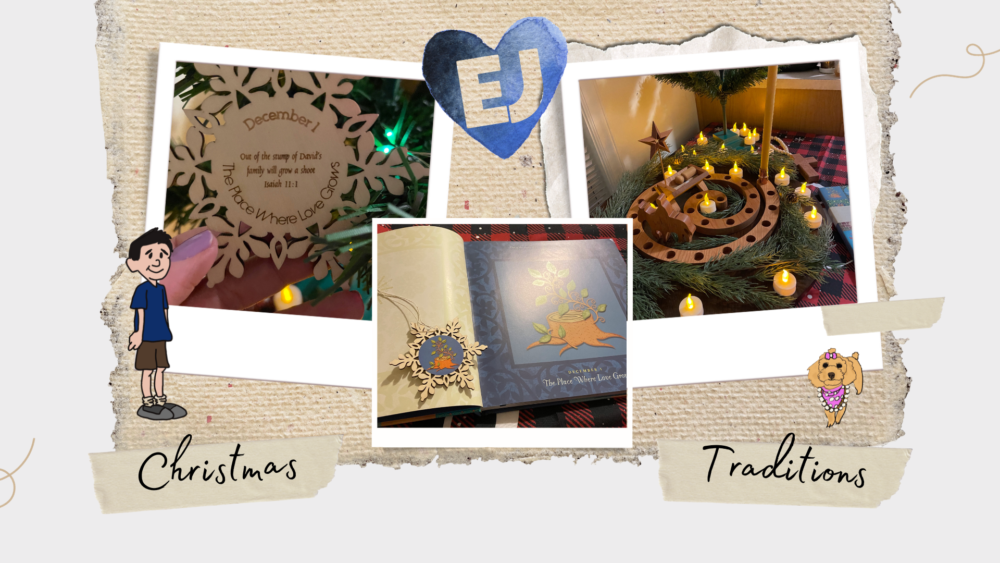
    Advent scripture decorations and wreath serves as our visual guide to the story of Christ’s birth.

    Making the Holidays Work for Your Autistic Child: Real Strategies from Our Family to Yours 🎄

    Because the most magical holiday moments aren’t always picture-perfect—and that’s perfectly okay.


    Listen, I get it. You’re scrolling Pinterest at 11 PM, looking at all those “magical autism-friendly holiday traditions” posts, and thinking, “That’s cute, but my kid would have a meltdown before we even got the glitter out.” 😅

    Been there. Done that. Have the sensory-overload-induced tears to prove it (both his and mine).

    Here’s the truth about making the holidays work for your autistic child: It’s messy. It’s unpredictable. And it looks nothing like those Instagram reels. But with some strategic planning and a whole lot of grace, you can create holiday memories that feel good for your whole family—even if they look totally different from what you imagined.

    Let me share what’s actually working in our house this December, along with some practical strategies you can steal, adapt, or completely ignore if they don’t fit your child. 💚

    making the holidays work for your autistic child
    Advent activities for Jacob!

    The Reality Check We All Need ☕

    Jacob loves Christmas. Like, countdown-starting-in-August kind of love. But here’s what took me years to accept: loving Christmas and tolerating traditional Christmas activities are two completely different things.

    Jacob doesn’t do the whole “family gathered around the tree unwrapping presents together” thing anymore. It’s too much—the noise, the expectations, the wrapping paper chaos, everyone watching him react “appropriately.”

    And you know what? That’s okay. 👏

    We’ve learned that making the holidays work for your autistic child means ditching the Hallmark movie script and writing your own story. Here’s ours.

    Strategy #1: Rethink Gift-Giving Entirely 🎁

    What we used to do: Wrapped presents under the tree, Christmas morning chaos, forced family togetherness while opening gifts.

    What we do now: Gift bags. Just gift bags. No tape, no wrapping paper, no sensory nightmare of ripping and tearing while everyone stares.

    Here’s the magic part—Jacob picks up his bag and takes it to his room when he’s ready. Sometimes that’s immediately. Sometimes it’s an hour later. Sometimes he peeks in, leaves, comes back three times before he’s ready to dive in.

    And we let him. ✅

    Your Action Step: Ask yourself—what part of gift-giving actually matters? For us, it’s Jacob feeling excited and safe, not performing joy on command. Maybe for your child, it’s opening one gift at a time over several days. Maybe it’s no surprises at all—just ordering exactly what they want and skipping the “surprise” element entirely.

    The tradition isn’t the wrapping. It’s the joy. Find what creates joy for your child. 💫

    Strategy #2: Master the “Drive-By” Participation 🏃‍♂️

    Jacob doesn’t sit through full family movie nights anymore. But he does what we lovingly call “drive-bys.”

    He’ll zoom through the living room where we’re watching Charlie Brown Christmas, shout his favorite line (“I never thought it was such a bad little tree!”), grin when we shout back the next line, then disappear back to his room.

    Ten minutes later? Another drive-by. Another quote exchange. Another moment of connection. 💙

    This is participation. Just because it doesn’t look like everyone snuggled on the couch doesn’t mean it’s not meaningful.

    Your Action Step: Redefine what “family time” means in your house. Is your child happy in the same general vicinity? That counts. Do they check in periodically? That counts. Are they comfortable enough to be themselves in your space? That really counts.

    Make a list of your child’s favorite movie quotes and have them ready. Turn drive-bys into a game. Let them set the pace.

    Strategy #3: Give Control Through Choices (Even Small Ones) 🎯

    We’ve learned that making the holidays work for your autistic child often comes down to one thing: control. Not control over everything, but control over something.

    For Jacob, it’s snacks or a movie selection. Before our “family” movie night (even if he’s not fully participating), Jacob picks:

    • What snacks we’re having 🍿
    • Which holiday movie we’re watching 📺
    • What time we’re starting ⏰

    Even if he only shows up for drive-bys, he knows he controlled those decisions. That sense of agency makes all the difference.

    Your Action Step: Identify three small holiday decisions your child can own completely:

    • Which day to decorate (within a reasonable window) 🎨
    • What goes on the tree 🎄
    • What’s for Christmas dinner 🍽️
    • Which relatives to video call (and for how long) 📱
    • Whether to participate in a specific tradition at all ✨

    Write these down. Make them visual if needed. Then honor those choices—even when they’re different from what you’d prefer.

    The Traditions That Actually Work for Us 🌟

    Let me share the holiday activities that have survived Jacob’s “absolutely not” filter over the years. These are our real autism holiday fun moments—the ones where I see him genuinely happy, not just tolerating an activity.

    The Cradle-to-Cross Wreath: Structure Meets Meaning 🕯️

    We use The Keeping Company’s Cradle-to-Cross Wreath—a beautiful wooden advent wreath with scripture decorations.

    Why it works for Jacob:

    • Visual and concrete: He can see the progression through Advent 👀
    • Same routine daily: Light candle, add decoration, read scripture 📖
    • Predictable timing: Takes exactly 5-7 minutes ⏱️
    • Clear endpoint: When we reach the cross, Christmas is here 🎄

    This is making the holidays work for your autistic child in action—taking something meaningful and making it accessible through structure and routine.

    Ceramic Christmas Tree Painting: Controlled Mess 🎨

    Remember those vintage ceramic Christmas trees? I decided to make omy own, and Jacob actually enjoys it because:

    • It’s a contained mess (paint stays on the tree) ✅
    • No time pressure—we can paint over multiple days 📅
    • He can see exactly what the finished product will look like (we show him examples first) 👁️
    • It connects to a sensory activity he genuinely enjoys (painting) 🖌️

    Check out Greg’s Pottery on Instagram for ideas. But honestly? A plain ceramic tree from a craft store works just fine.

    Pro Tip: Do this activity in November, before the holiday chaos hits. That way it’s just a fun activity, not another demand during an already overwhelming season. 💡

    making the holidays work for your autistic child
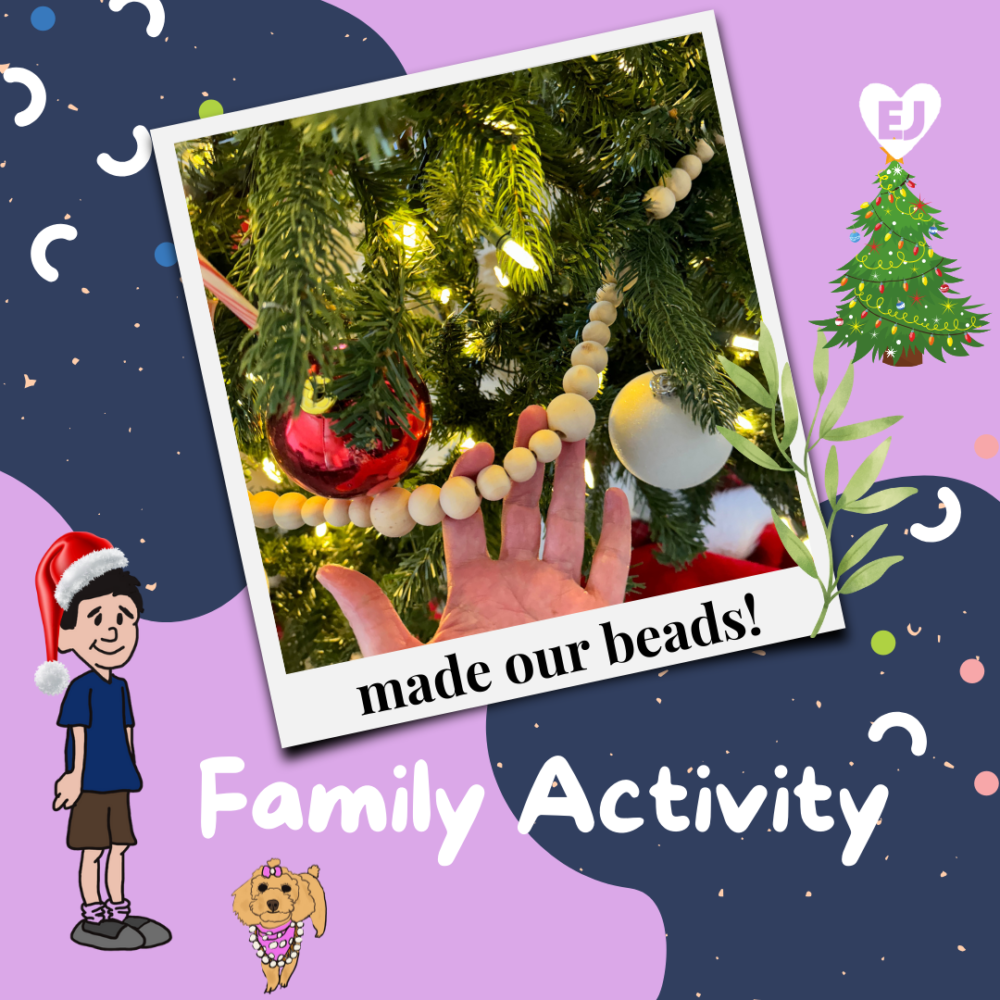
    Macrame beads for a strand on the tree!

    DIY Wooden Garland: Hands-On Success 🧶

    We ordered macrame beads from Amazon and let Jacob create wooden garland strands for the tree.

    Why this works:

    • Repetitive, calming motion (threading beads) 🔄
    • Clear beginning and end ✨
    • Visible result he can feel proud of 🏆
    • Low sensory input (just wood and string, no glitter or chaos) 🌿

    He doesn’t do this with us—he does it in his room, at his pace, while listening to his music. And that’s perfect. 🎵

    The Cookie Situation: Know Your Child 🍪

    Jacob loves my homemade cookies year-round. But at Christmas? He wants those Pillsbury Christmas-shaped cookies from the commercial.

    Why? Because they connect to his favorite holiday movies. The commercial reminds him of Rudolph and Charlie Brown. 📺

    The lesson here: Sometimes the “special” thing isn’t special because it’s homemade or elaborate. It’s special because it connects to something meaningful for your child.

    Don’t fight it. Just buy the cookies. 😊

    Movie Marathon, Redefined 🎬

    Our December movie lineup is sacred:

    • A Charlie Brown Christmas 🎄
    • A Year Without a Santa Claus ❄️
    • Rudolph the Red-Nosed Reindeer 🦌
    • The Santa Claus 2 🎅
    • Jingle All the Way 🎁

    But like I said—Jacob doesn’t sit through them anymore. He orbits. He drive-bys. He quotes them from his room. 💬

    Your Action Step: Let go of the picture in your head. If your child knows every line but watches from the hallway? They’re still engaging. If they only like one 10-minute segment? Play that segment on repeat. This is their tradition, not a performance. 🎭

    Amazon Wishlists: Start Early, Reduce Anxiety 📝

    Jacob makes his Christmas list starting in August (right after his birthday).

    I used to think this was “too early.” Now I realize it’s brilliant—it gives him months to process, change his mind, and feel in control. 🧠

    He shows me exactly what he wants on Amazon. No surprises. No guessing. No disappointment. 🛒

    Making the holidays work for your autistic child sometimes means accepting that surprises aren’t fun for everyone. And that’s okay. ✨

    #MakingTheHolidaysWorkForAutism
    Chloe’s Christmas hair day!

    Social Emotional Pup: The Furry Buffer 🐾

    Our dog Chloe is essential to our holiday survival. She:

    • Provides sensory comfort when things get overwhelming 💙 mostly for mom and dad but Jacob is warming!
    • Creates predictable routines (toy clean up, feeding times) that ground the day ⏰
    • Gives Jacob something to focus on during chaotic family moments 👀 Usually putting toys back in the basket!
    • Makes him laugh (especially when he tricks her with her Bark Box toys) 😂

    Does her enthusiasm sometimes annoy Jacob? Absolutely. But she’s also a safe, predictable constant in a season of change. 🌟

    If you have a pet, lean into them during the holidays. They’re often the steadiest thing in your child’s world right now. 🐕

    Memory Books: The Gift That Keeps Giving 📸

    Every year, we create a scrapbook—either on Shutterfly or Google Photos. He has homemade books of family members and trips to the beach and Great Wolf Lodge!

    Jacob loves these books. He pulls them out to:

    • Remember what we did last year 📖
    • Prepare for what’s coming 🗓️
    • Process the holidays after they’re over 🧩
    • Remind me when traditions are approaching ⏰

    This is visual support gold. These books serve as:

    • Social stories about our specific traditions 📚
    • Proof that change is temporary ✅
    • Concrete evidence that he survived (and maybe even enjoyed) past holidays 💚

    Start this tradition, even if this year is rough. Future you and future child  will be so grateful. 🙏 We can all see how far we’ve come!

    The Framework That Saves Us: CALM Through the Holidays 🧘‍♀️

    When things get overwhelming (and they will), I come back to my CALM Framework:

    C – Consistent Action Forward 🎯 Keep one or two traditions consistent, even if everything else is flexible. For us, this year it’s been Christmas books with school work and movie quotes and themed cookies. Those happen no matter what.

    A – Always Celebrate Wins 🎉 Jacob took his gift bag to his room instead of melting down? WIN. He did two drive-bys during the movie? WIN. He participated in his way? HUGE WIN.

    L – Learning to Create Schedules 📅 Use visual schedules for the whole month. Show when visitors are coming, when traditions happen, when regular routine returns. This reduces anxiety dramatically.

    M – Mindset 💭 Let go of “should.” Your holidays don’t need to look like anyone else’s. Jacob doesn’t sit through gift opening? So what. He’s happy, safe, and connected in his way. That’s what matters. How to Let Go of the Guilt and Find Peace as an Autism Mom, CALM Hacks!

    What to Do When It All Falls Apart 😰

    Because let’s be real—some years, it does. Article I found on sensory room tips! 👉 https://themonterabbi.com/13-must-have-items-for-an-autism-sensory-room/

    When meltdowns happen:

    • Return to routine as quickly as possible 🔄
    • Cancel traditions that aren’t working (yes, even in the middle of them) 🚫
    • Lower your expectations even further 📉
    • Remember that your child’s nervous system is likely in overdrive ⚡
    • Offer the quiet, dark, safe space they need 🛏️

    When you feel like you’re failing:

    • You’re not. You’re adapting. 💪
    • Other families struggle too (they just don’t post it on Instagram) 📱
    • Your child needs you present, not perfect ❤️
    • One meaningful moment is worth more than a dozen forced traditions ✨

    Your Holiday Action Plan 📋

    Here’s what I want you to do right now:

    1. List your current holiday traditions ✍️
    2. Mark which ones your child actually enjoys (be honest) ✅
    3. Identify which ones stress them out ⚠️
    4. Choose 2-3 to keep, modify, or create new 🎯
    5. Let the rest go 🎈

    Then, create a visual schedule showing:

    • Which traditions happen when 📆
    • What’s negotiable vs. non-negotiable 🔄
    • When normal routine returns 🏠

    Share this with your child. Let them ask questions. Make adjustments. 🗣️ Autism meltdowns on Christmas break? You can use my CALM frameworks.

    The Truth About Making the Holidays Work 💯

    Making the holidays work for your autistic child isn’t about finding the perfect autism-friendly activities. It’s about:

    • Knowing your specific child 👦
    • Honoring their needs over tradition 🙏
    • Redefining what “together” means 💚
    • Celebrating connection in whatever form it takes ✨
    • Releasing guilt about what you’re not doing 🎈

    Jacob doesn’t unwrap gifts with us. But he lights up every time we nail a movie quote exchange during his drive-bys. 💫

    He doesn’t sit through dinner. But he picks the menu. 🍽️

    He doesn’t pose for family photos. But he proudly shows off the garland he made. 🧶

    This is our autism holiday fun. It’s not perfect. It’s not Pinterest-worthy. 📌

    But it’s ours. And it works. ❤️

    Children on the autism spectrum often need sameness and repetition.
    #sameness

    You’ve Got This, Mama 💪

    The holidays are coming whether we’re ready or not. But here’s what I know for sure:

    You don’t need to do all the things. You don’t need to create magic. You don’t need your child to participate “correctly.” ✅

    You just need to show up with love, flexibility, and a willingness to throw the script out the window when needed. 🪟

    Making the holidays work for your autistic child is about making space for them to experience joy in their way. Even if that way includes gift bags, drive-bys, and absolutely zero sitting still. 🎁

    Those drive-by movie quote exchanges? They’re our new tradition. And honestly? They’re better than anything I could have planned. 💙

    So this December, I’m giving you permission to:

    • Skip the traditions that don’t serve your family ❌
    • Create weird new ones that actually work ✨
    • Let your child opt out of activities without guilt 🎈
    • Celebrate the small wins 🎉
    • Remember that presence matters more than presentation 💚

    Your holidays don’t need to look like mine. They just need to feel good for your family. ❤️

    And if they don’t? There’s always next year to try something different. 🔄

    Want more strategies for navigating autism parenting? Join me in the Autism Thrive Tribe where we share what’s actually working (and what’s spectacularly failing) in real-time. Because we’re all figuring this out together. 💪

    Now go forth and create your own perfectly imperfect holiday traditions. Your child—and your sanity—will thank you. 🙏

    🎄✨

    Pin this for later: “Making the Holidays Work for Your Autistic Child – Real strategies from an autism mom who’s been there. Forget perfect traditions—here’s how to create meaningful moments that actually work for your family. #AutismHolidayFun #AutismParenting #AutismMom” 📌

    Read More

  • How to Let Go of the Guilt and Find Peace as an Autism Mom, CALM Hacks!

    autism mom guilt and finding peace with CALM hacks
    Practice CALM this Thanksgiving!

    🕊️ Find Peace as an Autism Mom, Use CALM Hacks!

    Thanksgiving season brings warm meals, family gatherings, pretty table settings…
    and an extra layer of mom guilt that seems to crawl right into your chest and settle there. Let me share how to take autism mom guilt and ways of finding peace with CALM hacks.3 Ways Labor Day, Thanksgiving, and Christmas All Have Issues on Autism Island!

    If you’ve ever walked into a holiday gathering already carrying the weight of:

    💛 “I hope he doesn’t melt down…”
    💛 “I wish things were easier for us…”
    💛 “Why can’t I just be the calm mom everyone else seems to be?”
    💛 “I’m tired… but I feel guilty for saying it.”

    …then you’re exactly who this post is for.

    I’ve carried that weight too — the guilt, the comparison, the stress, the emotional load of being an autism mom during the holidays.

    And here’s the truth you need today:

    You can’t enjoy peace if you’re busy carrying guilt.
    You can’t experience gratitude if you’re drowning in “should haves.”
    You can’t show grace to your child if you refuse to give it to yourself.

    This season, I want to show you how to lay down the guilt, pick up peace, and walk into the holidays with confidence — using the CALM Framework that changed everything for our family on Autism Island.

    🧡 The Heavy Guilt Autism Moms Carry (Especially in Holiday Seasons)

    When Jacob was younger, Thanksgiving was one of the most overwhelming days of the year.

    Big crowds.
    New smells.
    Different foods.
    People touching him.
    Loud laughter and talking over each other.
    Disrupted routines.

    Every single trigger — all in one long, emotional day.

    And there I was, trying to keep the peace while also trying to make everyone else comfortable.
    Trying to keep Jacob regulated while smiling through other people’s comments.
    Trying to enjoy myself while feeling guilty for wanting one quiet moment. Mom Guilt Ruling the Day? Have a Plan and CALM for Autism Spectrum.

    I used to think:

    “I should be able to handle this.”
    “Other moms do this without falling apart.”
    “Why am I so tired already?”
    “Why can’t I stop worrying about the next meltdown?”

    Friend… this is the emotional weight every autism mom carries.

    And we don’t talk about it enough.

    🌿 What I Finally Learned: Guilt Doesn’t Make You a Better Mom

    For years I believed if I carried the guilt, I’d be more attentive.
    If I pushed harder, Jacob would progress faster.
    If I did more, everything would feel easier.

    But guilt doesn’t produce peace.
    It produces burnout.

    What changed?

    When I finally learned to release the guilt and embrace CALM — Consistent Action, Always Celebrate Wins, Learning to Create Schedules, Mindset — everything shifted.

    Not just for Jacob…
    But for me.

    🌼 C — Consistent Action Forward: Release the “Never Enough” Guilt

    Guilt whispers:
    “You’re not doing enough.”
    “You messed up again.”
    “You should’ve seen that coming.”

    CALM says:
    “You showed up.”
    “You took a step.”
    “You moved forward today.”

    Consistent Action Forward doesn’t require perfection.
    It just requires presence.

    Thanksgiving Example:
    Years ago I walked into a holiday gathering with a full meltdown plan, visual schedule, snacks, headphones…
    I forgot half of it at home.
    And Jacob still had a beautiful moment of joy when my mom handed him a chocolate chip cookie because he doesn’t do pie! 🥧

    That was enough.
    I was enough. Structure, Not Struggle: Calm Hack to Create Calm in Level 2 Autism Kids Daily

    🎉 A — Always Celebrate Wins: Release the “My Child Isn’t Where They Should Be” Guilt

    Autism mom guilt shows up as comparison.

    “Why does her child eat that and mine won’t?”
    “He’s not trying the new foods.”
    “He won’t sit at the table.”
    “They think I’m not strict enough.”

    Stop.
    Right here.

    Thanksgiving is not a test.
    It is not a milestone measurement.
    It is not a behavior report card.

    Celebrate the REAL wins:

    ✅ Jacob sitting in the same room
    ✅ Him tolerating the smells
    ✅ Him wearing the outfit we picked
    ✅ Him telling me he was overwhelmed
    ✅ Him taking a break instead of melting down

    These are the wins autism moms must honor.
    Because these are the wins other people overlook.

    hanksgiving-calm-hack-for-autism-challenges
    Use Visual Schedules and show flexibility and choice!

    🗓️ L — Learning to Create Schedules: Release the “Everything Falls Apart” Guilt

    Visual schedules changed Jacob’s life — and mine.

    Especially during holidays where routines shift, crowds grow, and expectations multiply.

    This is the CALM Hack that makes holidays survivable:

    Show the plan + show the flexibility.

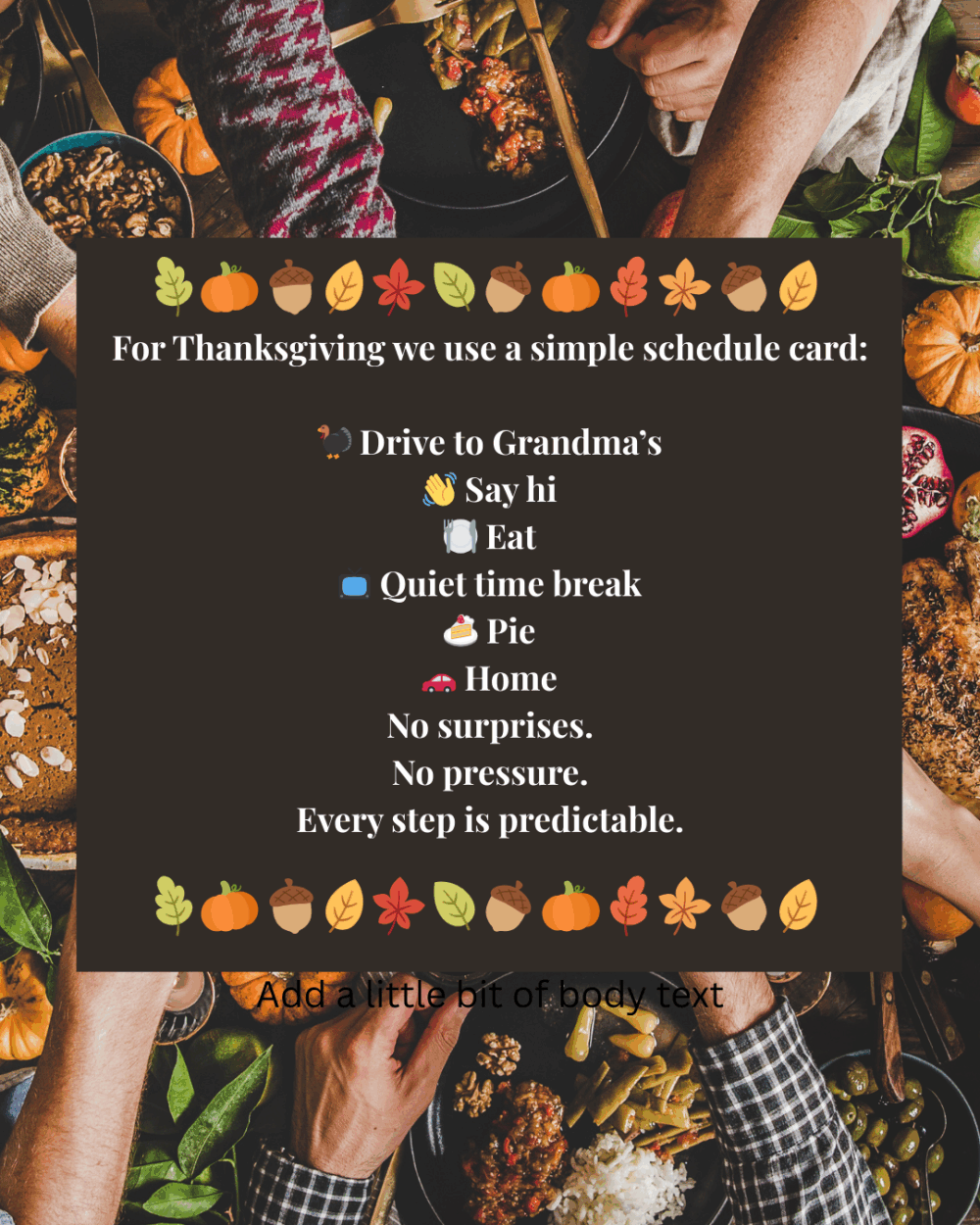
    For Thanksgiving we use a simple schedule card:
    🦃 Drive to Grandma’s
    👋 Say hi
    🍽️ Eat
    📺 Quiet time break
    🍰 Pie
    🚗 Home

    No surprises.
    No pressure.
    Every step is predictable.

    When routines feel safe, kids feel safe.
    When kids feel safe, moms feel peace.

    💭 M — Mindset: Release the “I’m Not Enough” Guilt

    This is the heaviest guilt of all.

    The voice that says:

    “I’m failing.”
    “I can’t keep up.”
    “I’m so tired, and that must mean I’m weak.”
    “Everyone else seems to handle their holidays better than I do.”

    Let me tell you what God showed me in one of my hardest seasons:

    “You are not behind.
    You are not failing.
    You are carrying something most people will never understand.
    And you are doing it well.”

    Mindset is where guilt dies and peace begins.

    This Thanksgiving, let this be your new thought:

    “I don’t have to match anyone else’s holiday.
    My family is allowed to function differently.
    Different doesn’t mean less.
    Different can still be beautiful.”

    🦃 A Thanksgiving Blessing for Autism Moms Who Are Exhausted and Worthy of Peace

    This season, I want to remind you:

    🌿 You are not the problem.
    🌿 Your child is not behind.
    🌿 You are not supposed to carry every emotion alone.
    🌿 You do not have to pretend the holidays aren’t hard.
    🌿 You deserve rest, peace, and support — not guilt.

    Let this Thanksgiving be the year you:
    ✨ lay down the guilt
    ✨ pick up the peace
    ✨ use the CALM hacks that actually help
    ✨ celebrate the wins only you can see
    ✨ create structure that gives your child safety
    ✨ allow yourself to enjoy the holiday differently

    This is the autism mom journey — unique, sacred, hard, beautiful, and worthy.

    And you’re doing it.
    You’re showing up.
    You’re loving deeply.
    You’re leading with calm.
    You’re building a home where peace is possible.

    And I’m proud of you.🫶

    CALM Hacks for Autism, predictability creates clarity and peace.📅
    Predictability, Clarity and Peace! ❤️

    Ready to Create Your CALM Thanksgiving?

    This year can be different. Not perfect — different.

    Use the CALM Framework to release guilt and create peace:

    C – Take consistent action forward (even imperfectly)
    A – Always celebrate your child’s unique wins
    L – Learn to create visual schedules that provide safety
    M – Shift your mindset from “not enough” to “exactly right”

    You’ve got this, mama.

    Not because you’ll do everything perfectly.
    But because you’ll show up with love, structure, and grace — for your child and for yourself.

    That’s what peace looks like on Autism Island.

    And that’s more than enough. https://marvelouslysetapart.com/2019/07/05/affirmations-for-kids/

    Happy Thanksgiving from our autism family to yours.

    May your holiday be filled with wins (even if only you can see them), may your child feel safe and understood, and may you finally give yourself permission to release the guilt and step into the peace you’ve always deserved.

    You are enough. Your child is enough. Your Thanksgiving will be enough.

    💛 Melissa & Jacob

    Read More

  • Structure, Not Struggle: Calm Hack to Create Calm in Level 2 Autism Kids Daily

    Calm in Level 2 Autism
    Use our Roadmap to Create Calm in your home!

    👉 CALM Hack For Autism Level 2: Create Calm in Your Home Today

    If you’ve ever fallen asleep wondering, “Am I doing enough?” or woken up already overwhelmed by what the day might bring, I’ve been there too. Let’s learn together how to create calm in level 2 autism—both at home and in your heart.

    Maybe you’ve cancelled plans because you weren’t sure how your child would handle the transition. Or explained to family members (again) why certain things just aren’t possible right now. Or sat in your car for five minutes before walking into your own home, just to gather the strength for what comes next.

    You’re not failing. You’re surviving in a world that wasn’t designed for your child — and nobody handed you the blueprint for what to do about it. How We Live CALM At Home With Level 2 Autism, We Are Neuro-Spicy! 🌶️

    When Jacob was first diagnosed with autism level 2, every day felt like a test I didn’t study for. His anxiety was high, routines were unpredictable, and I spent my energy trying to fix things — instead of building the structure that could create calm in level 2 autism. I was reacting instead of leading. I was exhausted instead of empowered.

    So, I went back to school. I earned a Master’s in Special Education. And while I learned a lot about teaching, what I really learned is this: A degree doesn’t calm the storm inside your home. Structure does. 

    🌴 Why Structure Matters

    As both an autism mom and a special education teacher, I can tell you this — structure is what makes independence possible for level 2 autism.

    Our kids thrive when they know what’s expected, what comes next, and how they can succeed. Boundaries and structure don’t limit them — they free them. This is true whether you’re trying to create calm in level 2 autism at home during breakfast or in the classroom during transitions.

    And here’s what nobody tells you: structure frees you too. It means you’re not the human calendar, the walking reminder system, the one who has to narrate every transition and negotiate every task. Structure does that work for you — quietly, consistently, without exhaustion.

    I use the exact same strategies with Jacob at home that I use with my students in the classroom. If it works for 20 kids with varying needs, it can work in your living room too.

    For Jacob, structure means peace. For me, it means rest. And for our family, it means fewer meltdowns and more moments of joy.

    Boundaries-create-calm-in-autism-@educatingjacob
    Boundaries and Schedules = Independence!

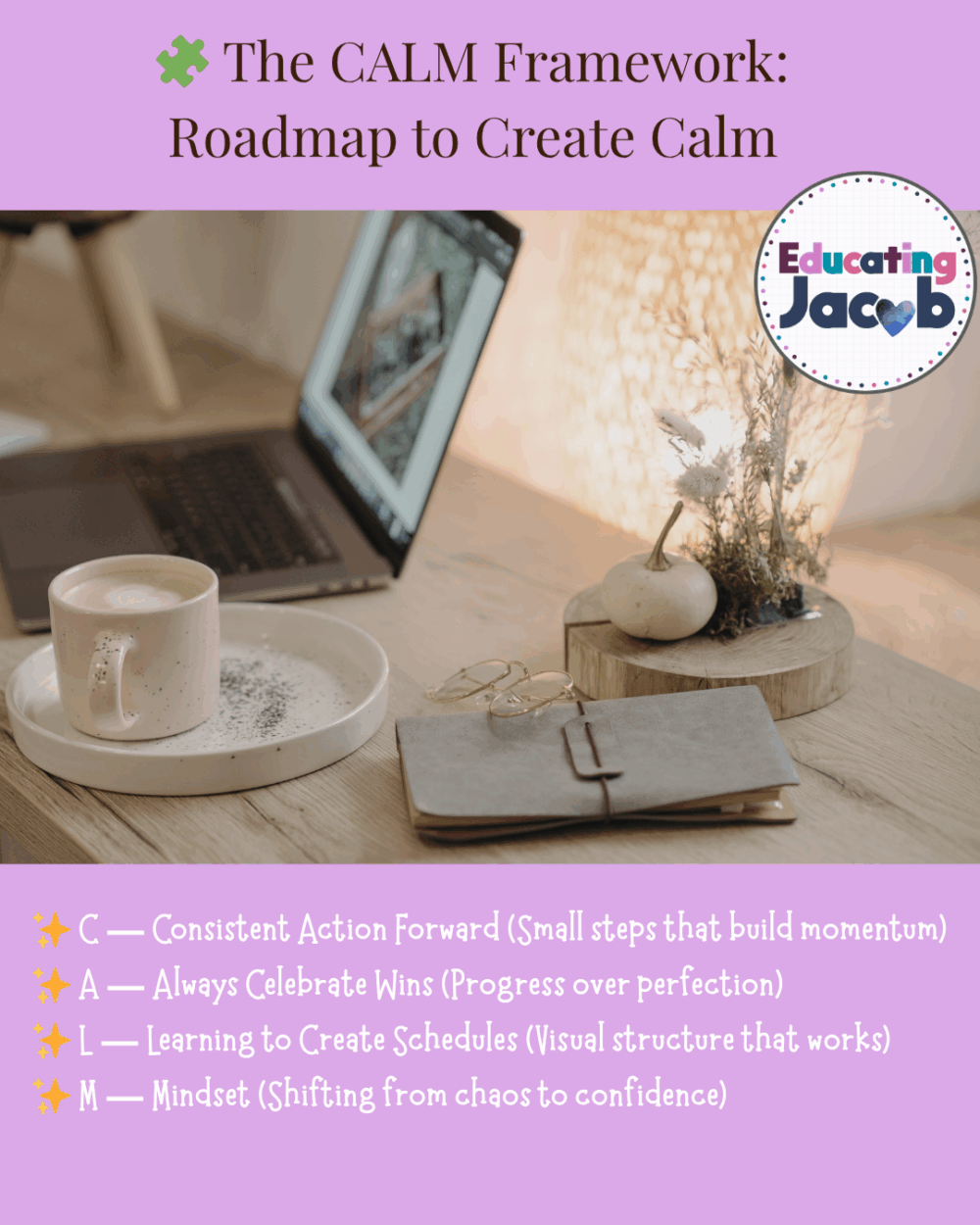
    🧩 The CALM Framework: Roadmap to Create Calm

    At Educating Jacob, I teach families our proven CALM Framework—the same system I’ve refined through years of autism parenting and classroom teaching. This framework helps you create calm in level 2 autism without burning out:

    C — Consistent Action Forward (Small steps that build momentum)

    A — Always Celebrate Wins (Progress over perfection)

    L — Learning to Create Schedules (Visual structure that works)

    M — Mindset (Shifting from chaos to confidence)

    This is the foundation that helps parents move from chaos to peace without burnout or guilt. Give Your Child with Autism a Visual Schedule, Create CALM Days! 📅✨

    Because the truth is — you don’t need another degree to parent your child with level 2 autism. You need a framework that works.

    You need something you can implement on a Tuesday afternoon when you’re exhausted, not just on days when you feel “on” as a parent. You need autism level 2 strategies that work when you’re at 60% capacity — because let’s be honest, that’s most days.

    These are the same practical tools I reach for when Jacob is struggling at home AND when my students need support in the classroom. They’re battle-tested in real life, not just theory from a textbook.

    🗓️ Visual Schedules for Autism Level 2: Structure That Actually Works

    When I first heard about visual schedules for autism, I’ll be honest — I thought, “One more thing to make. I don’t have time for that.”

    I pictured elaborate laminated cards, perfect handwriting, hours of prep time I didn’t have.

    But that one simple step changed everything for Jacob—and for my classroom too.

    Now Jacob starts each day by checking his visual schedule for level 2 autism: ☀️ Wake up 🪥 Bathroom 👕 Get dressed 🥣 Breakfast 📚 Learning time 🕹️ Break or choice activity

    He doesn’t wait for me to tell him what’s next. He knows.

    That predictability gave him independence — and it gave me breathing room to actually enjoy my coffee while it’s still hot.

    Even on days when things change (because they always do), we can adjust together. He sees the plan, understands the shift, and stays calm. In the classroom, I’ve watched this same tool transform students who struggled with transitions into kids who confidently move through their day.

    That’s what boundaries and structure for autism level 2 kids look like in real life — calm confidence instead of confusion and chaos. And the beautiful part? Once you set it up, it runs itself. The schedule becomes the teacher, not you.

    🫂 The Invisible Weight You’re Carrying (And How to Set It Down)

    Can I share something? Before we had structure in place to create calm in level 2 autism, I was constantly bracing for the next meltdown. Anticipating the next struggle. Mentally preparing for resistance before I even asked Jacob to do something.

    That hypervigilance? It’s exhausting. And it’s something I see in every autism parent’s eyes when we first start talking about our kids.

    I’d watch other parents casually tell their kids, “Time to get ready for bed,” and just… walk away. Their kids would do it. No visual countdown. No three reminders. No negotiation about which pajamas or what order to do things.

    And I’d think: What does that feel like? I could do that with my first son Nicholas but that is a distant memory for sure!

    Now I know. Because structure and visual schedule gave me that gift too.

    When your child with autism level 2 knows what’s expected and has the visual support to follow through, you get to exhale. You get to trust the system instead of micromanaging every moment. You get to be present instead of perpetually preparing for what might go wrong.

    This shift didn’t happen because I became a better parent. It happened because I became a smarter one. I stopped working harder and started working with the right tools—the same autism level 2 strategies I’d seen transform my classroom. This too shall pass, how we changed our mindset on autism island!

    💬 Real-Life Example: Boundaries That Build Trust in Level 2 Autism

    Last month, Jacob and I were preparing for a grocery trip. He had his list, his schedule card, and his favorite snack packed for the car. (Yes, I use the same visual shopping list system in my classroom for our school store visits!)

    Halfway through the trip, he decided he was “done.”

    Old me would’ve begged, bargained, and burned out. CALM me? I reminded him of our boundary: “We finish the list, then we can leave.”

    He took a deep breath (and so did I). We walked one more aisle, grabbed what we needed, and checked out.

    That moment wasn’t about groceries — it was about boundaries teaching follow-through in autism level 2.

    And here’s the part that matters: Jacob wasn’t upset that I held the boundary. He was relieved. Because kids with autism level 2 need to know that their world is predictable — even when their feelings aren’t.

    I’ve seen this same relief wash over my students when I hold consistent boundaries in the classroom. The structure isn’t restrictive—it’s reassuring. It tells them: “The world makes sense. You are safe.”

    🎯 Why Boundaries Create Calm in Autism Level 2 Kids

    Boundaries do three powerful things for our kids with level 2 autism:

    They reduce anxiety. When expectations are clear, the world feels safe. This is especially crucial for level 2 autism where anxiety can be overwhelming.

    They teach responsibility. Follow-through builds independence and pride—essential skills for autism level 2 kids working toward greater autonomy.

    They protect peace. Clear limits reduce power struggles and meltdowns, helping you create calm in level 2 autism daily.

    Jacob’s daily structure gives him freedom within safety. He gets to choose when or how he completes a task — but not if. That’s what true CALM boundaries for autism level 2 look like.

    And for you, parent? Boundaries mean you get to stop being the bad guy. The structure becomes the boundary — not you. You’re not the enforcer; you’re the guide. That shift changes everything.

    In my classroom, I’m not the mean teacher who says no. The visual schedule says it’s math time. The timer says choice time is over. The checklist says we need three more things done. I get to be the supportive coach, not the exhausted referee. You deserve that same role at home. https://themonterabbi.com/13-must-have-items-for-an-autism-sensory-room/

    🌈 From Stress to Peace: The Transformation Autism Parents Need

    I spent years chasing peace through education, research, and certifications. But the peace I wanted didn’t come from a classroom.

    It came from routines that worked at home, boundaries that stuck with Jacob, and visual supports that my son could understand—the same practical autism level 2 strategies I use every single day in my special education classroom.

    Now our days aren’t perfect (because perfection doesn’t exist on planet Earth). But they’re peaceful.

    We have moments of calm, laughter, and rest. We’ve replaced the struggle with structure that helps us create calm in level 2 autism. And that’s where independence — for both parent and child — begins.

    Some days we still have hard moments. But now they’re moments — not the entire day. Now I have energy left at 7 PM. Now I can say yes to things I used to automatically decline. Now I have the capacity to be the mom Jacob deserves, not just the exhausted manager of chaos.

    That’s not just progress for Jacob. That’s survival for me. That’s life instead of just existence.

    CALM-Framework-📸-Create-a-simple-visual
    Celebrate all wins, no matter how small!

    🕊️ A Message to Autism Parents Searching for Calm

    You don’t need another degree to feel capable. You don’t need to work harder to create calm in level 2 autism.

    You don’t need to be a better advocate, read one more book, or try one more therapy before you’re allowed to rest.

    You need a plan that works for your child with level 2 autism and gives you rest too.

    Start with one small change from the CALM Framework: 📸 Create a simple visual schedule (even just 3 steps to start!) 🕰️ Set one clear boundary for autism level 2 consistency 🌿 Celebrate one small win today (yes, getting dressed counts!)

    That’s how the CALM life begins — one peaceful step at a time. That’s how we create calm in level 2 autism, both at Educating Jacob and in homes just like yours.

    Because you deserve more than survival. You deserve a life where you’re not just getting through the day — you’re actually living it.

    💙 Ready to bring CALM to your autism level 2 home?

    Join us at Educating Jacob where I share the exact strategies I use with Jacob and my students—practical, tested, real-world tools that create calm in level 2 autism. Because you shouldn’t have to figure this out alone.

    Read More