Why I Teach That Autism and Schedules Work Together
Why do I teach that autism and schedules work together?
Because in my lived experience with my son Jacob and in my classrooms, replacing chaos with calm has always come through structure and consistency.
If you are parenting, teaching, or loving a child on the autism spectrum and life feels chaotic, overwhelming, or isolating, I want you to hear this first:
You are not failing. And you do not have to figure this out alone.
I did not have another autism mom to call. I did not have family members who understood what our daily life truly looked like. What I had was stress, fear, and a deep desire to help my son Jacob thrive in a world that often felt too loud and unpredictable for him.
This blog post is for the parent, family member, or teacher who knows something has to change but does not yet know where to start.
Transitions were difficult.
Behavior felt unpredictable.
Anxiety was constant.
Jacob lives with autism and epilepsy, and there were many days I worried about his safety, his future, and whether I was doing enough. I felt isolated and overwhelmed. That stress eventually pushed me to go back to school while working and earn a degree in special education because I needed answers.
I am not a daily journaling person. But during some of our lowest seasons, I started doing two simple things.
I took pictures of real moments.
I wrote short reflections when things felt heavy.
Often, I would end those reflections with Bible verses reminding myself that God had our family and that I could take the next step even when things felt impossible.
Looking back now, I can see something clearly.
Progress did not come from fixing everything.
Progress came from not giving up.
There were bad days. Hard moments. Seasons that felt like survival. But over time, continuing forward and trying something new moved us toward calm.
Why Visual Schedules and Autism Work Together
For a long time, I thought visual schedules were just one more thing to add to my already full plate. Mentally, I did not feel like I had the capacity for another strategy.
But what I did have was a lot that was not working.
So I tried visual schedules anyway.
And then I adjusted them.
Simplified them.
Tweaked them again.
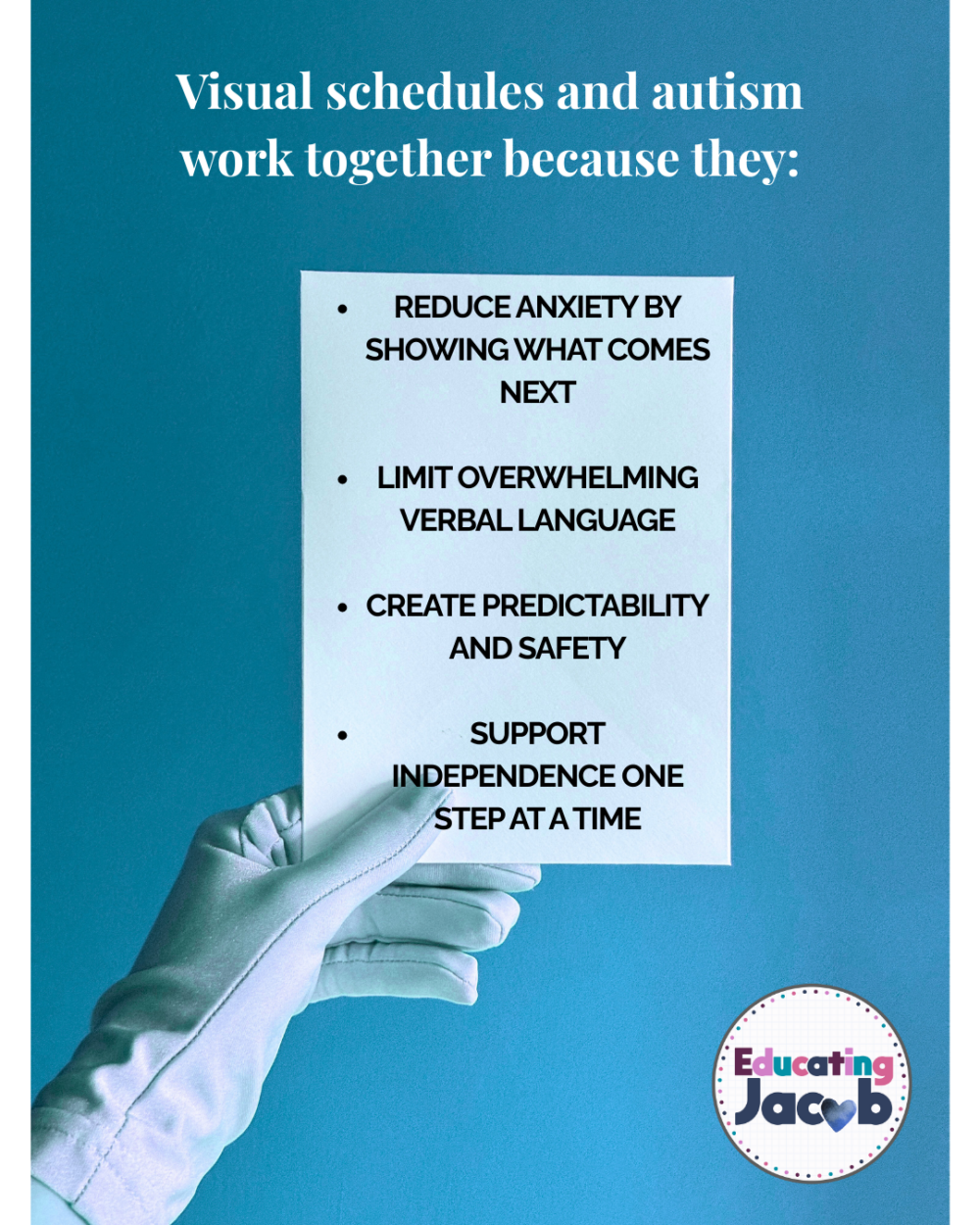
Visual schedules and autism work together because they:
Reduce anxiety by showing what comes next
Limit overwhelming verbal language
Create predictability and safety
Support independence one step at a time
When children with autism can see their day, they are not constantly guessing what is happening next.
Structure does not restrict children with autism.
Structure supports them.
How Visual Schedules Helped Jacob
When we began using visual schedules consistently, several things changed.
Jacob’s anxiety decreased.
Transitions became easier.
His independence slowly increased.
Visual schedules did not change who Jacob is.
They supported how he experiences the world.
Jacob will always need support, structure, and family to help him navigate life. Our goal has never been independence without help. Our goal is for him to thrive in every way he can.
One of our long-term hopes is to have a tiny house behind our home so Jacob can have more independence while staying connected and supported.
If your home feels loud, unpredictable, and exhausting, you are not failing. You are simply doing what you have always done in a situation that now requires something new.
That was me with Jacob.
I loved my son deeply, but chaos ruled our days. Mornings felt like battle. Transitions felt impossible. Conversations turned into meltdowns. And I kept thinking, Why isn’t this working?
The truth was simple and painful: what I was doing wasn’t working anymore.
If you want a calm home on Autism Island, something has to change. That is where calm home autism routines begin. Not with perfection. With courage to try something new.
Here are the three shifts that changed everything for our family. 💙
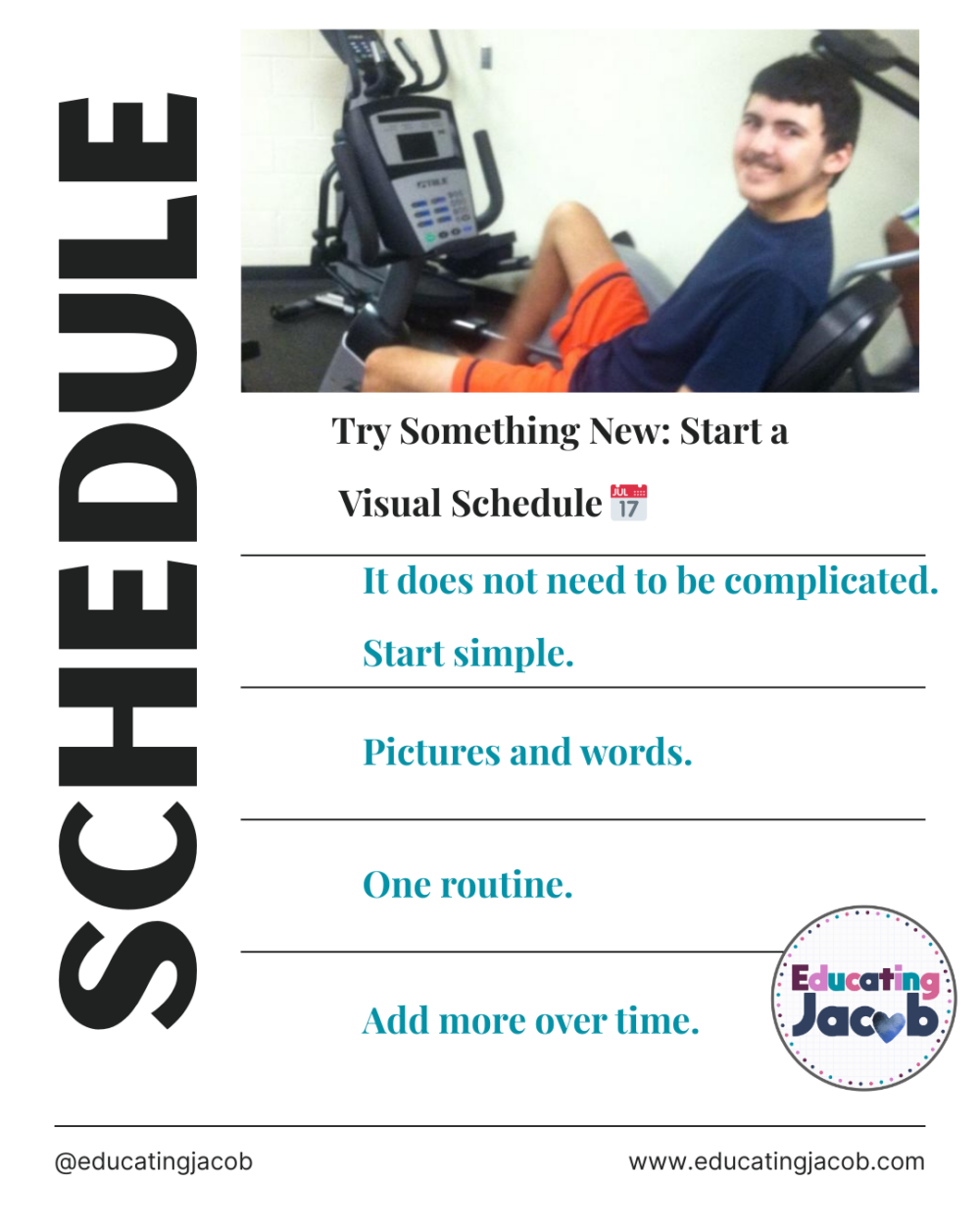
1. Try Something New: Start a Visual Schedule 📅
Jacob does not struggle because he is stubborn. He struggles because language overwhelms him.
He loves movie quotes. He can be loud and joyful. But when I talk at him or list steps out loud, his brain shuts down. Processing delays plus anxiety equal meltdown.
So I stopped talking and started showing.
A visual schedule let Jacob see his day.
What was expected
What came next
When he would get free time
What was his responsibility and what was not
It removed pressure from his mind. He no longer had to hold ten steps in his head. He no longer had to decode my words. He could simply look.
And the change was immediate.
Less anxiety. ✨
Less frustration.
More peace.
More fun.
Our home became calmer, happier, lighter.
What We Use Now:
A daily schedule
A weekly calendar
Visuals for chores and routines
A family calendar showing dad’s shifts, brother’s visits, workdays
Jacob wants to know all of this. He just does not want it spoken at him.
A visual schedule is communication without overload.
🛠️ Practical Steps to Start:
For Beginners: Start with just three activities. Breakfast. School/therapy. Bedtime. Use real photos of your child doing these activities or simple clipart. Laminate it or put it in a page protector. That’s it.
The First-Timer Trick: Take photos with your phone of your child’s actual bedroom, bathroom, kitchen table. Print them. Write one word under each: “Wake Up,” “Brush Teeth,” “Eat Breakfast.” Velcro them to a piece of poster board. Done. ✅
When to Use It: Put the schedule where your child naturally looks first thing in the morning—maybe taped to their bedroom door or on the fridge at eye level.
The Reset Rule: If they resist it for three days, move it. Try the bathroom mirror. Try their tablet case. Location matters more than perfection.
It does not need to be complicated.
Start simple.
Pictures and words.
One routine.
Add more over time.
When the schedule works, even a little, celebrate.
Not the perfect day.
The five good minutes.
The smooth transition.
The independent choice.
Let your child feel success.
We all repeat what brings praise and joy. Our children are no different.
Celebration builds:
Confidence 💪
Motivation
Independence
Our children do not need us doing everything for them. That leads to learned helplessness. What they need is to see that they can do things.
🛠️ Practical Ways to Celebrate:
The Immediate Win: When Jacob completes a step on his schedule, he gets a high-five right then. Not later. Not “good job today.” In the moment. Immediate connection between action and praise.
The Visual Victory: For a small child you can keep a small jar of pom-poms on the counter. Every time he follows the schedule independently, one pom-pom goes in. When the jar is full (doesn’t take long), he picks the family movie night pick. Simple. Visual. Rewarding.
The Sibling Strategy: Nicholas learned to be Jacob’s cheerleader. “Dude, you got dressed without being reminded!” Peer praise hits different. If you have neurotypical siblings, teach them how powerful their words are. He also uses movie quotes that Jacob loves in the characters voice! https://drroseann.com/magnesium-benefits-autism/
What NOT to Do: Don’t praise completion of the entire day if they struggled through it. That feels hollow. Celebrate the one thing they did well. That feels real.
Independence looks different for every child. The goal is always the same.
To:
Let them thrive. Help them grow. Believe, “I can.” 💙
That is part of building calm home autism routines.
3. Shift Your Mindset 🧠
I had to stop second-guessing myself.
I had to walk in confidence.
I had to accept that I did not know what I did not know.
So I made a deal with myself:
Try something
If it works, do more of it
If it does not, tweak it
If it still fails, ditch it and move on
Every small win became a clue.
Do not overcomplicate this.
Success leaves tracks.
Follow them. 👣
Most parents quit on day two.
🛠️ Practical Mindset Shifts:
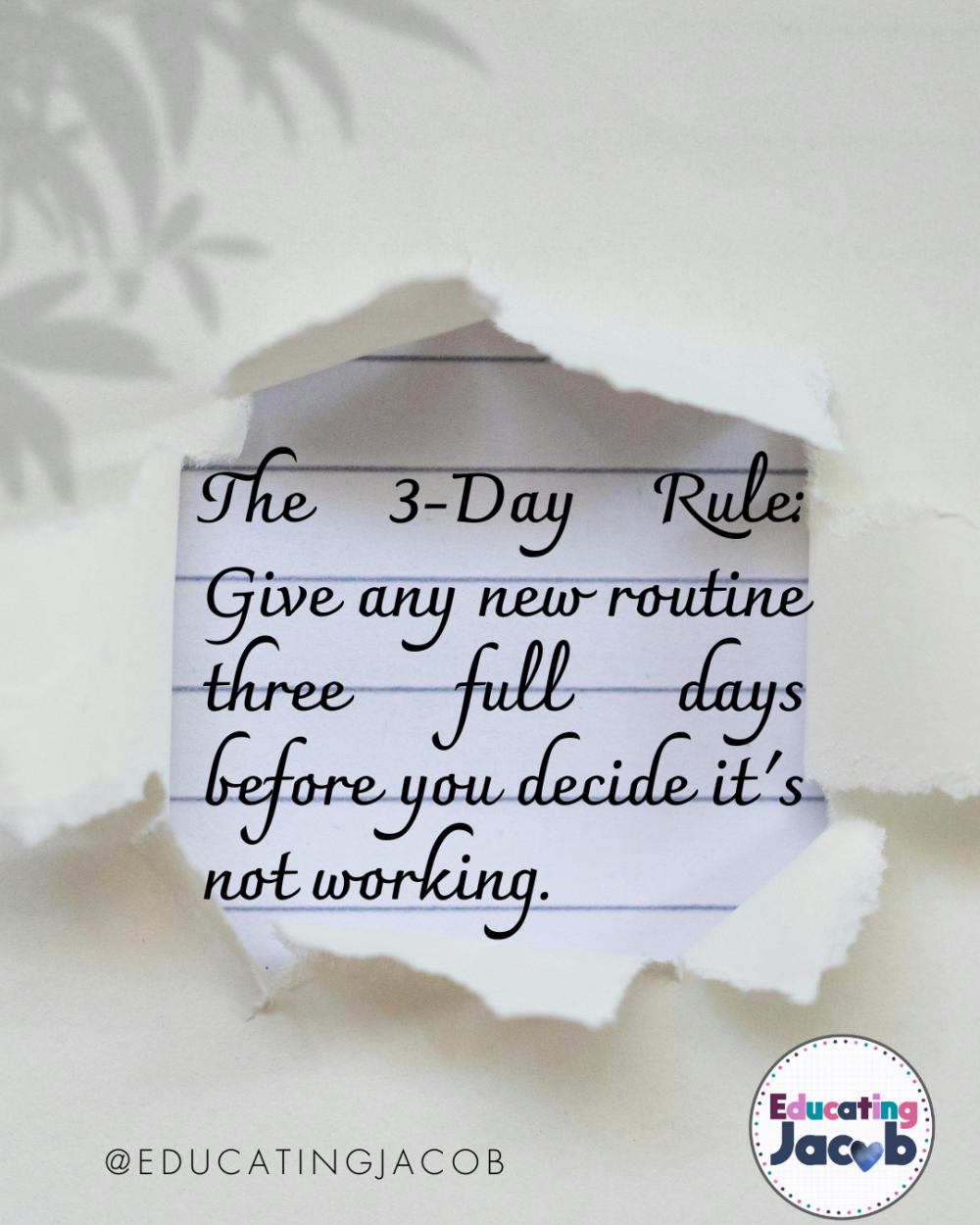
The 3-Day Rule: Give any new routine three full days before you decide it’s not working. Day one is chaos. Day two is resistance. Day three is where you see the truth. Most parents quit on day two.
The “Good Enough” Standard: Your visual schedule doesn’t need to be Pinterest-perfect. Jacob’s first schedule was printed clipart taped to construction paper with packing tape. It worked for eight months. Done is better than perfect.
The Comparison Trap: Other autism parents will do things differently. That’s okay. Their child isn’t Jacob. Your child isn’t Jacob. What works for us might not work for you. What works for you might not work for your neighbor. And that is completely fine.
The Permission Slip: I give you permission to stop trying strategies that don’t serve your family. If the sensory bin makes a mess and stresses you out, ditch it. If the token board confuses your child, try something else. You are not failing. You are being smart.
The Journal Hack: I keep a tiny notebook in my kitchen. When something works, I write it down with the date. “1/15 – Jacob transitioned to bath without meltdown when I gave 5-min warning + visual.” When I’m stuck, I flip back and look for patterns. This eliminates guessing. ✍️
That mindset became the foundation of everything I teach today.
Why This Matters 💛
For those who are new here, I am Melissa.
I am a mom to two boys, Nicholas and Jacob. Jacob is autistic. He was diagnosed at four. We knew early that he would need lifelong support.
Our entire family changed.
I became a special education teacher because I needed to understand how to help my own child. But long before any degree, I started teaching Jacob myself. I started homeschooling him before I knew what I was doing because I knew one thing.
Someone had to try.
And that someone was me.
Jacob has been my greatest teacher. 📚
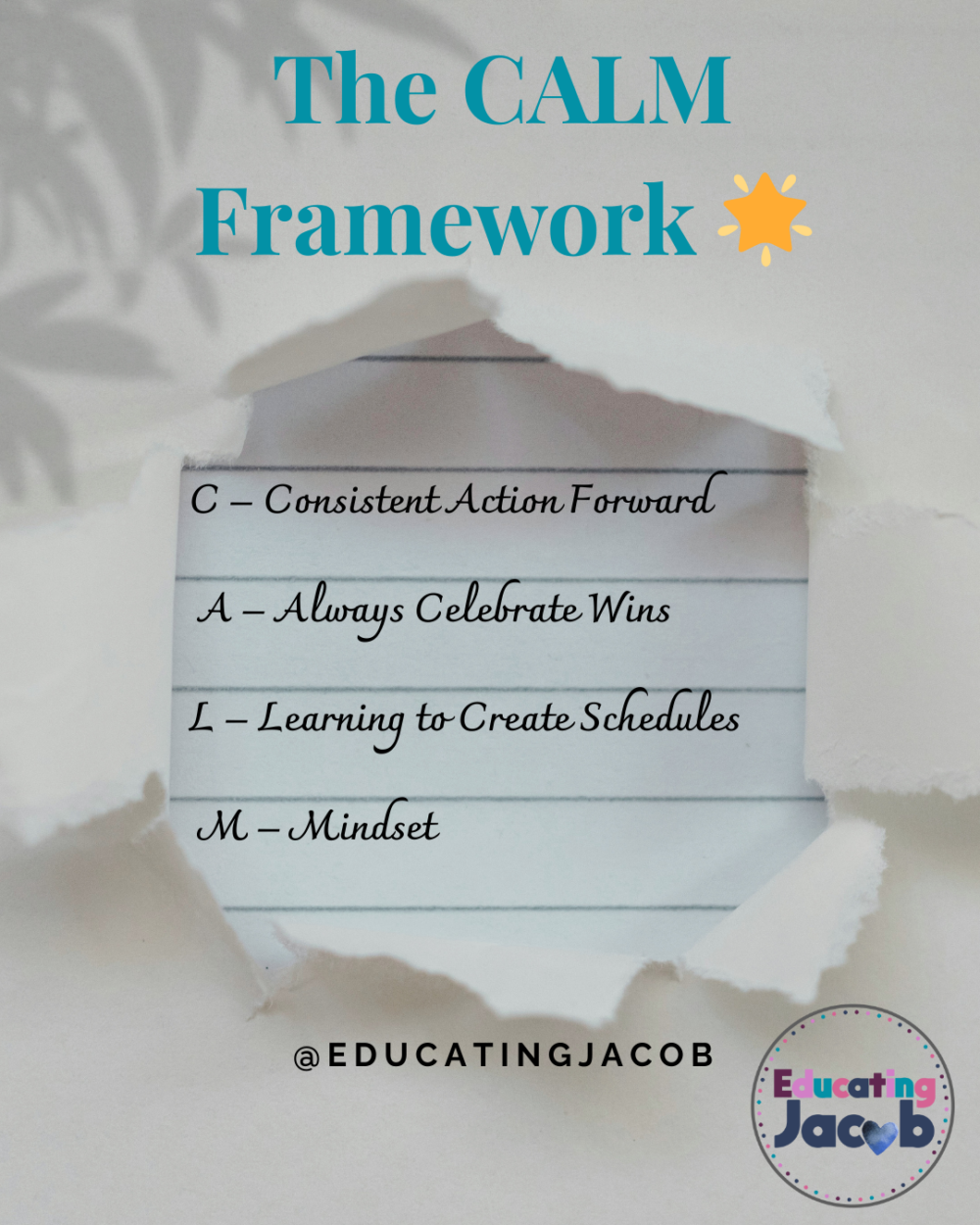
From him, I created the CALM foundations:
Consistent Action Forward
Always Celebrate Wins
Learning to Create Schedules
Mindset
These are not theories.
They are how we live.
They are how we turned chaos into calm on Autism Island. 🏝️
And they are how you can begin building your own calm home autism routines today.
Ready to Create Calm in Your Home?
You do not have to figure this out alone.
Autism Island can feel isolating, exhausting, and overwhelming, especially when every day feels like you are reinventing the wheel just to survive. That is exactly why I created Autism Thrive Tribe.
Autism Thrive Tribe is a safe, supportive community for parents who are tired of chaos and ready for calm. Inside, you will find:
Step-by-step guidance for building calm home autism routines
Visual schedule tools you can use immediately
Coaching rooted in real life, not perfection
Encouragement from parents who get it
A place where wins are celebrated, no matter how small</p>
So, if you are ready to stop surviving and start thriving, I would love to walk with you.
You don’t need a perfect system. You need a place to start.
If you’re an autism parent who feels like every day starts in survival mode, you are not failing. You’re tired. You’re carrying more than most people can see.
Life on Autism Island can feel lonely. 🏝️ Your circle gets smaller. Invitations fade. Friends drift. And some days, it feels like the world keeps moving while you’re just trying to hold things together at home.
You are not alone.
At Educating Jacob, our family lives this life too. Jacob is supported by his dad, his brother Nicholas, and me. We’re stronger together. And we believe God walks with us in this journey. He strengthens us when we’re worn down and reminds us we were chosen for each other and this journey for a reason. ✨
C – Consistent Action Forward A – Always Celebrate Wins L – Learning to Create Schedules M – Mindset
These four foundations help autism parents move from chaos to CALM. Let’s break down each one with real strategies you can start using today.
1. C – Consistent Action Forward 🎯
Create one predictable anchor in the day.
Chaos grows when nothing feels certain. Your child with autism needs something to rely on—a routine they can count on when everything else feels unpredictable.
Start With Just One Daily Anchor
Choose one routine. Just one:
☀️ Morning routine
🏠 After-school reset
🌙 Bedtime wind-down
For Jacob, mornings were overwhelming. Meltdowns before school. Resistance at every step. We created a simple visual schedule:
Wake up
Bathroom
Get dressed
Breakfast
Shoes
Out the door
Nothing fancy. Just clear.
That single anchor reduced meltdowns because Jacob knew what came next. The visual gave him control. For teachers, this looks like a consistent arrival routine or visual schedule on the board. Predictability is safety for children with autism.
💡 Your Action Step: You don’t need to fix everything today. Take one consistent step forward. Once your child is crushing this anchor routine with their visual schedule, then add another that will help them feel in control and more independent.
2. A – Always Celebrate Wins 🎉
Notice what’s working, not just what’s broken.
Autism parenting without chaos means training ourselves to see differently. We’re conditioned to scan for problems. We notice what went wrong. We forget to notice what went right.
Just scanning for problems is exhausting. It’s so amazing to notice and appreciate what went right and keep adding to that, not just the list of what’s in chaos. 💪
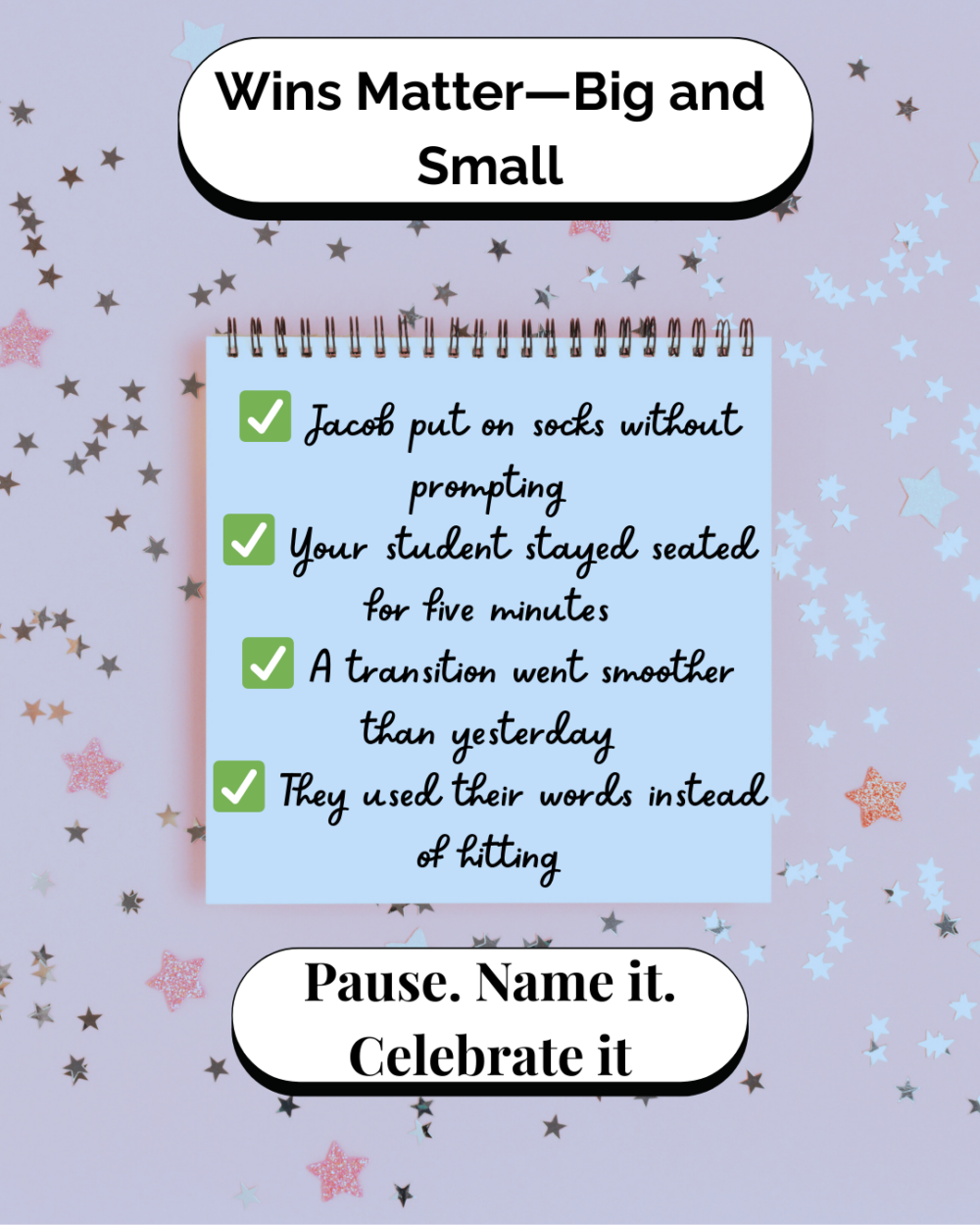
Wins Matter—Big and Small
Wins Matter—Big and Small
✅ Jacob put on socks without prompting
✅ Your student stayed seated for five minutes
✅ A transition went smoother than yesterday
✅ They used their words instead of hitting
Pause. Name it. Celebrate it.
Write wins on a sticky note. Say them out loud at dinner. Share them with your child. Text them to your spouse. Post them in our Autism Thrive Tribe community.
When your child with autism is dysregulated, their brain can’t process verbal instructions. “Go get dressed” becomes white noise. “It’s almost time for bed” triggers resistance. But a visual schedule turns chaos into clarity. Looking for a better way? Visual Schedules reduce Chaos!
At Home, Try:
🌅 Morning routine cards
📚 After-school checklist
🛁 Evening routine strip
🍽️ Mealtime visual
At School, Use:
First–Then boards
Task strips
Daily agenda with pictures
Transition warnings with timers
Visuals answer the questions that create anxiety:
What’s happening?
What comes next?
When will this end?
This is how autism parenting without chaos becomes possible. Not someday. Today.
For Jacob, we use visual schedules for everything—morning routine, homework time, even getting ready to go to the store. Our social emotional dog Chloe has become part of his visual cues too. When he sees Chloe’s name on the schedule, he knows we’re going to take her to get her hair done! 😂
📥 Want help getting started? Go subscribe on the homepage or join Autism Thrive Tribe on our facebook page. Let’s create a community and thrive together. Autism Thrive Tribe
4. M – Mindset 💭
Shift from survival to purpose.
This is the hardest part. And the most important.
You are not behind. ❌ You are not broken. ❌ Your child is not a mistake. ❌ God did not misplace your family. ❌
Life on Autism Island is different, but it’s not empty. It’s full of meaning, growth, and strength you never knew you had. Some days are still messy. CALM doesn’t erase hard moments—it gives you a way through them. 🙏
The Truth About Your Journey
Each small step is building a future. Every visual schedule you create is teaching independence. Every meltdown you navigate with patience is showing your child they’re safe. Every win you celebrate is reshaping their self-image.
You’re not raising your child alone. You have a tribe here. You have faith to lean on. You have a path forward.
Chaos is not your destiny. CALM is. ✨
CALM is built one routine at a time.
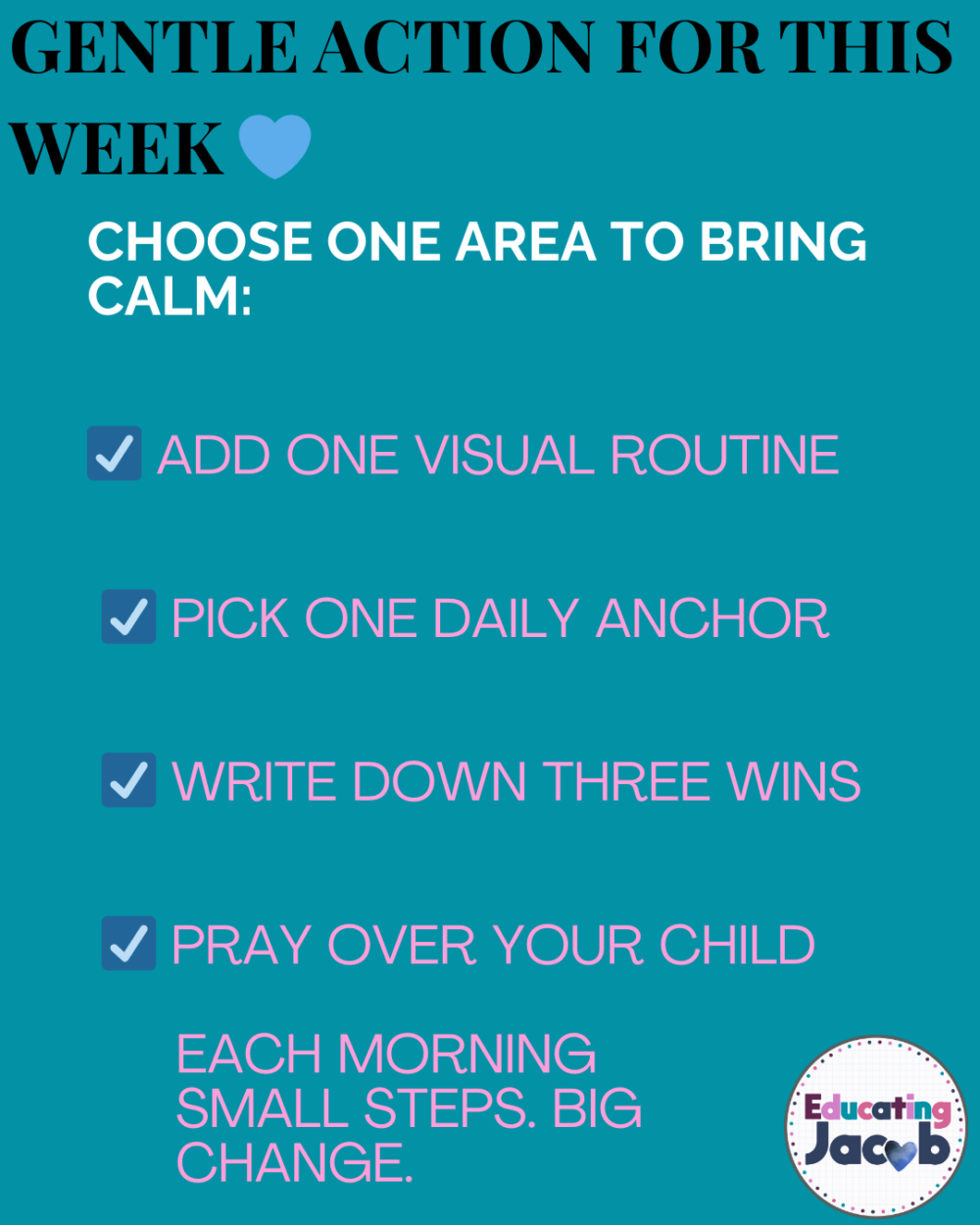
Gentle Action for This Week 💙
Choose one area to bring CALM:
☑️ Add one visual routine ☑️ Pick one daily anchor ☑️ Write down three wins ☑️ Pray over your child each morning
Small steps. Big change.
You are seen. You are supported. And you are stronger than you feel today. 💪
Educating Jacob is where overwhelmed autism parents learn how to move from chaos to CALM through simple routines, visual schedules, and real-life support from someone who gets it—because I’m living it too, right alongside you.
Ready to dive deeper? Join our free Autism Thrive Tribe community where we share wins, troubleshoot challenges, and remind each other we’re not alone on this island. 🏝️💙
Jacob has very limited interests and very specific tastes.
Why Christmas Shopping Is Overwhelming When Your Child Has Level 2 Autism 🎄
Christmas shopping is supposed to be joyful. You picture finding the perfect gift, wrapping it with care, and watching your child light up on Christmas morning.
But when you’re parenting a child with Level 2 autism, Christmas shopping is overwhelming in a very different way.
It’s not just the crowds, the noise, or the chaos of holiday stores.
It’s the deep reality that buying things for your child is genuinely hard.
And that part doesn’t get talked about enough.
If you’ve ever spent more time researching a discontinued coloring book than you spent buying your own Christmas gifts, welcome. You’re in the right place. 🎄😅
Let me be clear: this isn’t about navigating Target with a dysregulated kid during peak shopping hours (though yes, we’ve all been there and have the emotional scars to prove it).
This is about the fact that children with Level 2 autism are incredibly difficult to buy for.
The challenge isn’t them being there. The challenge is knowing what will actually work.
“Always wants the same things and sensory issues”, life with autism!
Why Christmas Shopping Is So Hard for Autism Parents During the Holidays 🛍️
Jacob doesn’t want what’s trending. He doesn’t want the newest toy, the updated version, or the holiday edition.
Jacob wants what feels safe and familiar.
He only wears clothes that are soft and plain. No tags. No stiff fabric. No surprise textures. Even something that looks identical to last year’s shirt can feel completely wrong to him.
(And yes, I’ve learned the hard way that “100% cotton” from one brand is NOT the same as “100% cotton” from another brand. Apparently, cotton has opinions. 😅)
He mostly wants movies from 10 to 15 years ago. The same ones he already knows. The same voices. The same scenes. Familiarity brings him comfort.
Jacob loves to color, but not just with any coloring utensil. It has to be a very specific Sharpie, in specific colors. Fancy sets don’t impress him. New brands don’t help. Too many options actually create anxiety.
He still enjoys certain coloring books from years ago. And if you’ve ever tried to replace something discontinued from a decade ago, you know how exhausting that search can be. 🔍😅
My Amazon search history during December looks like I’m either a very dedicated detective or someone who’s completely lost their mind:
“Blue coloring book Thomas The Train 2015”“Navy shirt soft no tag boys discontinued”“Sharpie fine point NOT ultra fine WHERE TO BUY”
This is the part of Christmas shopping that feels heavy.
You want to give your child joy, but the options feel incredibly limited.
And here’s the kicker: you can’t just ask them what they want.
Other parents complain about their kids’ endless Amazon wish lists. Meanwhile, you’d give anything for your child to be able to tell you what would make them happy.
So you become a researcher, a historian of your child’s preferences, a forensic investigator of past successes and failures.
You take notes. You photograph labels. You create spreadsheets.
And still, sometimes you get it wrong.
When you don’t whether to laugh or cry!
The Chinese Food Container Moment Every Autism Parent Understands 🍜😂
There’s an episode of The Big Bang Theory where Leonard’s favorite Chinese restaurant is going out of business. His roommate Sheldon has autism and eats from that same restaurant obsessively—same food, same containers, same routine.
So Leonard does something brilliant: he buys a stack of empty Chinese food containers from the closing restaurant.
His plan? Order from a different place and put it into the familiar containers so Sheldon won’t even notice the change.
The first time I saw that episode, I cried.
And then I laughed.
Because as an autism mom, I completely understood why Leonard did that.
That moment perfectly captures life on Autism Island. You’re not trying to trick your child. You’re trying to protect their nervous system.
You’re desperately preserving sameness in a world that keeps discontinuing everything your child loves.
You’re the parent refreshing eBay at midnight hoping someone still has that exact shirt from 2019.
You’re buying three backup copies of the same movie “just in case.” He will even look at the copyright date!
You’re literally Googling “how to fix a broken Sharpie” because throwing it away and opening a new one might cause a meltdown.
It’s funny because it’s true.
And sometimes, if we don’t laugh, we’ll cry. Sometimes we do both. Often in the same Target aisle. 😅
When Good Intentions Meet Autism Reality 📚💛
Here’s the thing about buying gifts for kids with autism: even when you get it right, it can still go sideways.
Jacob once received a book he had wanted when he was just five years old. A familiar book. A safe book. The perfect gift.
His well-meaning grandmother wrote a loving note in the front of it.
Yep. You guessed it.
Jacob did not handle that well. 😬
What was meant as love felt like a disruption. The book was no longer exactly the way he expected it to be. It had been altered.
In Grandma’s mind: “I’m making this extra special with a personal touch!”
In Jacob’s mind: “THIS IS NOT THE BOOK. THIS IS A DIFFERENT BOOK. ABORT MISSION.”
Did it ruin Christmas? No.
Did it create a learning moment for all of us? Absolutely.
Eventually, Jacob got over it. He learned to accept the inscription. The book became safe again.
And that matters.
Because I can’t give everyone a manual on exactly how Jacob will react to every loving gesture. I can’t predict every trigger. I can’t control every well-intentioned moment that goes a little sideways.
We’re all learning as we go.
But this is why autism parents second-guess everything during the holidays.
Because even getting it right doesn’t guarantee it’ll be received the way you hope.
The Emotional Weight Autism Parents Carry During the Holidays 💭
This is where the overwhelm sneaks in quietly.
You walk through stores filled with endless choices, and yet none of them fit your child.
You second-guess everything.
Will he wear this?
Will this bring joy or frustration?
Is it okay to buy the same thing for the third year in a row?
Should I risk the “upgraded version” or stick with the familiar one?
What if they discontinue this next year and I didn’t stock up?
Other parents worry their kids want too much. Autism parents worry about finding anything that works.
And then there’s the comparison trap.
You see Instagram posts of kids opening giant surprise gifts with squeals of delight.
You see Pinterest boards titled “Top 50 Gifts Kids Will LOVE This Year!”
And then you look at your own shopping cart: three identical navy shirts, a backup copy of Ice Age 2, and a 12-pack of the correct Sharpies.
It doesn’t exactly scream “magical Christmas morning.” 🎁😅
The guilt creeps in: Am I doing enough? Is this special enough? Will he feel loved?
Here’s what I’ve learned after years on Autism Island: that voice is a liar.
You’re not being picky. You’re being attentive.
You’re honoring sensory needs, preferences, and emotional regulation.
You’re doing the invisible detective work of figuring out what your child actually needs when they can’t always tell you themselves.
How CALM Helps Us Navigate Christmas Shopping With Level 2 Autism 🌊
This is where the CALM Framework keeps us from spiraling into holiday guilt and exhaustion.
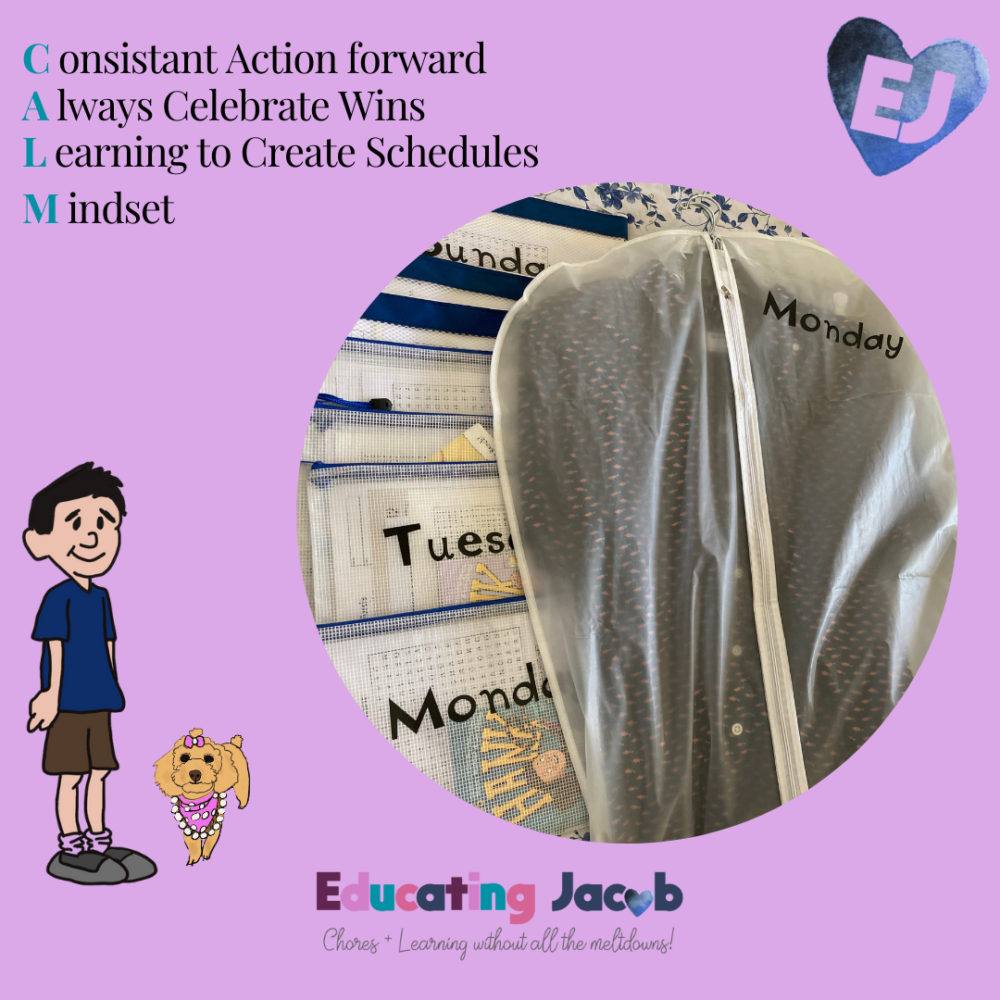
These zippered bags contain the days work and the garment bag holds his sensory friendly clothes! Schedules keep him grounded.
C: Consistent Action Forward
We stopped trying to reinvent the wheel.
If Jacob loves a shirt, we buy it again. If he loves a movie, we get a backup copy (and maybe a third, just in case).
We stock up on his favorite Sharpies like we’re preparing for an apocalypse. Because in our house, running out of the right marker basically is one. 😂
Progress for us isn’t about exciting variety. It’s about meeting Jacob where he is, not where the holiday ads say he should be.
We’ve created a running “Jacob’s Approved List” with exact brand names, item numbers, and links. When something works, we document it like archaeologists preserving ancient artifacts.
Because six months from now when that company “improves” their formula or discontinues the line, we’ll be glad we did.
A: Always Celebrate Wins 🎉
Finding the right Sharpie? That’s a win.
Tracking down a familiar coloring book on a random resale site? HUGE win.
Choosing comfort over novelty? Win.
Successfully ordering the same gift three years in a row without feeling guilty about it? That’s growth, friend. 🙌
Success doesn’t have to look exciting to be meaningful.
Every autism parent who’s ever done a victory dance because they found the discontinued item knows exactly what I’m talking about.
We celebrate differently on Autism Island. And that’s okay.
L: Learning to Create Schedules 🗂️
We plan shopping around what Jacob can tolerate, not what’s convenient for everyone else.
Short trips. Clear goals. Visual plans.
But here’s the thing: even when Jacob isn’t with me, I’m using visual supports for myself.
I keep a photo album on my phone of every successful gift from the past five years. I can visually reference what worked and what didn’t.
We also create a simple visual gift list for Jacob so he knows what’s coming. Reducing surprise helps him enjoy Christmas more.
I know some people think this “ruins the magic.”
But you know what ruins the magic? A completely dysregulated child on Christmas morning who can’t enjoy anything because the sensory and emotional overload is too much.
Predictability doesn’t ruin Christmas.
It saves it.
M: Mindset 💛
This is the foundation that changed everything for us.
Jacob doesn’t need new. He needs right.
Sameness is not lazy.
Repetition is not failure.
Comfort is not boring.
It is love.
I had to grieve the Christmas morning I imagined before Jacob—the one with piles of wrapped surprises, spontaneous squeals, and a child who wanted everything the TV commercials advertised.
And then I had to embrace the Christmas morning we actually have.
The one where the same navy shirt brings genuine joy because it’s exactly what he wanted.
The one where a backup copy of a beloved movie matters more than any trending toy.
The one where my son feels calm enough, safe enough, and understood enough to actually enjoy the day.
That shift in mindset is everything.
Your child’s happiness doesn’t depend on variety or novelty or keeping up with what other kids want.
Practical Gift-Giving Tips for Children With Level 2 Autism ✨
Here’s what actually helps when you’re shopping for a child with Level 2 autism:
✨ Buy duplicates (or triplicates) of preferred items. When you find something that works, buy extras. Future you will send past you a thank-you card.
✨ Use resale sites for discontinued favorites. eBay, Poshmark, Mercari, Abe Books—they’re goldmines. I’ve found 5-year-old coloring books and discontinued shirts. It’s like a treasure hunt, except the treasure is your child’s regulation. 😅
✨ Focus on comfort, not novelty. The most successful gifts fit into your child’s existing routine, not the ones that disrupt it.
✨ Limit new items to one or two per holiday. Everything else should be familiar and safe. Think of it as 90% comfort, 10% gentle expansion.
✨ Photograph tags and labels before you throw them away. Style numbers, fabric content, brand names—document everything. You never know when you’ll need to track it down again.
✨ Remember that sameness brings joy for many autistic kids. When Jacob opens another navy shirt and smiles because it’s soft and familiar, that’s genuine happiness. Don’t let anyone tell you otherwise.
✨ Keep a “success archive.” Take photos of gifts that worked. Note the year, the reaction, and where you bought it. This becomes your gift-giving bible.
✨ Don’t be afraid to ask directly (if your child can communicate preferences). “Do you want the red shirt or the blue shirt?” is better than a surprise that backfires.
✨ Prepare relatives with specific lists. Send links. Send photos. Be unapologetically specific. You’re not being controlling—you’re preventing everyone’s disappointment, including your child’s.
Here’s the tweaked section with your edits incorporated:
What to Say When People Don’t Understand 💬
One of the hardest parts isn’t the shopping itself—it’s managing other people’s reactions.
When Grandma says, “But I wanted to surprise him with something NEW!”
“You can, but please understand it might not go well. New doesn’t always go over well with Jacob.”
When a family member gives you a look that says, “You’re buying him the SAME thing again?”
“Yes. Because it works. And that matters more than variety.”
When someone suggests, “Maybe he’d like this if he just tried it!”
“Maybe, but don’t get upset if you don’t get a great reaction. Anytime I try something new with Jacob, it doesn’t go well at first. Eventually it might catch on, or we move on. And that’s okay.”
Here’s what we’ve learned to say:
“Jacob does best with familiar things. If you’d like to get him a gift, here’s a list with links. I know it seems repetitive, but these are the things that truly bring him joy.”
“Gift cards to Amazon or his favorite lunch spot are always appreciated too.”
And if they push back?
“I appreciate that you want to do something special. The most special thing you can do is understand that he may not react well to something new and unexpected—and that’s not a reflection of your love or thoughtfulness.”
It’s okay to be specific. It’s okay to set boundaries.
The people who truly love your child will understand. And the ones who don’t? That’s not your problem to manage during the holidays.
Jacob helps with decorations, holiday movies and Christmas cookies!
Christmas Can Still Be Meaningful 🎄
If your child opens gifts that look the same as last year, Christmas isn’t less special.
You are just more intentional.
It means you’re the Leonard buying Chinese food containers—doing the invisible work of preserving your child’s sense of safety in a world that doesn’t always understand.
Christmas on Autism Island may look quieter, simpler, and more repetitive than what you imagined.
But it’s also filled with understanding, advocacy, grace, humor, and strength.
You’re not giving your child less. You’re giving them exactly what they need to feel secure, loved, and understood.
And in a world that’s constantly asking them to change, adapt, and mask their needs?
That’s the greatest gift of all.
So when you’re searching for that discontinued coloring book at 11 PM, remember: you’re not alone.
When you’re buying the same shirt for the third year in a row, you’re doing it right.
When you’re explaining to relatives why Jacob doesn’t want anything “new and exciting,” you’re advocating beautifully.
When you’re documenting style numbers like you work for the FBI, you’re being an incredible parent.
And it’s enough. You’re enough. Your child’s Christmas is enough.💛
What’s your biggest Christmas shopping challenge this year? Are you hunting down a discontinued favorite? Explaining sameness to family? Drop a comment below—I’d love to hear what you’re navigating and celebrate your wins with you. 🎄