Blog

  • How Jacob’s Autism Makes Birthday Celebrations Unique on Autism Island.

    Happy Birthday! Autism and Birthdays
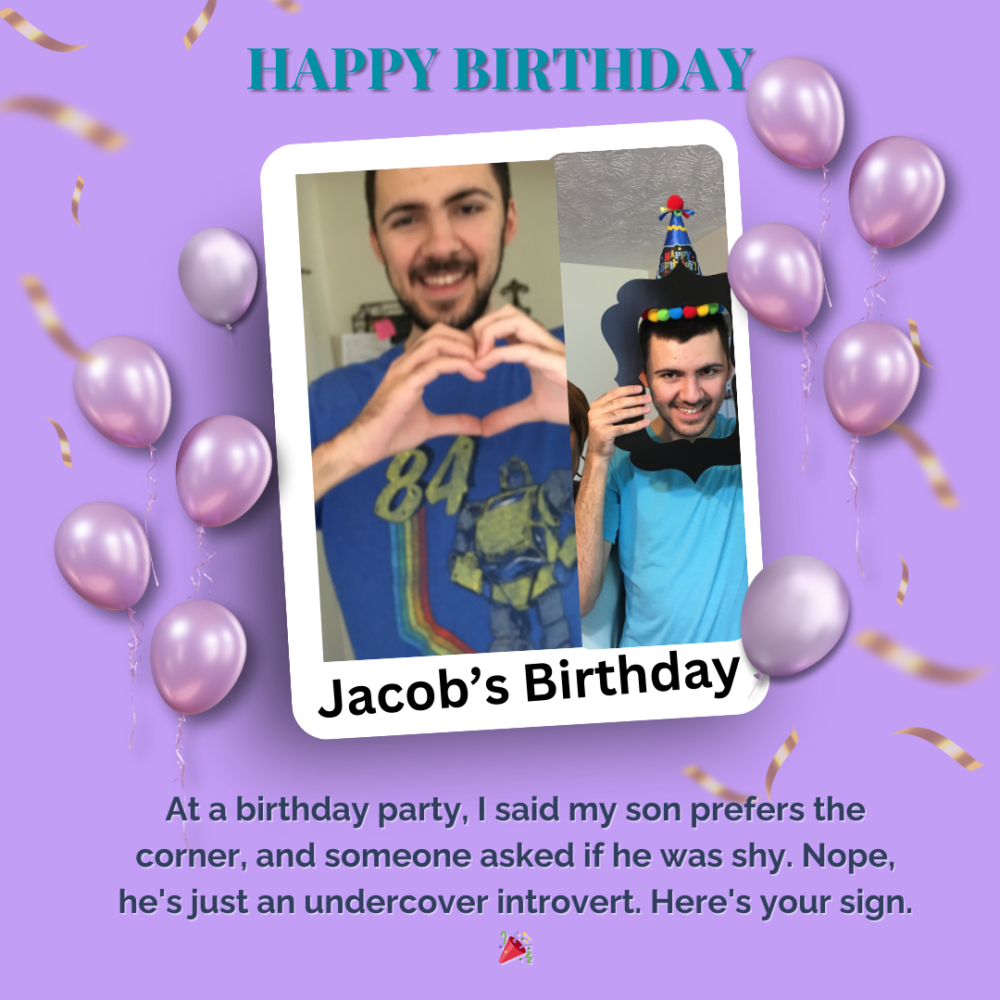
    Birthdays may look a little different on Autism Island!

    Autism And Birthday Celebrations

    If you’ve been following our journey here at Educating Jacob, you know life on Autism Island is full of adventures, surprises, and a little unpredictability — especially when it comes to birthday celebrations.

    This year’s birthday was… well, different — peaceful, no meltdowns, and Jacob was genuinely happy with everything he received. But here’s the twist: he didn’t want to open his presents when we put them out, and singing “Happy Birthday” was a no-go. No hugs, no “thank yous,” just a very determined quoting of a favorite movie clip: “Let’s go, lads, let’s get out of here!” from The Jungle Book. That buzzard scene stuck in his head for nearly three days straight!

    As a mom, it’s a little embarrassing when friends come over going out of their way with presents and well wishes, and your child isn’t quite willing to engage or reciprocate in typical ways. But here’s the thing — Jacob’s way of celebrating is just as valid as anyone else’s. The peace we had that day was a huge win, and sometimes, that’s the best celebration you can ask for.

    Here’s another post you can check out: https://hiblogimdad.com/2018/03/19/does-he-know-its-his-birthday/

    Autism Birthday and Superman!
    Jacob loves Superman!

    The Realities of Birthdays on Autism Island

    Birthdays on Autism Island aren’t your typical “cake, candles, and party games” affair. They’re a mix of joy, sensory challenges, and unique ways of expressing love and happiness.

    Jacob loves the idea of birthdays — he’s excited about his special day, choosing movies, foods, and even some decorations. But the social and sensory parts of birthday traditions like singing “Happy Birthday” or opening gifts publicly? Not so much.

    autism and birthday celebrations
    This year Jacob wasn’t ready for pictures so went with last years!

    Sensory Sensitivities Are Real 🎶🎈

    For Jacob, loud singing feels overwhelming. That classic “Happy Birthday” tune can cause sensory overload that makes him plug his ears or pace around — but he still beams with happiness underneath it all.

    Bright party lights, unexpected noise, and even textures of certain foods or decorations can be tough to handle. Over the years, we’ve learned to:

    • Use soft, calming lighting and keep decorations simple and sensory-friendly.
    • Prepare visual schedules to help Jacob anticipate what’s coming next.
    • Create a “quiet corner” for breaks when it all gets too much.
    • Offer noise-canceling headphones when needed.

    Social Interaction Looks Different 🤗

    Jacob’s way of showing appreciation or love doesn’t always match typical expectations. He may not give hugs or say “thank you” out loud, but that doesn’t mean he doesn’t feel it deeply.

    This year, instead of pushing him to engage in ways that feel overwhelming, we honored his style. We took pictures of the presents and our family together and reposted photos from previous birthdays when he was more engaged — a little reminder that each year looks different, and that’s okay.

    3 Ways Jacob’s Monthly Calendar and Daily Schedule Work on Autism Island!

    Evolving Traditions That Fit Our Family

    As Jacob has grown, birthday traditions have changed with him. Parties with a crowd of friends gave way to smaller, quieter family gatherings — movie nights, special dinners, and simple decorations that make Jacob feel safe and loved.

    Jacob takes an active role in planning his day — picking his favorite movie to watch, choosing the food he wants, and sometimes even the decorations. That sense of ownership makes the day special for him and us.

    Create joyful birthday celebrations for children with autism!
    Create joyful birthday celebrations for children with autism!

    Celebrating the Way That Works

    To all the parents on Autism Island, I get it. It can feel isolating and frustrating when your child’s way of celebrating doesn’t look like the norm. But remember this:

    There is no “right” way to celebrate a birthday with autism — only the way that brings your child joy and peace.

    Sometimes the best celebration is a quiet day without meltdowns, where your child feels safe, loved, and understood. And that is a celebration worth having.

    A Little Faith and Encouragement

    Living on Autism Island isn’t always easy, but as John 16:33 reminds us:

    “I have told you these things, so that in me you may have peace. In this world you will have trouble. But take heart! I have overcome the world.”

    There is peace to be found — even in the challenges — and joy to be celebrated, no matter how unconventional it looks.

    Your Turn: How Do You Celebrate Birthdays on Autism Island?

    I’d love to hear from you. What unique birthday traditions have you created for your child with autism? How do you navigate sensory challenges or social expectations? Let’s share and support each other in this special community.

    Drop your stories in the comments or on social media with #AutismIslandBirthdays.

    Thank you for being part of our journey. Here’s to many more peaceful, joyful, and uniquely wonderful birthdays — however they look!

    With love and understanding,
    Melissa Garcia
    Mom of Jacob, Educator, Autism Parent Advocate

    Chaos to CALM!


    Read More

  • How back to school goes with my son Jacob and all things autism!

    How-back-to-school-goes-with-my-son-Jacob-and-all-things-autism
    Back to School Home or at Public School looks different with autism!

    Back to School with All Things Autism!


    (A 2025 Refresher with Practical Tips from the Frontlines of Autism Island)

    Back-to-school season is here again—and while many families are shopping for supplies and packing lunchboxes, we’re brushing off our visual schedules and updating our routine binders here on Autism Island. 🏝️

    I’m Melissa, mom to Jacob, a young man with Level 2-3 autism and epilepsy. Although Jacob “aged out” of school a while ago, no one told him that—so every weekday morning, he’s still doing reading, writing, and math, right alongside me and our emotional support poodle, Chloe. 🐾✏️

    Why? Because structure is life-saving for him. And if I’ve learned anything over the years, it’s this:

    👉 If we don’t start the day with a plan, the day will start planning chaos for us.

    And that’s why I created our CALM Framework—to help bring peace, progress, and practical systems into the lives of autism families.

    Whether your child is in public school, private school, or your kitchen-turned-classroom like ours, this post is your practical guide to making back-to-school smoother, calmer, and a lot less chaotic.

    Jacob and All Things Autism! 🎒✨

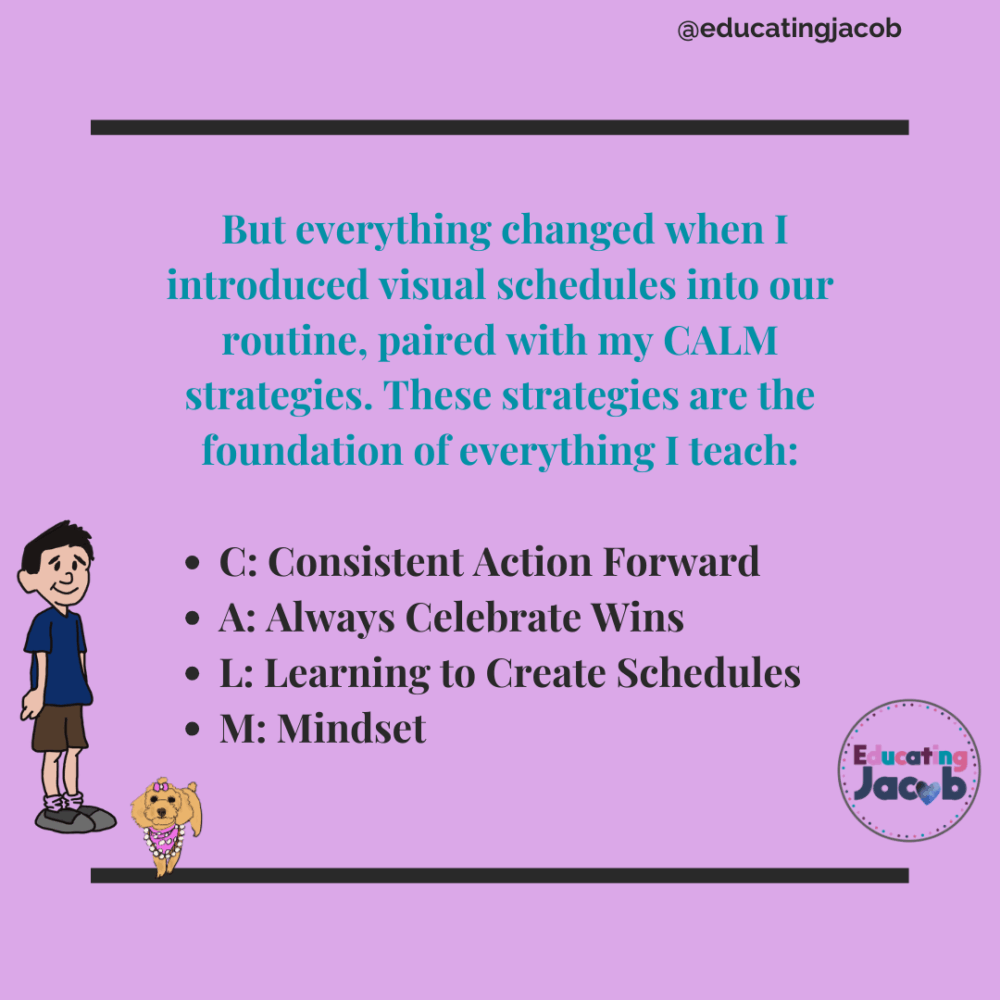
    Back-to-school season is always a unique experience when you’re living on Autism Island. For those of us teaching children with autism, whether at home or in the classroom, it’s a time to revisit the strategies that keep our kids on track and help them thrive. This journey is all about finding what works and sticking with it—what I like to call C-consistent A-action L-learning M-mindset, or “CALM” for short. I’ve talked about this framework before on Educating Jacob, https://educatingjacob.com/blog/, and today, I’m diving deeper into how it shapes our back-to-school routine. 🌟

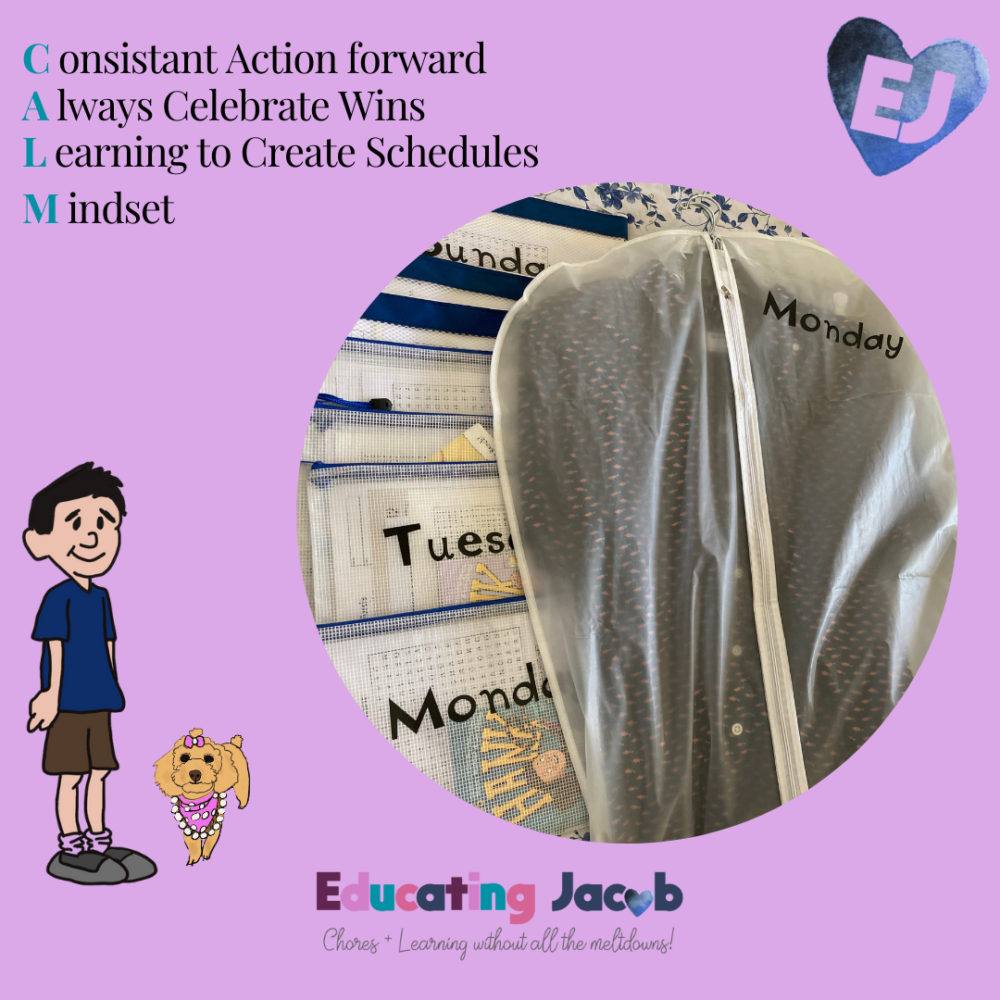
    CALM-frameworks-for-picture-with-school-work
    These zippered bags contain the days work and the garment bag holds the sensory friendly clothes!

    C – Consistent Action Forward 🛤️

    Here’s the truth: No progress happens without a plan.

    Jacob thrives with a visual schedule that lays out his entire day, and I update it weekly. He knows what to expect before I even say a word—and that reduces anxiety, resistance, and confusion before it starts.

    Here’s what works for us (and might for you too):

    • Use picture icons or short words for each task.
    • Show both work and breaks—yes, snack time counts!
    • Post it somewhere visible, like on the fridge or a clipboard.
    • Review it together every morning before starting.

    🎯 Parent Tip: Start with just the first half of the day if a full schedule feels overwhelming. A small win is better than no win! 💪

    Autism Diagnosis: My Home Was in Chaos and I Felt Like a Terrible Mom!

    A – Always Celebrate Wins 🎉

    Jacob is not a fan of getting things wrong—and let’s be honest, who is? That’s why we build his independence slowly by practicing new tasks together first, using:

    • Video modeling 📱
    • Prompting (verbal, visual, even hand-over-hand ✋)
    • Positive reinforcement (aka a happy dance from mom)

    Once he’s confident, that task goes into his independent work basket, and when he completes it solo?

    🥳 We celebrate like it’s New Year’s Eve.
    Not with glitter (because sensory issues) but with high-fives, favorite snacks, and “Good job, Jake!” cheers that make his face light up.

    🎯 Parent Tip: Write down 3 things your child did well today—and tell them out loud. Celebrate the effort, not just the result.

    L – Learning to Create Schedules 🗓️

    This one’s a biggie: A child with autism needs to SEE their day.
    Not guess. Not be told repeatedly. Not wait in limbo.

    Jacob’s visual schedule is not optional—it’s his anchor.

    Here’s how we make it work:

    • Clear start and end times (“Work time” followed by “Free time”)
    • Visuals that match his understanding level (PECs, real photos, or printed icons)
    • Include “finished” boxes or check marks so he can see his own progress

    🎯 Parent Tip: Don’t overcomplicate it! A whiteboard with sticky notes can be life-changing. You don’t need fancy tech to create CALM. 📅

    M – Mindset Matters 🧠

    This one’s for you, parent or teacher. 💛

    On Autism Island, even a good day can be exhausting. You might feel like you’re constantly “on.” But your mindset matters as much as the structure.

    So here’s your permission slip:
    Give yourself grace.
    Go slow to go fast.
    Take breaks before you break down.

    And tell your child:
    “You are a learner. You can do hard things. And I’m here to help.”

    🎯 Parent Tip: Start your day with 2 minutes of quiet, prayer, or even a coffee in the car. Reset your own nervous system before supporting your child’s. Here is another blog for adults on the spectrum: https://www.psychreg.org/jo-luck-all-things-autism/

    🧩 Our Autism Island Back-to-School Checklist:

    Here’s what we keep on deck every August:

    • ✅ Visual Schedule printed and posted
    • ✅ Work folders/binders ready with mastered tasks
    • ✅ Break items stocked (Chloe, chewy snacks, music, sensory bin)
    • ✅ Timer or clock visible (we love our Time Timer!)
    • ✅ Parent mindset reminders in the planner—because I need encouragement too


    Final Thoughts from the Island 🏝️

    Back-to-school doesn’t have to mean back to chaos.
    It can mean forward into structure.
    Forward into small wins.
    Forward into calm.

    This year, try the CALM Framework as your compass:
    Consistent Action Forward
    Always Celebrate Wins
    Learning to Create Schedules
    Mindset Matters

    We’re still learning too—and if no one has told you today, you’re doing an amazing job. Parenting a Child with Autism Level 2-3 Can Be Ra Ra Rough! Stay CALM

    Let’s take on this school year together, one structured, snack-filled, schedule-supported day at a time. 💪📚


    Read More

  • When Migraines Hit: How This Autism Mom Survived the Day (And You Can Too)

    Autism-Parent-Stress-Management
    Self-care for autism parents!

    How This Autism Mom Survived the Day


    Picture this: You wake up and your skull feels like it’s in a vise grip. Your teeth are throbbing. Even the thought of light makes you nauseous. But there’s no calling in sick when you’re parenting a child with autism. 😵‍💫

    Sound familiar? Why Hurting My Back and Foot Was So Scary: A Parent’s Journey with Autism

    I lived this exact scenario last Tuesday—and here’s what saved both my sanity and our day. These autism parent stress management techniques became my lifeline when I needed them most. 🛟

    Autism Parent Stress Management
    Autism Daily Routines = Independence

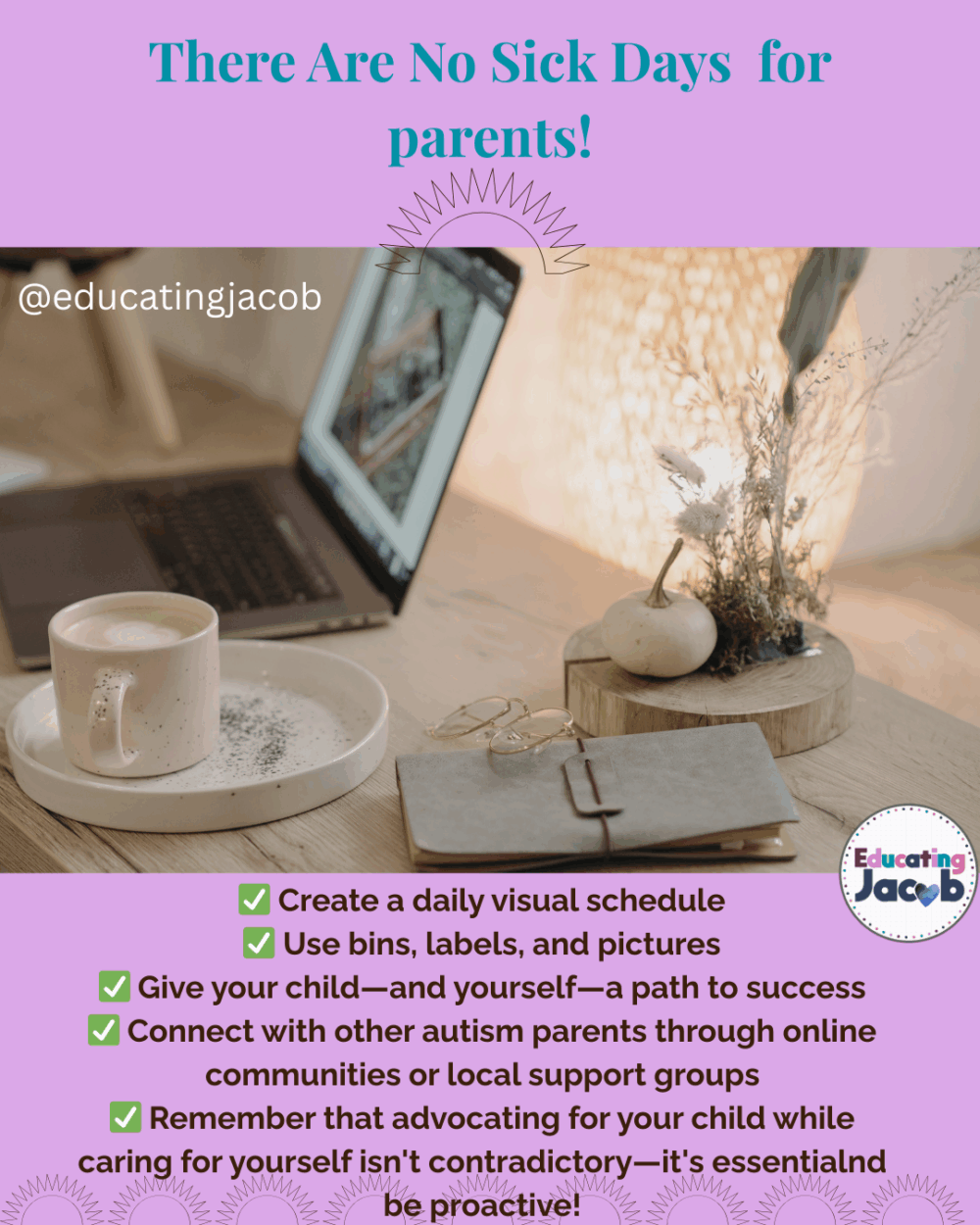
    The Reality of Autism Parenting: There Are No Sick Days 🚫🏠

    Here’s what most people don’t understand about raising a child with autism: every single day requires intention. Good days need structure. Hard days need structure. Days when you can barely lift your head off the pillow? They need the most effective autism parent stress management strategies you can find. 📅

    Research shows that children with autism are more likely to experience migraines and headaches than their neurotypical peers—but what about the parents? Between the constant vigilance, sensory overwhelm from our children’s needs, and chronic stress of navigating systems that weren’t built for our families, developing strong autism parent stress management skills becomes crucial for survival. 🧘‍♀️

    When my migraine hit, I had two choices: panic or rely on the autism daily routines and stress management systems I’d already built. ⚖️

    I chose systems. ✅

    The CALM Framework: Proven Autism Parent Stress Management 🌟

    Let me share what actually worked—not the Instagram-perfect version, but the real, messy truth of surviving when your body says “no” but your child still needs you. This autism parent stress management approach is battle-tested! 💯

    C: Consistent Routines Already in Place 🔄

    Jacob has Level 2/3 autism. He communicates through short phrases, movie quotes, and lots of pointing. On a good day, this requires patience. On a migraine day? It could have been a disaster without proper autism parent stress management in place. 😰  Summer Structure = School Success: Why Kids with Autism Need Predictable Routines Now!

    But here’s the thing: we’d already practiced this through our autism daily routines. 🎯

    ✅ His work bags were prepped for the entire week (Sunday prep saves Wednesday chaos) 📦 ✅ Visual schedules were posted and familiar 📋 ✅ His daily routine was so predictable that he could navigate it independently 🚶‍♂️

    When I curled up on the couch with an ice pack, Jacob didn’t panic. He looked at his visual schedule, grabbed his work bag, and got started. No meltdowns. No confusion. Just calm consistency. This is what effective autism parent stress management looks like in action! 🧊💙

    The Reality Check: When Preparation Saves You ⚠️

    I’ll be honest—there have been days, even recently, when I didn’t do what I should have. The zippered work bags weren’t put together in advance. The haircut that was scheduled got ignored. Sometimes you can get away with that and survive because you have wiggle room in your autism daily routines. 🤷‍♀️

    Once the routine is built and everyone understands how to work through the schedule, things can be changed without bad results. If I had woken up with that migraine and Jacob wanted a haircut, I could have easily changed the schedule to reflect another day without much of a problem—if his hair wasn’t overgrown and the cut hadn’t already been put off. In other words, if it wasn’t already on his nerves. 💇‍♂️

    But here’s what would have been a disaster: if he had come to me with an empty work bag while I was dealing with a pounding headache. I would have had to put that together even though I wasn’t feeling well, probably making both of us stressed and frustrated. 😵‍💫

    The Truth About Autism Parent Stress Management:

    We are human and things won’t get done sometimes. But if we stop being prepared consistently, it will not end well. We WILL get caught on days when we desperately need a break, and then the whole family will experience the chaos. This is why building these autism daily routines isn’t just helpful—it’s essential for effective stress management. 🌪️➡️☮️

    A: Always Celebrate Small Wins 🎉

    That day, “winning” looked like: 🏆

    • Jacob following his schedule without prompting ✨
    • Getting pizza heated up without burning down the house 🍕
    • Both of us making it through the day without major meltdowns 😌

    These weren’t small wins—they were everything for successful autism parent stress management! 💪

    L: Learning Through Visual Supports 👀📚

    Jacob’s communication challenges mean that verbal directions on a migraine day would have been impossible. But visual schedules? They speak his language perfectly and are essential components of both autism daily routines and autism parent stress management. 🗣️

    His picture schedule showed: 📸

    • Morning routine ☀️
    • Independent work time 💼
    • Lunch break 🥪
    • Quiet activity time 🤫
    • Evening routine 🌙

    No interpretation needed. No repeated explanations required. 🙌

    M: Mindset Shift: Progress Over Perfection 🧠💭

    The old me would have pushed through the migraine, probably making myself sicker and definitely making Jacob’s day harder. The new me with effective autism parent stress management? I accepted that survival mode was enough. 🛡️

    We ate frozen pizza. We watched more screen time than usual. Jacob did his work independently while I rested. And you know what? It was exactly what we both needed—successful autism parent stress management in real life! 🍕📺✨

    Why Autism Parent Stress Management Matters for Your Family 👨‍👩‍👧‍👦💙

    Whether your child is 3 or 30, whether they’re newly diagnosed or you’ve been on this journey for years—you need autism daily routines and stress management strategies that work even when you don’t. 🔧

    Recent research indicates that approximately 20 to 50% of individuals on the autism spectrum suffer from migraine or frequent headaches, and the stress of autism parenting significantly increases the risk for parents too. This makes developing strong autism parent stress management skills absolutely essential! 📊⚡

    This isn’t about being a “perfect” autism parent. This is about being a human one with effective stress management tools. 💝

    Your Next Steps: Building Stress-Proof Routines 🛠️📝

    Start where you are with these autism parent stress management strategies: 🏁

    This Week: 📅

    • Create one visual schedule for your child’s most challenging time of day 📋✨
    • Prep something ahead (snacks, activities, anything that removes decisions from hard moments) 🥨🎨
    • Practice one transition when you’re feeling good so it’s automatic when you’re not 🔄

    This Month: 🗓️

    • Build work bags or activity boxes for independent time 📦🎯
    • Establish predictable autism daily routines for mornings and evenings ☀️🌙
    • Create a “stress management plan” for your hardest days (yes, actually write it down) 📝💡

    Beyond: 🚀

    • Remember that teaching independence to your child with autism isn’t just good for them—it’s essential autism parent stress management for your survival as their parent 💪👨‍👩‍👧‍👦

    The Science Behind Autism Parent Stress Management 🧠⚡

    Both autism and migraines involve sensory processing differences and shared neurological patterns. We’re not just imagining that this parenting journey is overwhelming our nervous systems! But here’s what research-backed autism parent stress management teaches us: 🤯

    The same structured, visual, predictable autism daily routines that help our children thrive also create space for us to be human. To have bad days.  Needing to rest. To practice effective stress management. 😴💙

    Your child with autism doesn’t need you to be superhuman. They need you to be consistent, prepared, and present, which is much easier when you have proven autism parent stress management strategies and aren’t forcing yourself to function through preventable chaos. 🦸‍♀️➡️👩‍💼

    routines that support your child with autism
    You need autism daily routines that work even when you don’t. 🔧

    Ready to Master Autism Parent Stress Management? 🌊➡️☮️

    I spent years believing that good autism parenting meant sacrificing my own wellbeing. That stress was just part of the job. That my needs always came last. 😔

    I was wrong. ❌  Parenting a Child with Autism Level 2-3 Can Be Ra Ra Rough! Stay CALM

    Building autism daily routines that support your child with autism AND create space for your humanity isn’t selfish—it’s strategic autism parent stress management. It’s how we go from surviving to thriving, even on the days when your head is pounding and you can barely see straight.  https://www.funsensoryplay.com/how-to-make-a-sensory-room-at-home/💡🎯

    Because here’s the secret: when you take care of yourself using proven autism parent stress management techniques, you’re modeling something crucial for your child with autism. You’re showing them that everyone, even caregivers has limits, needs support, and deserves care. 🤗💕

    That’s not just good parenting. That’s good life preparation. 🌱📚


    Want to dive deeper into building autism-friendly routines that work for the whole family? The CALM framework has transformed not just our hardest days, but our everyday life. Because every autism family deserves autism daily routines and stress management strategies that support both the child and the parent—especially when life throws you curveballs. 💙🏡✨

    Read More

  • How We Celebrate ASD Communication: Beyond Just Words

    autism-communication-strategies
    Your love and presence count more than the special degree you have!

    Because Connection Doesn’t Always Sound Like a Conversation

    If you’re an autism parent drowning in daily chaos, exhausted from trying to talk your child through meltdowns, transitions, and overwhelming routines… this post is your lifeline.

    Because sometimes words just aren’t the bridge to autism communication strategies that actually work.

    When Traditional Communication Strategies Fall Short

    I used to think that if I just kept talking, explaining, and redirecting, Jacob would eventually understand. But all my talking felt like white noise to him—and let’s be honest, it made both of us more frustrated and stuck in that familiar cycle of autism anxiety.

    Jacob, my incredible son with level 2-3 autism, doesn’t communicate like most people. Words can be overwhelming, delayed in processing, or completely bypassed when anxiety is high. And trust me, high anxiety was our baseline for a long time—that suffocating feeling where every day felt like survival mode.

    The turning point? Realizing that autism communication strategies go far beyond words. And Jacob? He was already communicating—through behavior, gestures, looks, routines, and preferences.

    I just needed to listen differently and learn his language.

    Your Parent Bond is More Powerful Than Any Degree

    Here’s something I wish someone had told me back then: You don’t need a degree to connect with your child using effective autism communication strategies.

    Yes, I went back to school and got my degree in special education after Jacob’s diagnosis—but that paper didn’t unlock the magic. What really mattered was learning to see Jacob’s world, his signals, and his communication—his way.

    And guess what? You already have something more powerful than any credential:

    ➡️ The unbreakable bond you have with your child ➡️ Your commitment to figuring out what works ➡️ Your daily, relentless love that doesn’t quit

    You don’t need to be perfect. You need to be present and willing to try autism communication strategies that meet your child where they are.

    A-visual-schedule-gave-Jacob-a-language-he-could-understand
    Visual Schedules = Independence

    What We Celebrate in Our Autism Communication Journey 🎉

    We celebrate communication in all its beautiful, non-traditional forms:

    Pointing to the schedule. ✅
    Taking your hand to lead you. ✅
    Using a picture card or tapping on a device.✅
    Even repeating phrases they heard on YouTube (yep, echolalia counts—it has purpose!).✅

    And when Jacob started following his visual schedule consistently using our autism communication strategies—that’s when everything shifted. That’s when the chaos began to melt. That’s when the daily power struggles transformed. That’s when we finally started feeling like a team instead of opponents.

    Here’s another site you might like:https://specialedresource.com/keep-your-child-calm-while-at-home-with-adhd-autism-high-energy

    Our Game-Changing Autism Communication Strategies: Visual Schedules 📅

    Jacob thrives with fewer words and more structure. Why? Because visual schedules take the mystery out of his day and become one of the most effective autism communication strategies we’ve ever implemented.

    They give him:

    • A sense of control over his environment
    • Crystal-clear expectations
    • Immediate anxiety relief
    • No more guessing games about what’s next

    That’s why I built our CALM System, starting with the L: Learning to Create Schedules. It’s not just about stickers and pictures—it’s about creating a roadmap your child understands using proven autism communication strategies.

    structure-in-action-CALM
    Structure = Calm

    How Our CALM Framework Transformed Our Daily Life

    Our autism communication strategies helped us:

    Getting Started: Simple Autism Communication Strategies You Can Try Today

    If you’re reading this wondering where to begin with autism communication strategies, start here:

    Step 1: Observe Your Child’s Natural Communication

    Watch how your child naturally communicates—remember, behavior IS communication! Notice their patterns, triggers, and what they’re trying to tell you.

    Step 2: Reduce Words, Add Visuals

    Even just 3-4 picture steps can be a complete game-changer. Less talking, more showing.

    Step 3: Celebrate Every Small Win

    Eye contact, a pointed finger, following one step of a routine—every step forward is still forward, and these small wins build into major breakthroughs.

    Step 4: Stay Consistent

    Autism communication strategies work best when they’re part of your daily routine, not just crisis management tools.  How to reduce chaos at home with an autistic child using my CALM frameworks.

    You’re Not Alone in This Autism Communication Journey

    If you’re ready to ditch the chaos and implement autism communication strategies that actually work, grab our free CALM Visual Schedule Starter Kit and start creating a calm foundation at home today.

    This isn’t about perfection—it’s about connection, understanding, and giving your child the tools they need to thrive.

    Final Thoughts from One Autism Mom to Another ❤️

    Friend, I’ve been exactly where you are—sitting in the parking lot crying, wondering if anything will ever get easier, questioning if these autism communication strategies will work for YOUR child.

    But slowly, with the right tools, support, and faith in your child’s abilities, it does get easier. The chaos transforms into calm. The power struggles become partnerships. And those autism communication strategies that felt impossible? They become second nature.

    You’ve got this, and you’re not walking this path alone. 💙

    Ready to transform your daily chaos into calm? Download our free CALM Visual Schedule Starter Kit and start implementing these autism communication strategies today.

    Read More