Blog

  • Sensory-Friendly Strategies for Autism: Enjoy a Calm, Joyful Easter Holiday!

    Easter-activities-for-autistic-children-
    #EasterWithAutism

    If you’ve ever watched your autistic child melt down during an Easter egg hunt — the noise, the chaos, the pressure to perform — you already know that holidays don’t come with an autism-friendly instruction manual.

    You’re not alone. And you’re not doing it wrong.

    When Jacob was younger, Easter looked a lot less like a Hallmark movie and a lot more like survival mode. Too many people, too much noise, too many expectations that nobody had thought to prepare him for. I loved the holiday. He dreaded it. And that gap broke my heart every single spring. Unlocking the Easter Joy: A Guide to Teaching Children with Autism about Easter

    What changed everything wasn’t a bigger Easter basket or a better egg hunt location. It was preparation. Simple, visual, consistent preparation. Once I started building the holiday toward Jacob instead of dragging him into it, Easter became something he actually looked forward to.

    In this post, I’m sharing the exact strategies our family uses — rooted in my background as a special education teacher and refined through years of real life on what I call Autism Island. Whether you’re brand new to autism parenting or just looking for fresh ideas, these Easter strategies for autistic children can help your family exhale a little this season.

    Why Easter Can Be Hard for Autistic Children (And Why That’s Not a Character Flaw)

    Before we get to the how, it helps to understand the why. Easter is a holiday loaded with sensory and social demands that can genuinely overwhelm an autistic child:

    • Unexpected schedule changes from a typical routine
    • Noisy, crowded gatherings with extended family
    • Unfamiliar foods, textures, and smells
    • Abstract concepts (resurrection, new life) that are hard to make concrete
    • Social pressure to perform — hug people, say thank you, act excited
    • Sensory overload from scratchy Easter outfits, bright decorations, or loud environments

    None of these things mean your child is broken or that your family is failing. They mean your child’s nervous system is working exactly as it was wired, and your job is to build a bridge — not bulldoze a path.

    “The strategies that made Easter possible for Jacob weren’t complicated. They were just intentional.”

    Step 1: Build a Visual Schedule for Easter Morning

    Visual schedules are the single most effective tool I’ve used with Jacob — both as his mom and as a special education teacher. For autistic children, uncertainty is often more distressing than the actual event. A visual schedule removes the uncertainty.

    For Easter specifically, I recommend creating a simple, picture-based schedule that covers the entire day from wake-up to bedtime. Here’s what Jacob’s Easter schedule has looked like:

    • Wake up
    • Eat breakfast (familiar foods first)
    • Get dressed
    • Easter basket time at home
    • Egg hunt (with a visual showing where we’re going)
    • Family gathering (show whose house, how many people)
    • Quiet break
    • Dinner
    • Home and wind-down routine

    The key is predictability. Your child doesn’t need every surprise removed from Easter — they need to know the shape of the day so their brain can stop bracing for impact.

    If you’re not sure where to start with visual schedules, my free Visual Schedule Starter Kit walks you through exactly how to build one, even if you have zero design experience. You can grab it at the link below.

    Step 2: Use a Social Story to Prepare Your Child Before Easter Arrives

    A social story is a short, simple, first-person narrative that walks your child through what’s going to happen and what’s expected of them. Carol Gray developed this approach specifically for autistic children, and it’s been a cornerstone of our Easter prep for years.

    Your Easter social story might cover:

    • What Easter is and why your family celebrates it
    • What an egg hunt looks like and how it works
    • Who will be at the family gathering and what the house will look like
    • What your child can do if they feel overwhelmed
    • What a successful Easter day looks like for your family

    Start reading the story 3–5 days before Easter, not just the morning of. Repetition is what makes social stories work. By the time Easter arrives, your child’s brain has already rehearsed the day.

    For families who celebrate the religious meaning of Easter, books like Max Lucado’s The Easter Story for Children can help make abstract theological concepts more concrete and age-appropriate.

    Easter-activities-for-autistic-children-
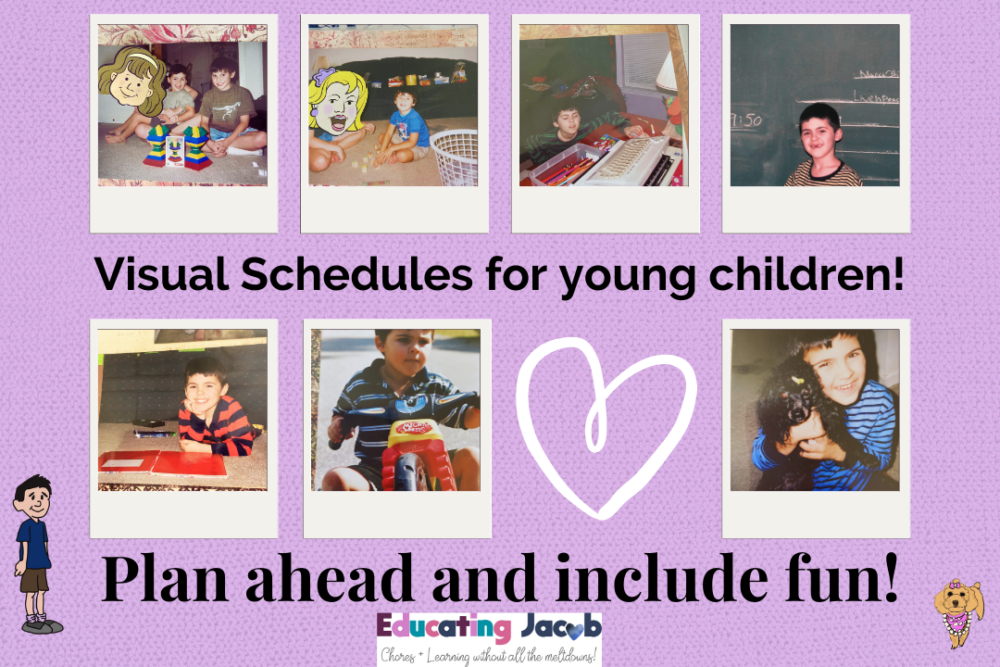
    Use social stories, video and visual schedules to prepare!

    Step 3: Adapt the Egg Hunt to Actually Work for Your Child

    The traditional Easter egg hunt is chaos by design — kids scrambling, adults cheering, everyone moving fast. For many autistic children, this is a sensory nightmare dressed up in pastels.

    Here’s how to adapt the egg hunt so your child can actually participate and enjoy it:

    Modify the Environment

    • Choose a familiar location (your own backyard is gold)
    • Hunt with just your immediate family before any larger gathering
    • Set clear physical boundaries for where eggs are hidden
    • Reduce noise by keeping the group small

    Modify the Hunt Itself

    • Use color-coded eggs so your child knows which ones are “theirs”
    • Try a “reverse egg hunt” where your child hides eggs instead of finding them
    • Offer eggs with different sensory elements (textured, light-up, ones that make sounds)
    • Give your child a visual showing how many eggs they’re looking for and where to start

    Fill the Basket with Purpose

    Jacob’s Easter basket has never looked like a Pinterest board. It looks like Jacob. Fidget tools, sensory items, and a few of his favorite snacks alongside any traditional treats. That simple shift from “traditional Easter basket” to “Jacob’s Easter basket” helped him feel seen. That’s the whole goal.

    Step 4: Set Your Family Gathering Up for Success

    Extended family gatherings are often where Easter goes sideways for autistic children. And honestly? For autism parents, too.

    Here’s what has helped our family navigate Easter with extended family:

    • Communicate ahead of time.
    • Designate a quiet space.
    • Set a time limit and stick to it.
    • Have an exit plan.
    • Bring familiar foods.

    Let me say a little more about each:

    Communicate ahead of time. A brief, kind heads-up to family members — “Here’s what helps Jacob thrive at gatherings” — goes a long way. You don’t need to write a dissertation. Just the basics.

    Designate a quiet space. When we arrive somewhere new, the first thing I do is find or create a low-stimulation space where Jacob can retreat if he needs to decompress. A bedroom with the door cracked, a corner with headphones — whatever the space allows.

    Set a time limit and stick to it. Promising your child you’ll leave by 3pm means nothing if you stay until 6. Honor what you said. This builds trust.

    Have an exit plan. Agree on a word or signal with your child that means “we’re leaving soon.” This gives them agency and reduces the panic of unexpected transitions.

    Bring familiar foods. Holiday meals are full of unfamiliar textures and smells. Pack one or two foods you know your child will eat so they’re never stranded without a safe option.

    Step 5: Make the Religious Meaning of Easter Accessible

    For those of us who celebrate Easter as a faith holiday, finding ways to make the meaning of the resurrection accessible to our kids is important. And it’s possible — it just takes a little creativity.

    What has worked for our family:

    • Using concrete objects to represent parts of the Easter story (a stone, a cloth, flowers)
    • A Lent calendar or visual wreath to track the journey leading up to Easter
    • Age-appropriate books with illustrations that anchor abstract concepts
    • Short video resources made specifically for children with different learning styles
    • Simply telling the story in plain, direct language without pressure to “get it all” right now

    Jacob’s understanding of Easter has grown over many seasons. There is no deadline. God’s faithfulness doesn’t hinge on how quickly our children can articulate theological concepts. We plant seeds and trust the process.

    CALM-framework-for-Easter-
    Parenting autism without chaos!

    The CALM Framework: How We Navigate Every Holiday, Including Easter

    Everything I’ve shared above lives inside the framework I use with every holiday and every new challenge we face as an autism family. I call it the CALM Framework:

    C — Consistent Action Forward. Small, steady steps every day. You don’t have to overhaul everything before Easter arrives. Pick one strategy and start there.

    A — Always Celebrate Wins. Your child wore the Easter outfit without a meltdown? That’s a win. They tried one new food? Win. They made it to the egg hunt? Win. We celebrate what actually happened, not what we wished had happened.

    L — Learning to Create Schedules. Visual schedules aren’t just an autism tool — they’re a communication bridge. They say to your child: I thought about you. I planned for you. You are safe here.

    M — Mindset. You are not behind. You are not failing. You are learning how to love your child well in a world that wasn’t designed for them. That is not small. That is everything. 4 ways overwhelmed autism parents can move from chaos to CALM! Autism Family Life

    One More Thing Before You Go

    Easter doesn’t have to be perfect to be meaningful. It doesn’t have to look like anyone else’s Easter photos. It just has to be yours — thoughtfully shaped around the real child in front of you.

    I’ve spent years figuring out what that looks like for Jacob, and I want to help you figure out what it looks like for your child. That’s the whole reason Educating Jacob exists.

    If you’re not sure where to start, grab the free Visual Schedule Starter Kit. It’s the foundation of everything else, and it takes less than an afternoon to put into practice.

    And if you’re looking for a community of parents who actually get it — the exhaustion, the grief, the stubborn hope — the Autism Thrive Tribe is your people. Come find us.

    Because every child deserves to learn. And every parent deserves to hope.

    Wishing your family a peaceful, chaos-free Easter. — Melissa

    Read More

  • When Autism Parenting Gets Hard: Why I Chose Not to Give Up on My Son

    Raising-a-child-with-autism
    Choose your Hard, here was a season of Homeschool!

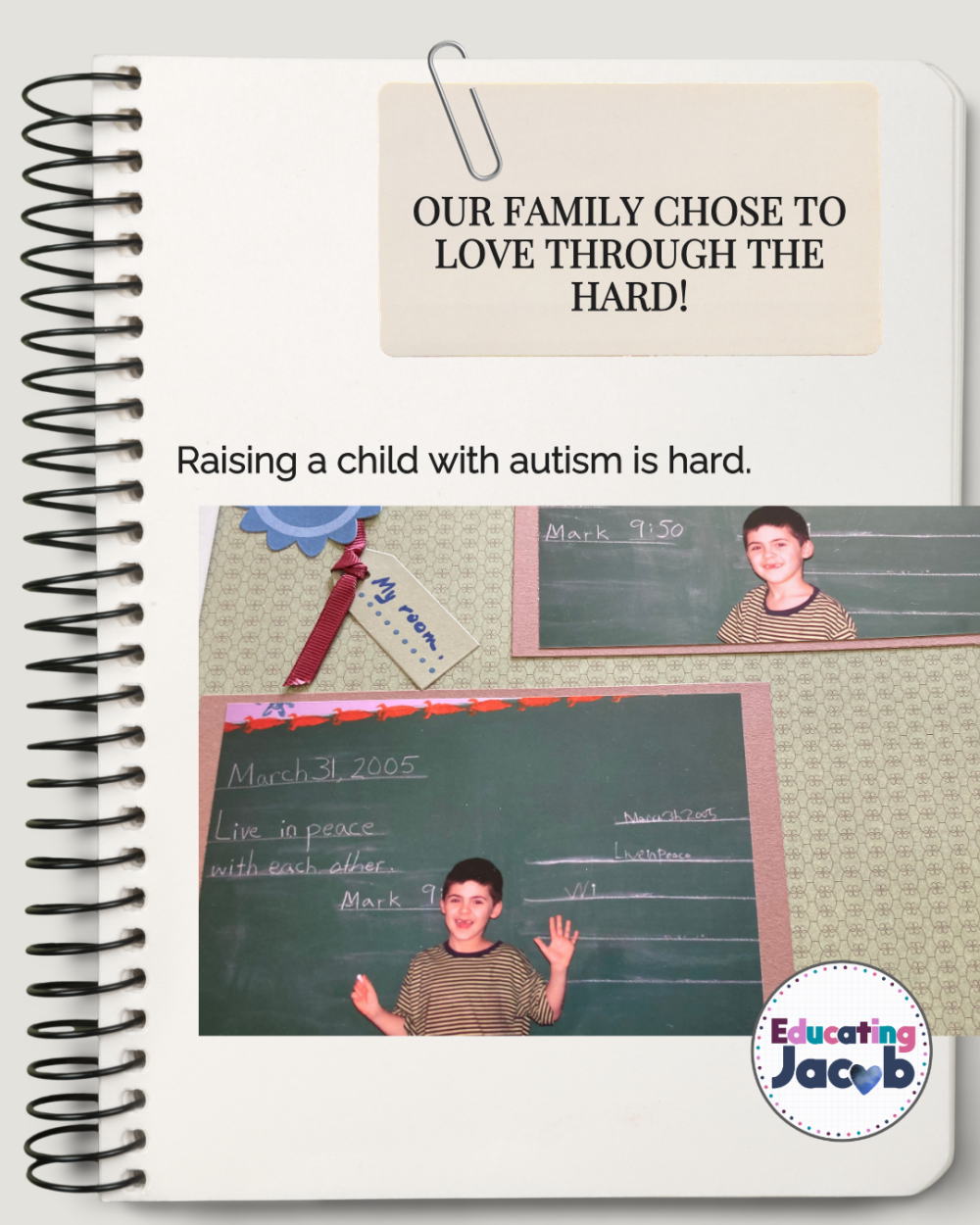
    Raising a child with autism can be beautiful, exhausting, heartbreaking, and hopeful all at the same time. There are days filled with laughter and connection, and there are days when everything feels heavy.

    If you are in one of those heavy seasons right now, I want you to know something important.

    You are not alone.

    There were seasons in our life with Jacob when I cried more than I talked about. I researched everything I could find. I questioned myself as a mother. I felt overwhelmed and even depressed at times.

    But one thing never changed.

    I could not and would not give up on my son. This too shall pass, how we changed our mindset on autism island!

    When Raising a Child With Autism Feels Overwhelming

    When Jacob was younger, I often felt like I was constantly searching for answers.

    I read books.
    I researched therapies.
    I tried different approaches.

    My confidence as a mom took a hit because I wanted so badly to help him, and sometimes it felt like nothing was working.

    When I didn’t know what else to do, I made a big decision.

    I went back to school and earned my master’s degree in special education, hoping it would help me better understand autism and help me parent Jacob more effectively.

    Education helped me learn strategies. But the truth is something deeper carried our family forward.

    We refused to give up on each other.

    Raising-a-child-with-autism-2-
    Jacob’s journey has never been walked alone.

    Our Family Chose to Love Through the Hard

    Jacob’s journey has never been walked alone.

    Our family stood together.

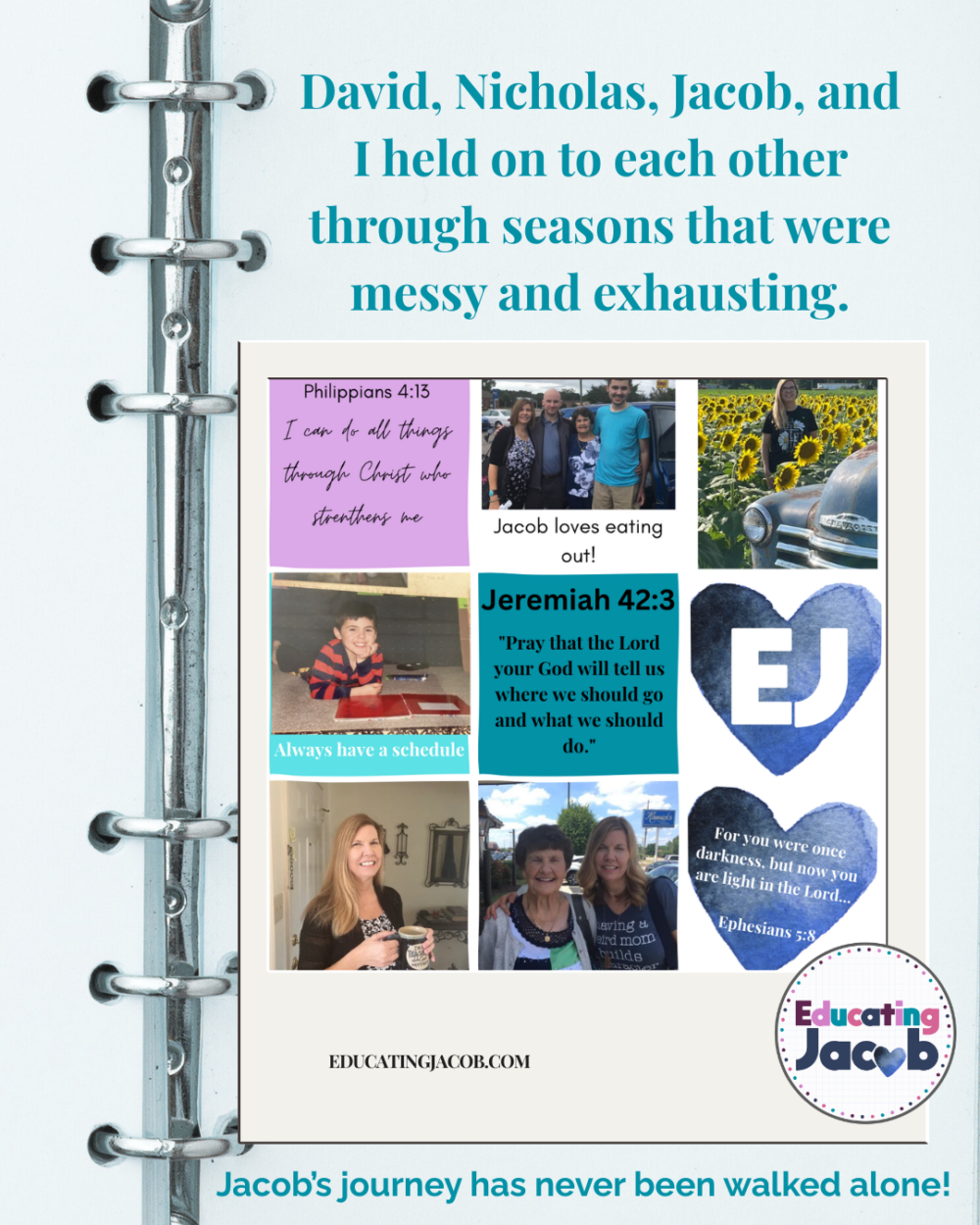
    David, Nicholas, Jacob, and I held on to each other through seasons that were messy and exhausting.

    Sometimes we supported each other with energy and determination.

    Other times we simply hugged each other because that was all we had left.

    We prayed.
    We studied.
    We tried again.

    But we never gave up.

    Trying Everything While Raising a Child With Autism

    Like many autism families, we tried many different things hoping something would help.

    We explored:

    • Special diets
    • Different strategies
    • New routines
    • Various therapies

    Some things helped. Some things didn’t.

    But something surprising happened along the way.

    The biggest progress often came from the smallest changes.

    Using-Autism-Schedules-
    I honestly did not believe that something as simple as visual schedules would help our family.

    The Small Things That Changed Everything

    At one point, I honestly did not believe that something as simple as visual schedules would help our family.

    It seemed too small to make a difference.

    But we tried them anyway.

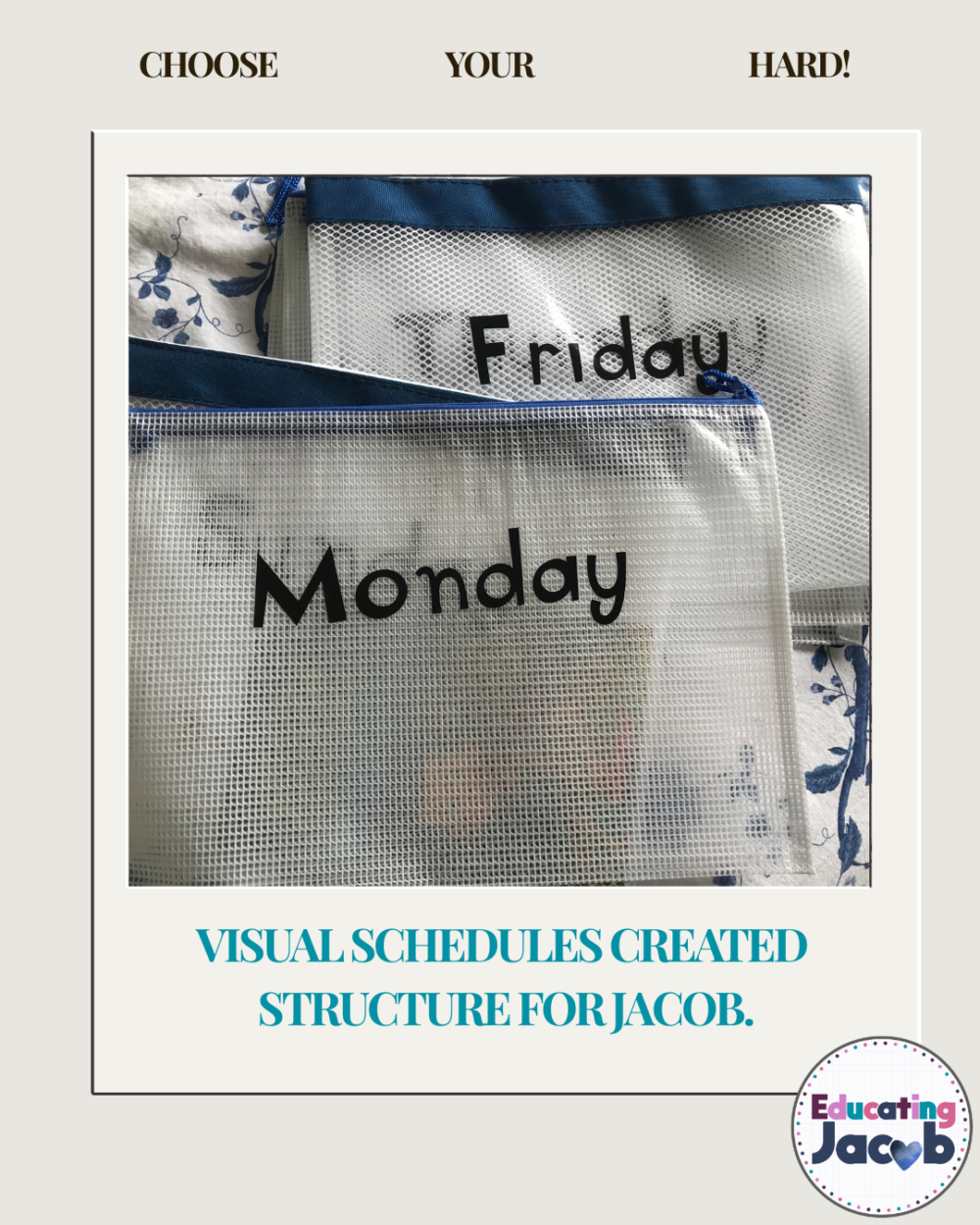
    Visual schedules created structure for Jacob. They helped him understand his day. They reduced anxiety and made transitions easier.

    We also focused on routines, nutrition, and most importantly, our mindset as a family.

    Those small steps did not fix everything overnight. But over time they helped replace chaos with calm.

    Choose Your Hard When Raising a Child With Autism

    There is a phrase that has stayed with me over the years.

    Choose your hard.

    Exercise is hard.
    Living with disease from not exercising is hard.

    Saving money is hard.
    Living with financial stress is hard.

    Autism can be hard for the child.
    Autism can be hard for the family.

    So we had to choose our hard.

    We could give in to exhaustion and let life happen to us.

    Or we could choose the hard work of moving forward, learning, adjusting, and trying again.

    We chose to keep moving forward.

    The CALM Framework Became Our Way Forward

    Over time, the lessons our family learned became the CALM Framework that now guides both our home and my classroom.

    C – Consistent Action Forward

    We kept taking the next step even when progress felt slow.

    A – Always Celebrate Wins

    Small victories matter. Independence grows one step at a time.

    L – Learning to Create Schedules

    Schedules helped bring structure to Jacob’s world and calm to our home.

    M – Mindset

    The most important piece of all was believing that we would keep going, even when things were hard.

    Life Can Get Better When You Keep Moving Forward

    Raising a child with autism is not about finding a perfect solution.

    It is about building systems that support your child and your family over time.

    Today our life looks different than it did in those early chaotic seasons.

    We still face challenges. Autism and epilepsy are part of Jacob’s life and always will be. But we have learned how to move forward with structure, patience, and hope.

    Jacob continues to grow in independence. Our family has time for rest, laughter, and even fun again.

    And we continue to adjust as each new season comes. How to replace Chaos with Calm, plays for the long game! #autismschedules

    If Autism Parenting Feels Hard Right Now

    If you are raising a child with autism and things feel overwhelming today, please hear this.

    You are not alone. https://www.facebook.com/groups/1093600039340070

    You do not need to solve everything today.

    Just take the next step forward.

    Try something new.
    Celebrate small wins.
    Lean on your support system.

    And when things feel impossible, remember this:

    You do not have to give up.

    “I can do all things through Christ who strengthens me.”
    Philippians 4:13

    Read More

  • How to replace Chaos with Calm, plays for the long game! #autismschedules

    Using-Autism-Schedules
    Visual schedules and autism can replace chaos with calm.

    How to Replace Chaos With Calm

    By Melissa | Educating Jacob

    When you’re in the thick of autism parenting and navigating meltdowns before 8 a.m., dreading every transition, bracing for the next hard moment — it can feel impossible to think past today.

    I know that place well. For years, survival mode wasn’t a phase for our family. It was just Tuesday.

    But over time, something shifted for me — not because life got easier, but because I stopped asking “How do we get through today?” and started asking a bigger question:

    What kind of life do we want Jacob to have? And what are we building toward, right now, to get him there?

    That question changed everything.

    using autism schedules
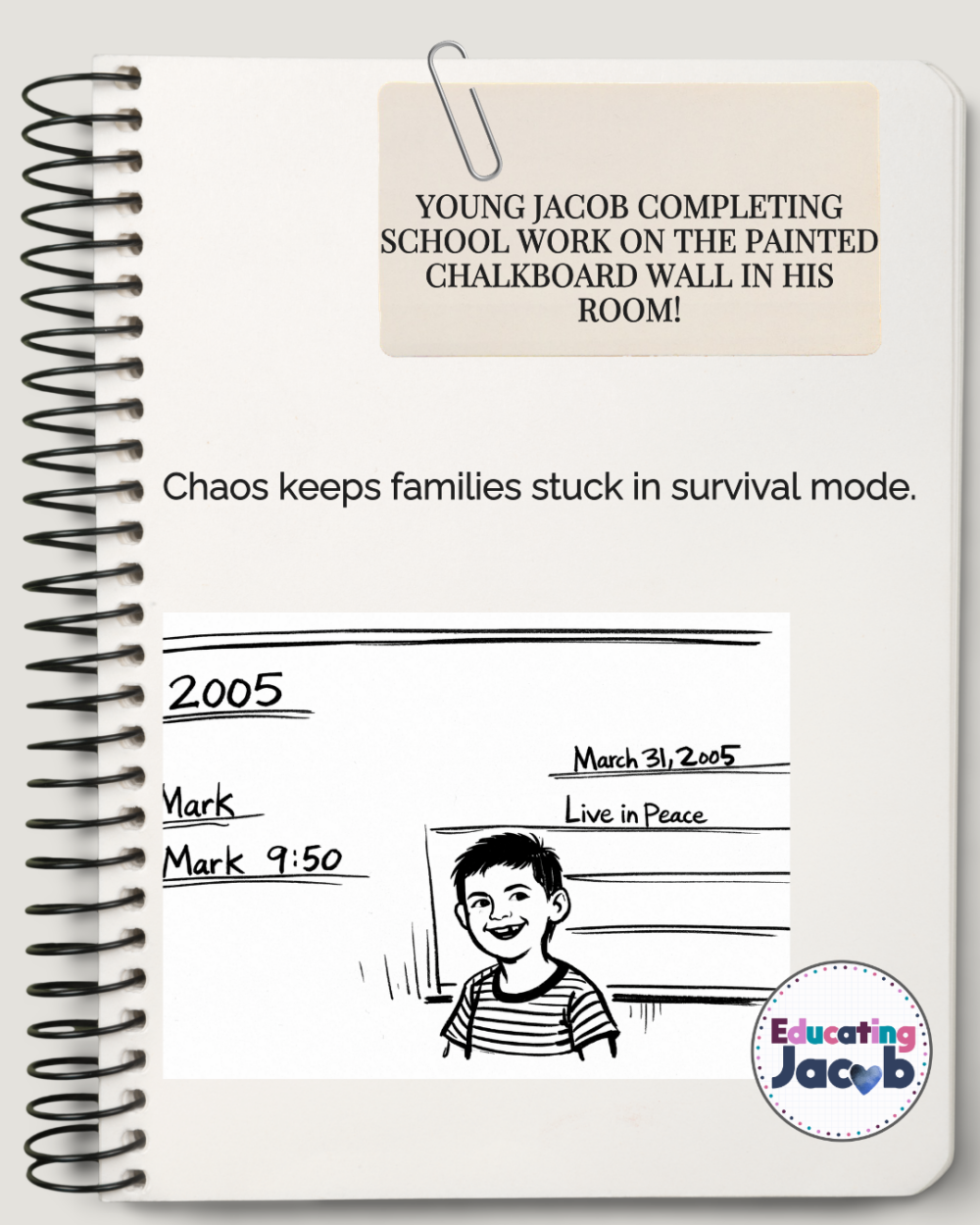
    Chaos keeps families stuck in survival mode. You need growth not survival tricks!

    The Long Game I’m Playing With Jacob

    Jacob is 28 now. He has Level 2 autism and epilepsy, our dog Chloe is always a nice distraction and social support for us. Jacob will always need support — that’s not something I’m trying to fix or ignore. Safety matters. Structure matters. Supervision matters.

    But here’s what I know for certain: my goal has never been to keep Jacob dependent on us forever.

    Our long game looks like this:

    Jacob has an older brother, Nicholas, who will be there for him when we’re gone. That matters more than I can put into words. But I never want Jacob’s life to feel like a burden placed on someone else’s shoulders.

    So we think long term. We dream about having a tiny house behind our home someday — a space where Jacob can have his own routines, his own privacy, his own slice of independence, while still being close enough for us to step in when he needs us.

    Independence with support, not independence alone. That’s the goal.

    And if you’re an autism parent reading this, I’d bet that’s your goal too.

    Why Schedules Are a Long-Game Strategy (Not Just a Daily Survival Tool)

    Here’s something I’ve said to countless parents over the years, both as a mom and as a special education teacher: visual schedules are not just about keeping today running smoothly. They are life skill training.

    When chaos ruled our days — and it did for a long time — Jacob was constantly reactive. His anxiety was high. Every transition felt like a battle. Independence felt like a distant, maybe even impossible, dream.

    Schedules changed that.

    Not overnight. Not perfectly. But gradually, consistently, they gave Jacob something he desperately needed: a way to understand what comes next.

    And that’s everything for a child whose brain is wired to struggle with uncertainty.

    As a special ed teacher, I’ve watched this same transformation happen in classrooms over and over. The child who can’t make it through morning circle without a meltdown — once a visual schedule is in place, once they can see the shape of their day — something settles in them. The anxiety doesn’t disappear, but it has somewhere to go. How a Visual Schedule for Autism Gave My Son Independence 📅✨

    Schedules gave Jacob a way to:

    🗓️ Know what was coming next without having to ask or guess

    ✅ Practice the same skills in small, repeatable ways until they became automatic

    🧠 Lower his anxiety simply by reducing uncertainty

    🌱 Build toward independence one predictable routine at a time

    That’s the long game.

    Visual-schedules-for-the-win
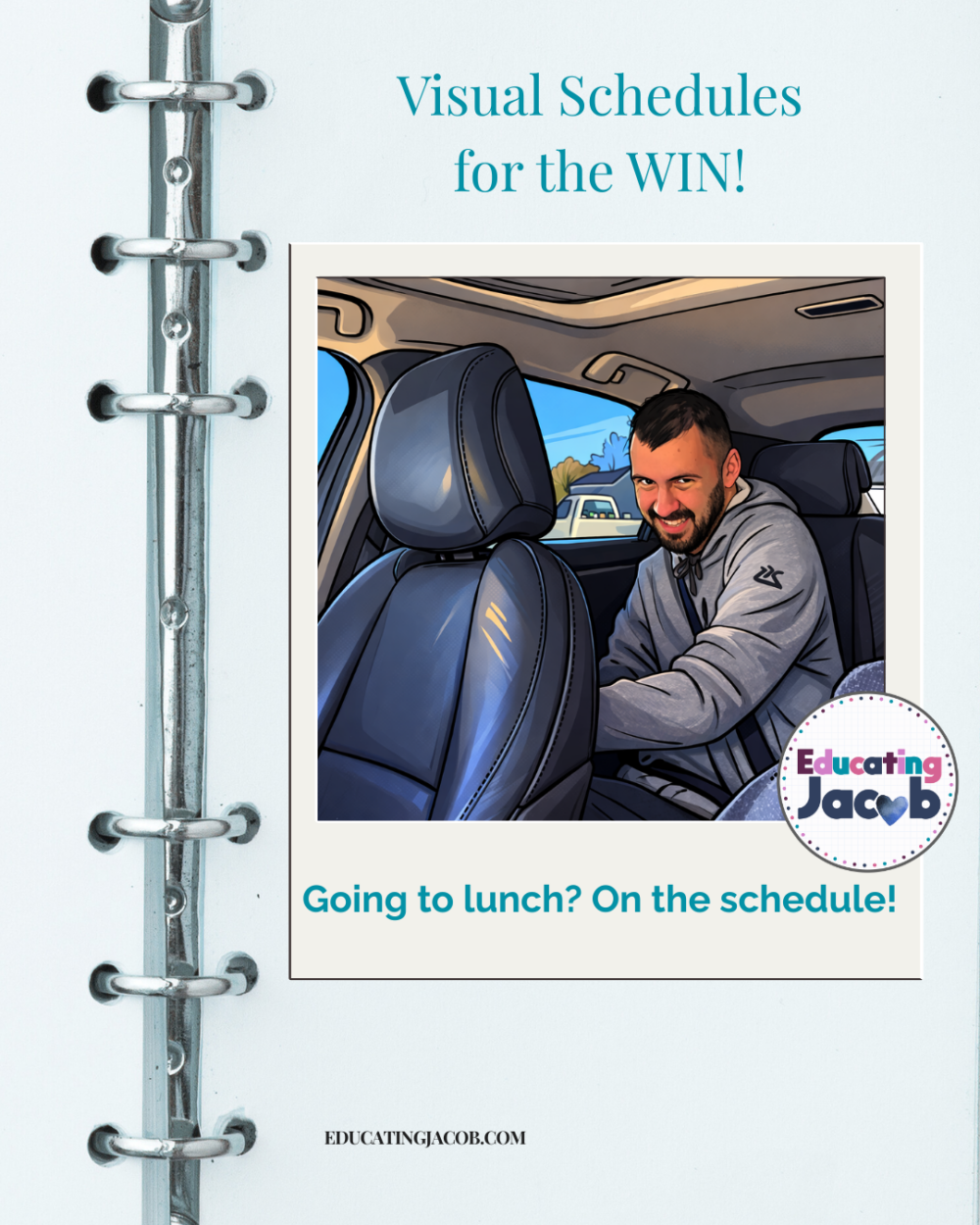
    Jacob is all smiles going out for lunch! It’s on his daily schedule.

    Using the CALM Framework to Replace Chaos With Calm

    Everything I do — both with Jacob at home and in the resources I create for parents — flows through my CALM Framework. Because calm doesn’t come from one good day or one perfect strategy. It comes from consistency over time. How to Let Go of the Guilt and Find Peace as an Autism Mom, CALM Hacks!

    Here’s what that looks like in real life:

    C — Consistent Action Forward

    The long game requires you to keep showing up even when it’s hard, even when progress is invisible, even when you’re exhausted.

    Consistency is what teaches your child what to expect — and what’s expected of them. When we first introduced Jacob’s morning routine schedule, it was messy. He resisted. I second-guessed myself. But we kept showing up, and slowly, it clicked.

    A — Always Celebrate Wins

    This one saved me more times than I can count.

    When Jacob started putting his dishes in the sink without being reminded, we celebrated like he’d won an Olympic medal. Because in our world? He had.

    The small wins aren’t small. They are the building blocks of the big life skills you’re working toward. Please don’t skip celebrating them.

    L — Learning to Create Schedules

    Schedules aren’t one-size-fits-all, and they’re not permanent.

    What worked for Jacob at 8 looks nothing like what works for him at 25. The long game means your systems grow with your child. You adjust.  Personalize to your child. Stay curious about what your child actually needs, not just what worked before.

    M — Mindset

    This is the hardest one. Hands down.

    Playing the long game means letting go of comparison. It means releasing the guilt when things fall apart. It means choosing — over and over — to focus on progress, not perfection.

    On the days I feel discouraged, I come back to this: calm today is preparing Jacob for tomorrow. That’s enough.

    The Lie We Tell Ourselves About Autism and Independence

    I want to address something directly, because I hear it from parents all the time and I felt it too for a long time:

    We think that if our children always need support, they’ve somehow failed to become independent.

    That’s not true. And it’s a harmful way to measure success.

    Independence doesn’t mean doing everything alone. It means doing as much as possible — with the right support in place.

    For Jacob, independence looks like following his daily routine without being prompted step by step. It looks like making simple choices about what to eat, what to wear, how to spend his time. It looks like feeling confident in his own space, safe within structure, and knowing that if he needs help, it’s there.

    That kind of independence — independence with support — is what we’re building toward through every schedule, every routine, every consistent structure we put in place.

    Why Replacing Chaos With Calm Matters So Much

    Chaos keeps families stuck in survival mode. And when you’re just surviving, there’s no room for growth — not for your child, and not for you.

    When calm becomes part of your daily life — even imperfect, partial calm — something opens up:

    Your child can practice skills because anxiety isn’t consuming all their bandwidth. Their confidence grows because they know what to expect. Your household stops bracing for impact and starts moving forward.

    And you, the parent? You get to breathe. You get to be present instead of perpetually reactive.

    That space — that exhale — is where the real work happens.

    If You’re Playing the Long Game Too

    If thinking about your child’s future keeps you up at night, I want you to hear this:

    You are not alone.

    We are still on this road with Jacob. Some days are hard. Some days are really hard. But we are not where we started, and that matters.

    Replacing chaos with calm is not about being a perfect parent or having a perfect system. It’s about doing what works, being consistent, and staying in it for the long haul.

    Start small. Stay consistent. Celebrate the wins. Keep the long game in mind.

    Your calm today is preparing your child for tomorrow.


    “I can do all things through Christ who strengthens me.” Philippians 4:13


    Want support as you work to create more calm in your home? Join us in the Autism Thrive Tribe — a community of parents and caregivers who get it. [Click here to join the free Facebook group →]

    📌 Save this post for later — and share it with an autism parent who needs to hear this today. https://themomkind.com/autism-vitamins-adhd/?utm_source=Pinterest&utm_medium=organic


    Read More

  • Visual Schedules and autism, we’ve got you! Don’t figure this out alone!

    Why I Teach That Autism and Schedules Work Together

    Why do I teach that autism and schedules work together?
    Because in my lived experience with my son Jacob and in my classrooms, replacing chaos with calm has always come through structure and consistency.

    If you are parenting, teaching, or loving a child on the autism spectrum and life feels chaotic, overwhelming, or isolating, I want you to hear this first:

    You are not failing. And you do not have to figure this out alone.

    I did not have another autism mom to call. I did not have family members who understood what our daily life truly looked like. What I had was stress, fear, and a deep desire to help my son Jacob thrive in a world that often felt too loud and unpredictable for him.

    This blog post is for the parent, family member, or teacher who knows something has to change but does not yet know where to start.

    I have lived this life. I am still living it. And I want to help where I can. 3 Ways You Can Stop Chaos On Autism Island. Use My Calm Home Autism Routines.

    2-Corinthians-129
    My grace is sufficient for you!

    When Autism Parenting Feels Heavy and Lonely

    There was a season when everything felt hard.

    Transitions were difficult.
    Behavior felt unpredictable.
    Anxiety was constant.

    Jacob lives with autism and epilepsy, and there were many days I worried about his safety, his future, and whether I was doing enough. I felt isolated and overwhelmed. That stress eventually pushed me to go back to school while working and earn a degree in special education because I needed answers.

    What I did not realize at the time was this:

    The biggest lessons would not come from textbooks.
    They would come from Jacob. When the Guilt Hits Hard: Autism Level 2–3, Meltdowns and Mom Regret

    Finding Strength in the Hard Moments

    I am not a daily journaling person. But during some of our lowest seasons, I started doing two simple things.

    I took pictures of real moments.
    I wrote short reflections when things felt heavy.

    Often, I would end those reflections with Bible verses reminding myself that God had our family and that I could take the next step even when things felt impossible.

    Looking back now, I can see something clearly.

    Progress did not come from fixing everything.
    Progress came from not giving up.

    There were bad days. Hard moments. Seasons that felt like survival. But over time, continuing forward and trying something new moved us toward calm.

    Why Visual Schedules and Autism Work Together

    For a long time, I thought visual schedules were just one more thing to add to my already full plate. Mentally, I did not feel like I had the capacity for another strategy.

    But what I did have was a lot that was not working.

    So I tried visual schedules anyway.

    And then I adjusted them.
    Simplified them.
    Tweaked them again.

    Before I knew it, the chaos in our home started to decrease. 5 ways to regain my calm when my special needs child is dancing on my last nerve!

    visual schedules and autism
    Replace Chaos with Calm, use Visual Schedules.

    Visual schedules and autism work together because they:

    • Reduce anxiety by showing what comes next
    • Limit overwhelming verbal language
    • Create predictability and safety
    • Support independence one step at a time

    When children with autism can see their day, they are not constantly guessing what is happening next.

    Structure does not restrict children with autism.
    Structure supports them.

    How Visual Schedules Helped Jacob

    When we began using visual schedules consistently, several things changed.

    Jacob’s anxiety decreased.
    Transitions became easier.
    His independence slowly increased.

    Visual schedules did not change who Jacob is.
    They supported how he experiences the world.

    Jacob will always need support, structure, and family to help him navigate life. Our goal has never been independence without help. Our goal is for him to thrive in every way he can.

    One of our long-term hopes is to have a tiny house behind our home so Jacob can have more independence while staying connected and supported.

    This is what thriving looks like for our family. https://lifewithasideoftheunexpected.com/what-not-to-do-with-an-autistic-child/?utm_source=Pinterest&utm_medium=organic

    The CALM Framework That Guides Our Home

    Everything we do at Educating Jacob is built on the CALM Framework, because calm does not happen overnight.

    C – Consistent Action Forward
    You keep moving forward, even when it is hard.

    A – Always Celebrate Wins
    Every win matters, no matter how small.

    L – Learning to Create Schedules
    Schedules are learned and adjusted, not forced.

    M – Mindset
    Progress over perfection. Grace over guilt.

    It sounds simple. I know it is not simple in the moment. But it pays off.

    Celebrate what works.
    Do more of what helps.
    Do less of what does not.
    And be willing to try something new.

    Start-Small-if-You-Are-New-to-Visual-Schedules
    Simple =Success, celebrate all wins!

    Start Small if You Are New to Visual Schedules

    If you are just starting, please hear this clearly.

    You do not need an all-day schedule.

    Start with one routine:

    • Morning routine
    • After-school routine
    • Bedtime routine

    Use three to five steps only.

    Small steps create confidence.
    Confidence creates independence.

    You Do Not Have to Do This Alone

    If you are tired, overwhelmed, or unsure where to start, you are in the right place.

    At Educating Jacob, we share real life on Autism Island and practical tools that support both the child and the family.

    Here are your next steps if you need support:

    • Explore the CALM Visual Schedule Starter Kit
    • Join Autism Thrive Tribe for community and continued guidance
    • Visit my consulting page if you want one-on-one support
    • Connect with us on Facebook and be part of a community that understands

    We are stronger together, and calm is possible.

    “I can do all things through Christ who strengthens me.”
    Philippians 4:13

    Read More