Blog

  • Why Visual Schedules Are a Game Changer for Moderate and Severe Autism

    Visual Schedules for Autism Success 🧩

    When your child struggles with communication, anxiety, transitions, or challenging behaviors, everyday life can feel like walking a tightrope. Every change, every unknown, every “what’s next” moment can trigger stress for both your child and your entire family.

    Predictability-is-powerful.-Visual-schedules-turn-everyday-chaos-into-calm-and-confidence
    Visual Schedules for Autism Success!

    Visual schedules for autism success eliminate the mystery. They create predictability in a world that often feels chaotic to our children. They give our kids with autism a way to literally “see” what’s happening next without requiring endless verbal reminders or struggling through frustration. Self Compassion, Navigating the Journey as Autism Parents without fear and chaos.

    Essential Benefits for Level 2 and Level 3 Autism: ⭐️

    • They reduce anxiety: Knowing what comes next significantly lowers fear and resistance 😌
    • They improve communication: Even nonverbal children can point to the next activity and feel empowered 💬
    • They encourage independence: Kids learn to transition from one activity to the next without constant adult prompting 🚶‍♂️
    • They prevent meltdowns: Transitions become smoother when children can anticipate and prepare for them 🛑
    • They create a calmer home: When expectations are clear and visible, the whole household breathes easier 🏡

    Our Personal Journey: How Visual Schedules Transformed Jacob’s Life 💙

    We’ve been implementing visual schedules for autism success with Jacob since his diagnosis around age four. He’s twenty-seven now. Visual learning became deeply integrated into our daily routines early on, and it has made a remarkable difference in how Jacob navigates the world.

    Over these years, visual schedules have helped Jacob:

    • Feel confident about upcoming activities and transitions
    • Complete tasks independently with minimal prompting
    • Build consistent routines that make life feel calmer and more secure

    As a teacher, I’ve also utilized visual schedules in my classroom for students with various needs. These visual supports help them understand what tasks they need to complete before moving on to preferred activities. We always strategically sandwich challenging tasks, like reading or math, between activities students love. This same method works brilliantly at home too.

    When Jacob knows he must complete a reading or math assignment, he also knows something enjoyable awaits him afterward. A movie, a walk, his favorite show. This visual roadmap motivates him and maintains a positive flow throughout the day. How Simple Planning Ahead Can Save the Day When Working with Someone Who Has Autism!
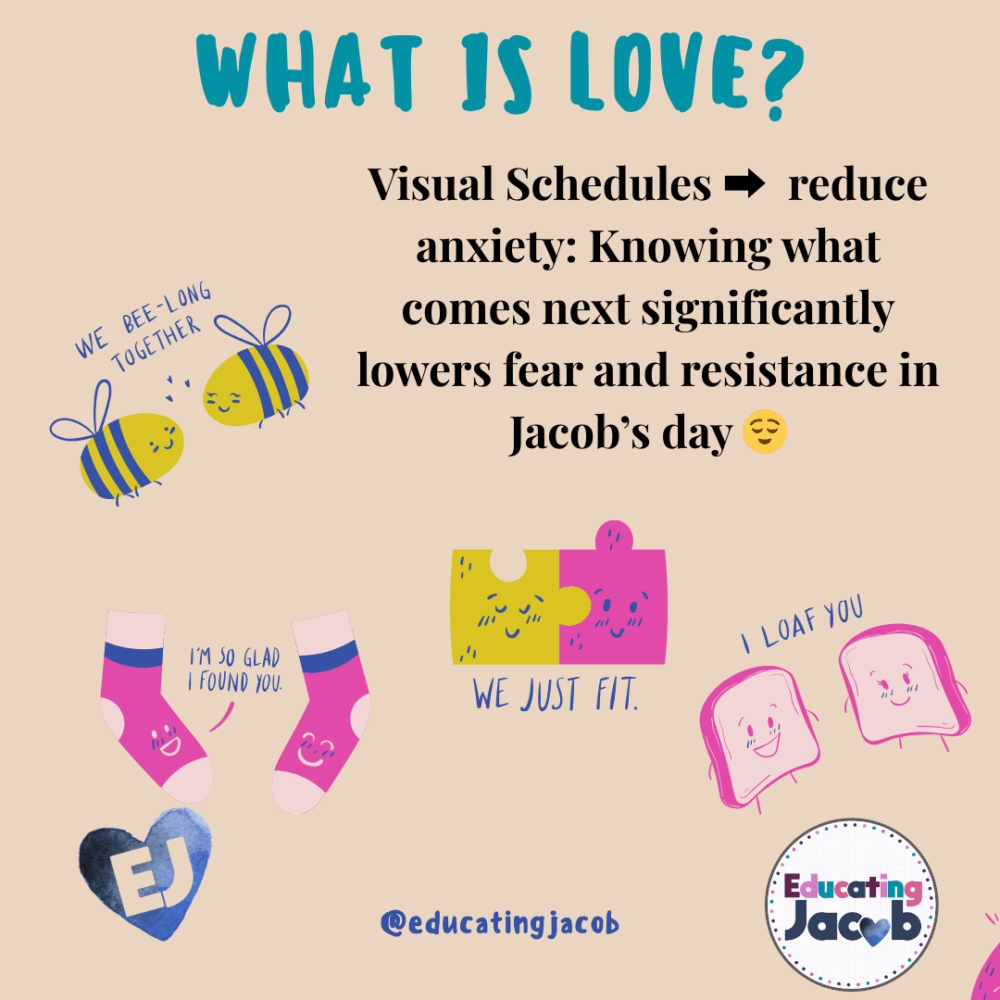
    Visual Schedules ➡️ reduce anxiety
    Visual Schedules ➡️ reduce anxiety

    Visual Schedules Aren’t Just for School 🎒

    Many parents mistakenly believe schedules belong only in classrooms. But for children with moderate to severe autism, home is where structure matters most. The consistency between school and home creates a seamless experience that reduces anxiety and builds confidence.

    We Successfully Use Visual Schedules For:

    • 🌞 Morning routines
    • 🍎 Meals and snacks
    • 👩‍⚕️ Therapy appointments
    • 📚 Learning time at home
    • 🧹 Chores and hygiene tasks
    • 🚗 Outings and errands
    • 😴 Bedtime routines

    Creating visual schedules for autism success isn’t about imposing rigid structures. It’s about giving our children the confidence to navigate their day without feeling lost, overwhelmed, or anxious about what’s coming next.
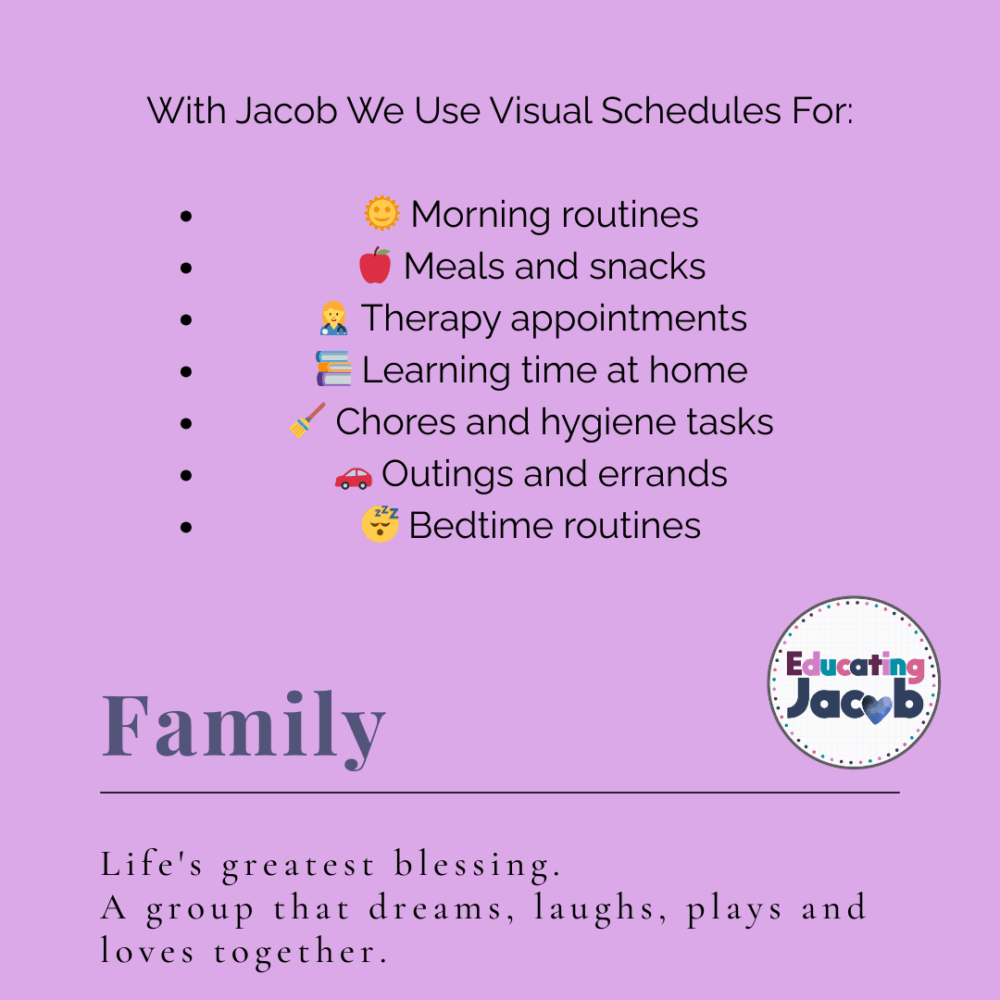
    With-Jacob-We-Use-Visual-Schedules-For
    Schedules are a game changer for our son and home!

    The Freedom of Structure: Breaking the Misconceptions 🔓

    I once thought following a schedule sounded restrictive. This was especially true as someone with ADHD myself. But the truth? A well-designed visual schedule actually creates freedom.

    It frees us from:

    • The overwhelm of decision fatigue
    • Forgetting important tasks or appointments
    • The anxiety of unpredictability

    And it empowers our children with:

    • Confidence in knowing what’s happening next
    • A sense of control over their environment
    • The ability to complete tasks independently

    Today, if I don’t have Jacob’s daily work prepared in the zippered bags we use, he comes looking for it! He hands me the empty bag with a “let’s get this show on the road” look. That visual system makes him feel empowered and grounded in his routine. ➡️ Autism Parenting Mistakes

    Even Through Challenges, Routines Provide Comfort 🌈

    Even last week, after Jacob experienced a seizure, I witnessed how powerful his routine has become. Though tired and needing more rest, by lunchtime, he independently went to his schedule and started working through it. He wanted his normal back. He craved the security of his daily structure.

    That’s what visual schedules for autism success provide. A roadmap to independence, even when days are challenging.

    And yes, it’s enjoyable for them too! When Jacob successfully completes a week of work, he earns a special reward. He selects something from Amazon, usually a movie he’s been anticipating, and we order it together as his achievement reward.

    Visual Schedules Create Opportunity, Not Restriction 🌟

    Visual schedules aren’t about controlling our children. They’re about creating opportunities for:

    • Learning with less frustration
    • Completing tasks with a sense of accomplishment
    • Enjoying life with greater confidence and reduced anxiety

    When we thoughtfully construct schedules, considering their unique needs, joys, sensory profile, and energy patterns, everyone benefits. The entire family experiences more peace and predictability.

    Moving Forward with CALM and Purpose ✨

    If Autism Awareness Month left you feeling overwhelmed or disheartened, please know you’re not alone in this journey.

    Let’s move forward together with intention. Let’s refocus on what truly matters: helping our children thrive through practical strategies and consistent support, one small step at a time.

    Visual schedules represent one crucial piece of the autism support puzzle. They’re a fundamental component of the “Learning to Create Schedules” step in our CALM Frameworks, and they’ve genuinely transformed our daily family life.

    If you’re ready to learn how to build a simple, effective visual schedule tailored to your child’s specific needs, keep following along. I’ll be sharing practical tips, implementation strategies, and ongoing encouragement in upcoming posts. And at the end of this series, you’ll receive an invitation to join our supportive Autism Thrive Tribe community.

    Because here at Educating Jacob, we prioritize:

    • Action over arguments
    • Hope over division
    • Building CALM, one day at a time

    You are never alone on this journey. “Remember, every visual schedule you create is another step toward independence for your child, less anxiety in their daily life, and more peace and happiness for your entire home. We’re cheering you on!”💙

    Join a Community That Understands

    Join 👉 Autism Thrive Tribe offers more than strategies and support. It provides a sanctuary where your experiences are validated, your challenges are met with practical solutions, and your growth as both a parent and person is celebrated.

    Because while this journey may have begun unexpectedly, you don’t have to walk it alone. In fact, the path becomes not just manageable but meaningful when traveled together.

    Your place in this community is waiting. Come as you are—your authentic, imperfect, remarkable self—and discover how connection changes everything 💙

    Read More

  • RFK Jr. HHS Secretary, those offended, Levels 2-3 Autism Affects the Family

    Advocate-for-Acceptance-Inclusion-and-Research-🧩-
    Honest conversations that include all autism experiences.

    How Levels 2-3 Autism Affects the Family

    Why is it that when someone speaks an uncomfortable truth about how severe autism affects families, so many rush to shut it down? 🤫

    Let’s be honest — families living with Level 2 and Level 3 autism are often carrying invisible weights. These aren’t just social quirks or a lack of awareness training. We’re talking about profound daily challenges that impact every area of life.

    We should be able to talk about what’s hard, what hurts, and what might help  without being shamed for it. Wanting to prevent suffering, or make our children’s lives more manageable, is not the same as rejecting who they are. It’s love in action. ❤️‍🩹

    The Statement That Ignited a Firestorm 🔥

    RFK Jr. is in the headlines again—this time for directly addressing the autism community in a way that has sparked intense reactions.

    During a recent appearance, Kennedy promised new studies with preliminary results expected by September, aiming to better understand the alarming rise in autism rates. He noted that in the early 2000s, autism affected 1 in 50 children. Today? It’s 1 in 36, with some reports citing 1 in 31. https://www.statista.com/statistics/1237464/autism-research-funding-united-states-by-nih/

    But it wasn’t these statistics that created the backlash. It was this statement:

    “Autism destroys families, and more importantly, it destroys our greatest resource, which is our children. These children who should not be suffering like this… These are kids who will never pay taxes, they’ll never hold a job, they’ll never play baseball, they’ll never write a poem, they’ll never go on a date, many of them will never use a toilet unassisted.”

    His words were blunt. They were uncomfortable. And yes, they hurt many in the autism community.

    But as a mother of a 27-year-old son with moderate autism and epilepsy, I need to say something that might be equally uncomfortable:

    For many families like mine, he wasn’t wrong. ❤️‍🩹

    How Levels 2-3 Autism Affects the Family: A Reality Many Don’t See 👨‍👩‍👧‍👦

    I’ve spent decades in the trenches of autism—both as a mother and as a special education teacher. I’ve witnessed the spectrum in all its complexity. And I’ve watched autism rates climb steadily throughout my career, far beyond what “better diagnosis” alone could explain.

    The reality is that autism isn’t a monolith. It exists on a vast spectrum that includes:

    • Those who are verbal, employed, creative, and living independently
    • Those who need moderate support but can achieve meaningful independence
    • Those who require lifelong, 24/7 supervision and will never experience the milestones most take for granted

    My son Jacob falls into that last category. Despite decades of therapies, interventions, and unwavering love, he:

    • Cannot be left home alone 🏠
    • Will likely never live independently
    • Requires constant support for basic daily functions

    This isn’t because we haven’t tried. This isn’t because we don’t have hope. This is simply the reality of How Levels 2-3 Autism Affects the Family—a reality that’s exhausting, financially devastating, and yes, sometimes feels like it’s destroying the family unit. Autism Awareness Month! Parenting on the spectrum, no judgment here?🏝️

    Why We Feel Silenced: The Vaccine Conversation 🔇

    Let’s address the elephant in the room. Many parents like me have been effectively silenced when we mention our children’s dramatic regressions following vaccinations.

    To be clear: I’m not claiming all autism is caused by vaccines. I’m not even claiming my son’s autism was caused by vaccines. What I am saying is that many of us witnessed our children change dramatically after certain medical interventions. Maybe not the cause but there was harm. As parents we saw:

    • Children who had words suddenly lose them 💔
    • Children who made eye contact suddenly stop
    • Children who developed severe gut issues where none existed before
    • Children whose developmental trajectory took a sudden, dramatic turn

    And when we mention these observations—even gently, even as part of a complex conversation about multiple potential factors—we’re immediately dismissed with “correlation doesn’t equal causation” signs and accusations of being “anti-science.”

    But here’s what those critics don’t understand: We were there. We lived it. We watched our children change before our eyes.

    No one can prove to us that vaccines weren’t a contributing factor—just as no one can prove with certainty that they were. But dismissing our lived experience doesn’t help anyone, least of all our children who continue to suffer with communication barriers, sensory processing disorders, and medical complications.

    Government Transparency 🔍

    Another uncomfortable truth: many agencies that should be protecting us haven’t always been transparent about potential toxins in our medical interventions, foods, and environment.

    The history of public health is littered with examples of substances once declared “safe” that later proved harmful:

    • Lead in gasoline and paint ⚠️
    • Mercury in thermometers and dental fillings
    • Asbestos in building materials
    • Various pharmaceutical products later pulled from market

    I did whatever our doctor suggested when my boys were young because that’s how I was raised. I trusted the system completely. But over the years, my perspective has evolved as I’ve witnessed concerning patterns and learned more about regulatory oversight.

    It’s not “anti-science” to ask whether our regulatory agencies have been fully transparent about preservatives in vaccines, the dramatically expanded childhood vaccination schedule, or the cumulative effect of multiple interventions. It’s not wrong to wonder if we could do better as a country.

    RFK Jr.’s promise to investigate further doesn’t threaten neurodiversity—it threatens complacency. It challenges the notion that we should simply accept the status quo without asking hard questions about how we might prevent more families from experiencing what ours have.

    Beyond “Inclusion,Acceptance”: Why Some of Us Want More 🧩

    “Autism doesn’t need a cure, just acceptance and inclusion.”

    I’ve heard this refrain countless times and for some I believe that’s true. Their neurodivergence brings gifts along with challenges, and they rightfully want a world that appreciates their unique perspective.

    But for families like mine, dealing with the moderate-severe end of the spectrum, this sentiment feels dismissive of our daily reality.

    My son hasn’t been “robbed” of just social acceptance. He’s been robbed of:

    • The ability to tell me when something hurts 🗣️
    • The joy of a conversation where he can share his thoughts and feelings in detail
    • The comfort of eating without sensory issues making most foods intolerable
    • Freedom from obsessive-compulsive behaviors that consume hours of his day
    • Independence that others take for granted

    These aren’t just “quirks” that society needs to accommodate. They’re profound challenges that cause my child suffering every single day.

    Wanting to ease that suffering—wanting to understand what caused it and how we might prevent it in other children—doesn’t make me ableist. It makes me a mother who can’t bear to see her child struggle when perhaps those struggles could have been prevented.

    How autism affects the family goes far beyond needing more inclusive classrooms or workplace accommodations. For us, it means a lifetime of specialized care, medical interventions, behavior management, and constant supervision. It means planning for 50+ years of dependency and worrying what happens when we’re gone.

    The Moderate-Severe Autism Family Impact: Realities We Face Daily 📣

    When advocates called Kennedy’s comments “eugenic” or “setting the community back,” I have to ask: which community are they speaking for?

    Because while I celebrate every  person with autism leading a fulfilling, independent life, there’s another community being left behind in this conversation:

    • Parents changing adult diapers 👨‍👩‍👧‍👦
    • Siblings who’ve become default caregivers
    • Marriages crumbling under the financial and emotional strain
    • Families planning for 50+ years of dependent care
    • Schools struggling with limited resources for severe behaviors

    For us, acknowledging the devastating severe autism family impact isn’t offensive—it’s validating. It’s someone finally seeing our daily struggle.

    And when Kennedy promises research into environmental factors, rising rates, and potential causes, that’s not an attack on individuals with autism it’s offering hope to exhausted families desperate for answers. ✨

    Why “Just Genetics” Isn’t Enough 🧬

    The pushback against environmental research frustrates many parents like me. We’re told:

    “It’s just better diagnosis.” ❌ “It’s  genetic.” ❌ “We’re just more aware now.” ❌

    But those of us who’ve worked in education for decades have witnessed this explosion firsthand. I never saw these numbers of severely affected children when I began teaching. Now, special education classrooms are overflowing.

    While genetics may certainly play a role, the dramatic rise suggests something more complex at work, perhaps a gene-environment interaction that deserves serious investigation.

    The truth is, we know harmful substances exist in our environment, our food, and yes, sometimes in our medical interventions. These chemicals and compounds don’t affect everyone equally, some individuals are more susceptible based on their unique genetic makeup. Acknowledging this complex interplay isn’t anti-science; it’s the very essence of modern scientific inquiry.

    Wanting to understand why isn’t eugenic. It’s responsible.

    Moving Forward with Heart: Beyond the Division 💞

    I don’t write this to create more division in an already divided community. I write this because healing can only begin with honesty.

    For too long, parents of severely affected children have been silenced:

    • We’re told our observations about regression after medical interventions are invalid
    • We’re accused of not accepting our children when we seek to ease their suffering 😔
    • We’re labeled as “anti-science” for questioning whether environmental factors played a role
    • We’re told to focus solely on acceptance when our children need intensive interventions

    But we need to reclaim our voice, because our reality is valid too.

    Supporting research into environmental factors doesn’t mean we love our children any less. It means we want to prevent other families from facing the same struggles. It means we want better interventions for those already affected.

    And acknowledging the devastating aspects of how autism affects the family doesn’t diminish our children’s worth—it acknowledges their challenges and our sacrifices.

    Jacobs-heart-hands-say-it-all-we-are-here-to-advocate-for-Acceptance-Inclusion-and-Research-
    Let’s Love and show Kindness!

    A Path Forward: Beyond the Signs and Slogans 🛣️

    Here’s what I believe we need:

    1. Honest conversation that acknowledges the full spectrum of autism experiences—from mild to profound 🗣️
    2. Respect for parents’ observations about their own children’s developmental history
    3. Comprehensive research into both genetic AND environmental factors—without political biases
    4. Better transparency from regulatory agencies about what goes into our bodies and environment
    5. Support for those who are suffering without accusations of being anti-neurodiversity
    6. Recognition that wanting to prevent suffering is not the same as devaluing those with autism

    Because at the end of the day, this isn’t about RFK Jr. or political affiliations. It’s not about being pro-vaccine or anti-vaccine. It’s about families like mine who are moving through each day with a smile, trying our best to improve our children’s lives while carrying burdens few can understand.

    To the Parents Experiencing Severe Autism Family Impact 💪

    If you’re reading this while exhausted from another sleepless night with your severely autistic child…

    If you’ve ever watched your child struggle to communicate basic needs… 😢

    If you’ve been dismissed when sharing observations about your child’s developmental regression…

    If you’ve been made to feel like you’re “part of the problem” for asking questions about environmental factors…

    I see you. Your experience is real. Your questions are valid. Your observations matter. 👏

    You’re not alone in feeling that parts of Kennedy’s statements—however imperfectly expressed—spoke to your lived reality.

    And you’re not wrong for wanting answers, research, and solutions while simultaneously loving your child exactly as they are.

    Moving-Forward-Together-🤝
    Let’s Thrive Together in This Journey!

    Moving Forward Together 🤝

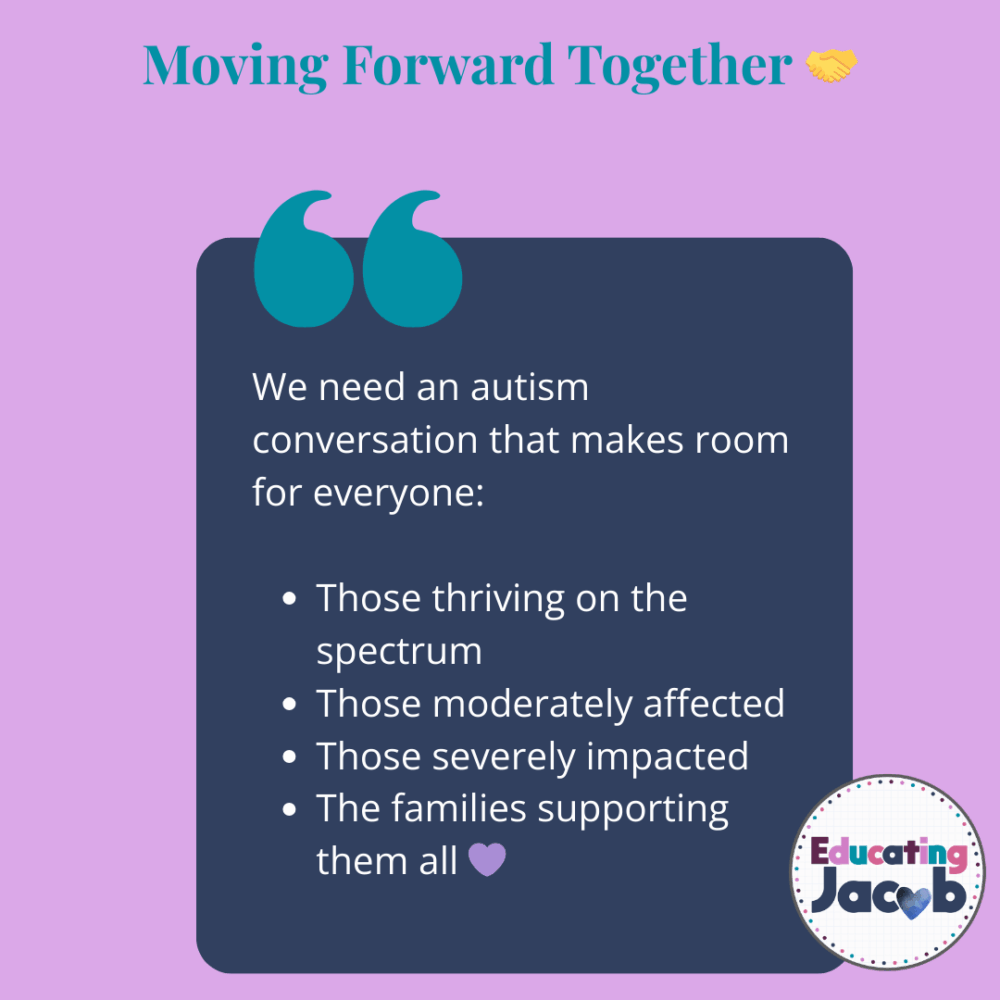
    We need an autism conversation that makes room for everyone:

    • Those thriving on the spectrum
    • Those moderately affected
    • Those severely impacted
    • The families supporting them all

    And most importantly, we need a conversation that respects parents’ right to share their observations and ask difficult questions without being labeled or dismissed.

    Because until we can honestly address the full reality of how all Levels of autism affects the family, including its most challenging presentations and potential cause we can’t truly support the entire community.

    It’s time to listen to ALL voices in this conversation, even when what they have to say makes us uncomfortable.

    If you’re raising a child who struggles every single day you’re not alone. If your child is like Jacob, and the world seems to forget about them I’m here for you. Join us inside Autism Thrive Tribe ✨, where we support each other through the challenges of how autism affects the family while celebrating every victory, no matter how small.

    Read More

  • Self Compassion, Navigating the Journey as Autism Parents without fear and chaos.

    Navigating-the-Journey-as-Autism-Parents-Without-Fear-and-Chaos
    Jacob loves water and this was a real treat! Great Wolf Lodge

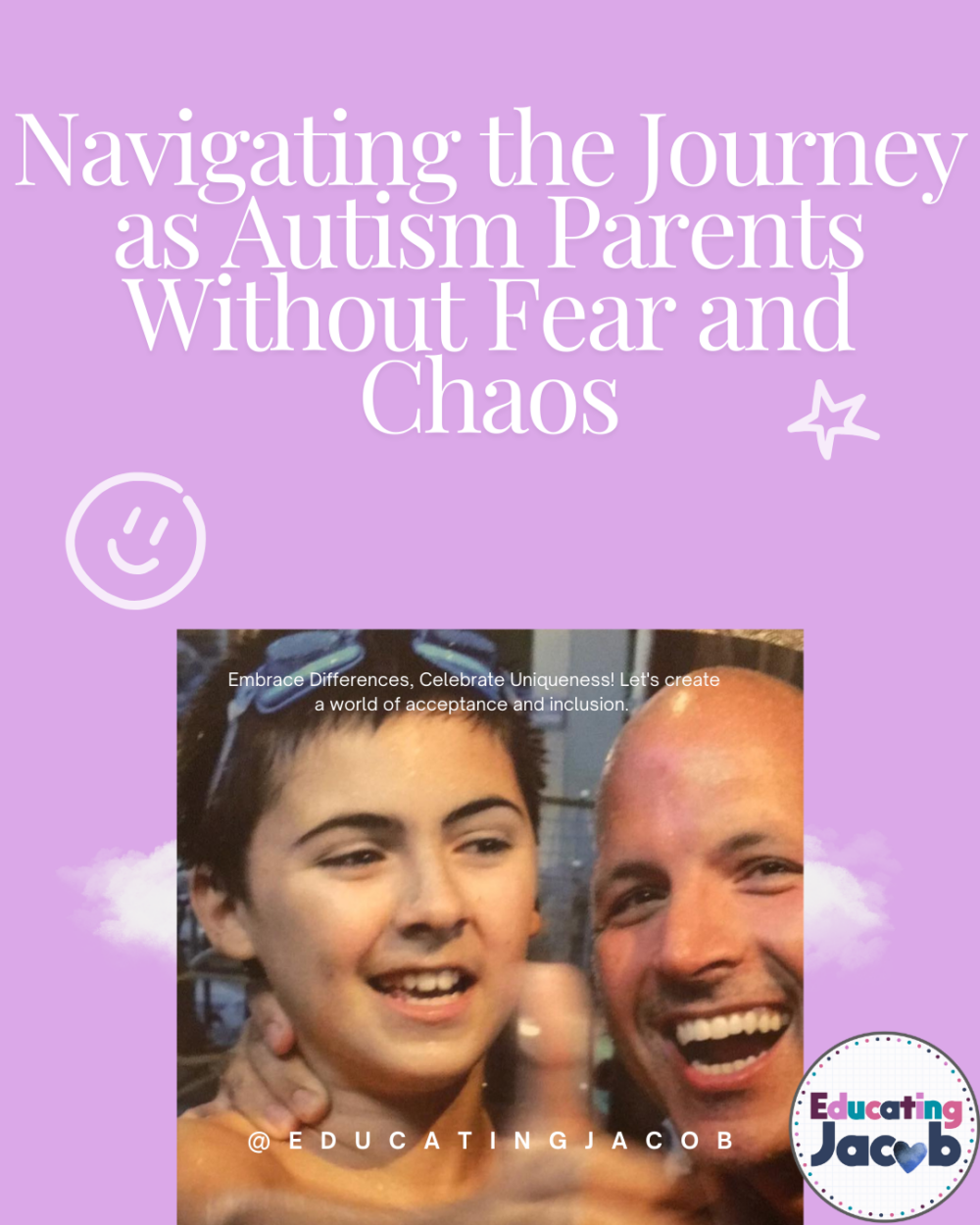
    Navigating the Journey as Autism Parents Without Fear and Chaos

    Let’s be real — parenting a child with autism isn’t just challenging; it’s transformative. It reshapes your expectations, your daily routines, and most profoundly, your relationship with yourself. When your days begin before dawn (fellow 5 AM autism warriors, I see you ☕), one truth becomes clear but is often overlooked:

    Your wellbeing isn’t optional—it’s essential.

    In our home, the journey of parenting Jacob revealed something unexpected: we couldn’t effectively support him without first learning to nurture ourselves—with patience, flexibility, and a deliberate practice of self-compassion. Beyond the Chaos: Scheduling 101 Class for Special Needs Children

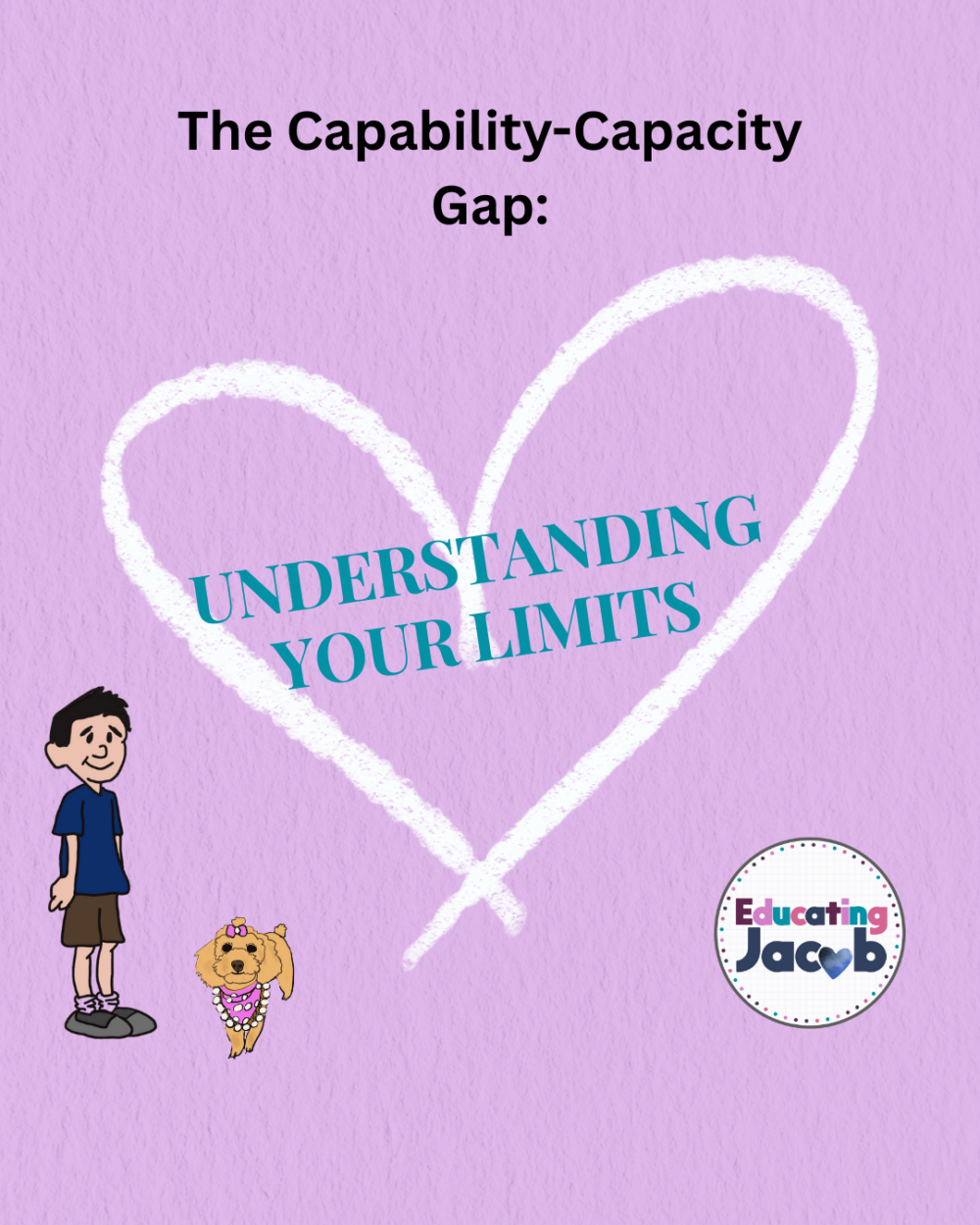
    The Capability-Capacity Gap Understanding Your Limits
    Have a plan and start small!

    The Capability-Capacity Gap: Understanding Your Limits

    As autism parents, our capabilities are extraordinary. We navigate complex healthcare systems, become overnight experts in therapeutic approaches, defuse meltdowns in public spaces, and advocate with the tenacity of seasoned attorneys.

    But capability doesn’t equal infinite capacity—and this distinction changes everything.

    I navigate this landscape with ADD (making life extraordinarily colorful 🌶️ and spicy). Some mornings I’m strategizing IEP meetings with laser focus; other days I’m standing in rooms wondering what I came for. Sound familiar?

    Self-compassion emerges from recognizing this gap—understanding that your capabilities remain constant even when your capacity fluctuates. The most powerful parenting skill might be giving yourself permission to acknowledge when your tank is running low.

    Structured Freedom: How Visual Systems Transform Family Life

    Our breakthrough came when we discovered a counterintuitive truth: structure doesn’t constrain children with autism—it liberates them.

    Visual schedules transformed our daily reality. Transitions, once triggering unpredictable reactions, became navigable pathways. Jacob gained confidence through predictability. He could see what was coming, prepare mentally, and move through his day with growing independence.

    The unexpected gift? We found ourselves transformed too—less anxious, more present, and better equipped to respond rather than react.

    This realization forms the foundation of our CALM Framework—a comprehensive approach recognizing that exceptional parenting isn’t about perfection. It’s about creating consistent, adaptable systems that honor both your child’s neurodivergent needs and your family’s unique dynamics. Visual Schedule Hacks for autism parents, Starting 2025 CALM!

    The Full-Spectrum Challenge: When Parenting Meets Adult Realities

    Autism parenting happens within the complex ecosystem of adult responsibilities. We’re simultaneously managing:

    • Sensory processing challenges (theirs and sometimes our own)
    • Executive function demands across multiple domains
    • Financial pressures and career obligations
    • Relationships that require nurturing
    • Household management (including the diplomatic negotiations around Jacob’s steadfast chicken-hamburger rotation 🍗🍔)

    The self-compassion revolution in autism parenting begins with acknowledging this reality: you cannot perform superhuman feats indefinitely without restoration. Rest isn’t weakness—it’s strategic sustainment of your most valuable resource: yourself.

    Community as Medicine: Breaking Isolation Through Connection

    The research is unequivocal: parent isolation correlates directly with increased stress levels and diminished mental health outcomes. Connection isn’t a luxury—it’s a necessity.

    At Educating Jacob, we’ve witnessed the transformative power of authentic community. We share unfiltered moments, celebrate small victories (yes, including Chloe the Poodle’s Easter makeover 🐩💐), and create space for both laughter and tears.

    Chloes-Easter-Glow-was-on-Jacobs-Daily-Schedule
    Jacob knew we were getting up early to drop off Chloe at the groomers! #DailySchedule

    This vision inspired 👉 Autism Thrive Tribe—not merely a support group, but a collaborative learning environment where parents exchange practical wisdom, implement evidence-based strategies, and perhaps most importantly, find themselves surrounded by others who truly understand.

    The profound isolation many autism parents experience isn’t inevitable. It’s a challenge we can address together through intentional community-building and shared resources.

    The-Self-Compassion-Revolution-Practical-Steps-Forward
    Ephesians 4:32
    Be kind and compassionate to one another, forgiving each other, just as in Christ God forgave you.

    The Self-Compassion Revolution: Practical Steps Forward

    Self-compassion isn’t abstract philosophy—it’s practical action. Consider implementing these evidence-based approaches:

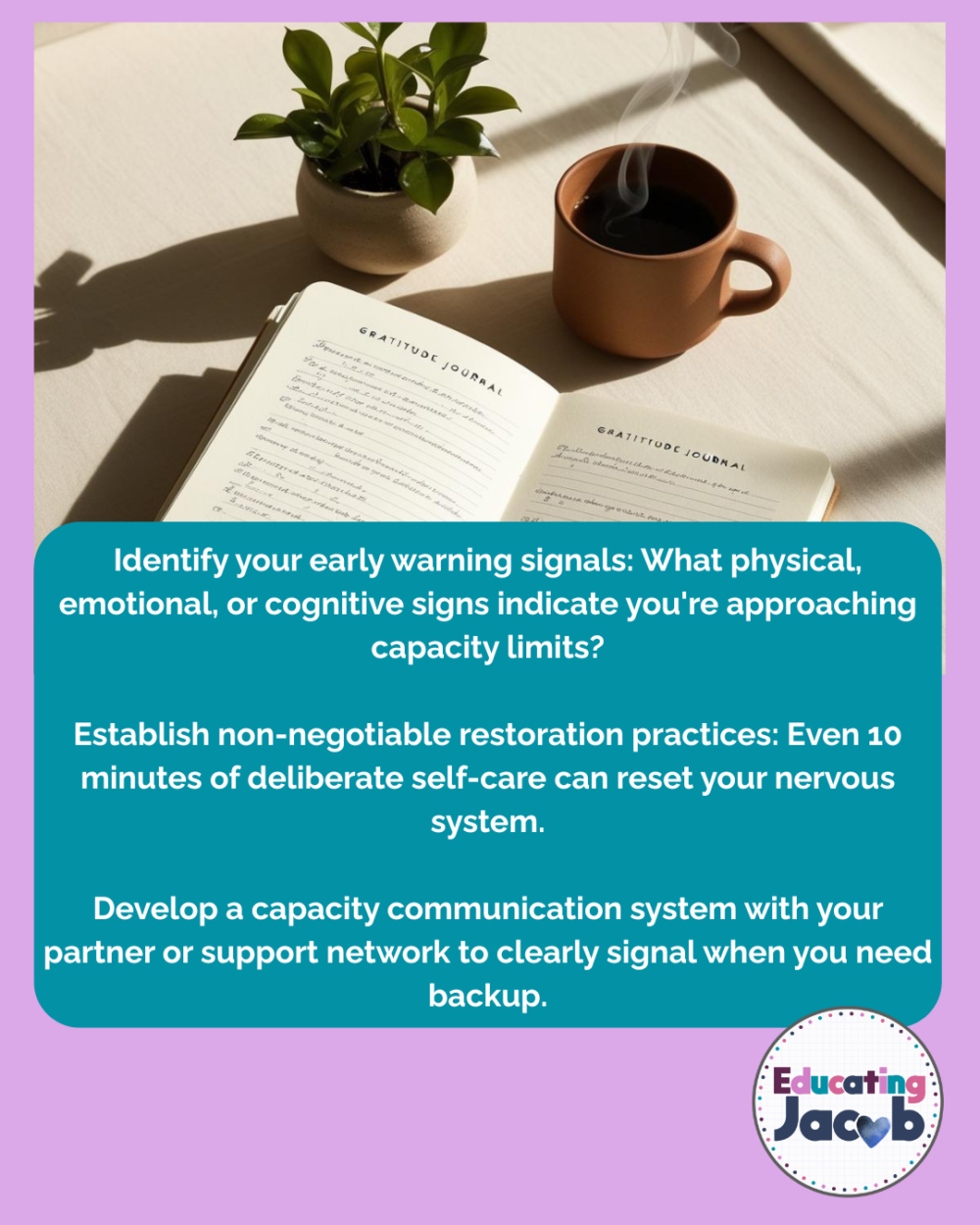
    1. Identify your early warning signals: What physical, emotional, or cognitive signs indicate you’re approaching capacity limits?
    2. Establish non-negotiable restoration practices: Even 10 minutes of deliberate self-care can reset your nervous system.
    3. Develop a capacity communication system with your partner or support network to clearly signal when you need backup.
    4. Right-size your expectations on low-capacity days, focusing on essential functions rather than optimal performance.
    5. Document your wins, however small, to counter the negative bias our brains naturally develop during challenging periods.

    You’re doing remarkable work—even when you feel overwhelmed. Even when plans derail. Even when you’re operating on minimal sleep and maximum stress.

    The journey of autism parenting isn’t about achieving perfection. It’s about sustainable support, meaningful connection, and the courage to treat yourself with the same compassion you show your child every day. Check out Therapy in a nutshell for mental health tips: https://therapyinanutshell.com/how-to-build-an-internal-locus-of-control/

    Join a Community That Understands

    Join 👉 Autism Thrive Tribe offers more than strategies and support. It provides a sanctuary where your experiences are validated, your challenges are met with practical solutions, and your growth as both a parent and person is celebrated.

    Because while this journey may have begun unexpectedly, you don’t have to walk it alone. In fact, the path becomes not just manageable but meaningful when traveled together.

    Your place in this community is waiting. Come as you are—your authentic, imperfect, remarkable self—and discover how connection changes everything 💙
    Read More

  • Unlocking the Easter Joy: A Guide to Teaching Children with Autism about Easter

    Plan-ahead-to-make-the-holidays-chaos-free-and-sensory-friendly
    Schedules and planning ahead are wins!

    🐰 Teaching Children with Autism about Easter: Creating Joyful & Meaningful Experiences 🌷

    Welcome back to Educating Jacob! Easter is just around the corner, and as parents of children with autism, we understand the unique challenges and opportunities this holiday brings. My journey with Jacob has taught me that with thoughtful preparation, Easter can be a beautiful time of inclusion, learning, and celebration for our children. Let’s explore how we can make this Easter special while honoring our children’s unique needs. Autism Awareness Month! Parenting on the spectrum, no judgment here?🏝️

    🧠 Understanding the Easter Experience Through Your Child’s Eyes 🌈

    For children with autism, Easter celebrations can present both excitement and challenges. The sensory-rich environments, disrupted routines, and social expectations may feel overwhelming. Abstract concepts like resurrection might be difficult to grasp. Yet with understanding and preparation, we can transform potential obstacles into opportunities for growth and connection.

    When teaching children with autism about Easter, remember that personalization is key. Every child has different sensory preferences, communication styles, and interests that can guide your approach. Jacob, for instance, responds well to visual supports and hands-on activities that make abstract concepts more concrete.

    📅 Preparing for Success: Visual Schedules & Social Stories 📚

    Create Clear Visual Roadmaps

    Visual schedules are invaluable tools for helping our children navigate Easter activities. These step-by-step visual guides eliminate uncertainty and provide a sense of security. For Easter morning, consider creating a simple schedule with pictures showing:

    • Wake up time
    • Breakfast
    • Getting dressed in Easter clothes
    • Egg hunt activities
    • Family meal time
    • Quiet time breaks


    Craft Custom Social Stories

    Visual-i-use-for-Jacob-for-lent-@educatingjacob
    We use social stories and schedules for everything!

    Social stories can demystify Easter traditions and expectations. Create simple, personalized stories explaining:

    • What Easter celebrates
    • What will happen during family gatherings
    • How egg hunts work
    • What to expect during religious services

    For Jacob, we’ve found that reading these stories several days before Easter helps him process and prepare emotionally. Teaching short term and maintenance goals for daily life with autistic son.

    🥚 Sensory-Friendly Easter Activities That Spark Joy 🎨

    Teaching children with autism about Easter becomes more effective when we incorporate sensory-friendly activities that engage their interests and accommodate their needs. https://www.brighterstridesaba.com/blog/autism-awareness-month/

    Adaptive Egg Hunts

    Traditional egg hunts can be modified in several ways:

    • Choose a quiet, familiar location
    • Use visual markers or color-coding to guide hunting
    • Offer eggs with different sensory elements (textured, light-up, noise-making)
    • Consider alternatives like a “reverse egg hunt” where children place eggs rather than find them

    Calming Craft Experiences

    Easter crafts can be adapted to different sensory preferences:

    • Mess-free egg decorating with stickers or markers
    • Creating Easter sensory bins with colored rice and small Easter figures
    • Making simple Easter cards with pre-cut shapes
    • Crafting egg shakers filled with different materials for musical exploration

    🕊️ Making Easter’s Meaning Accessible & Meaningful 📖

    For families who celebrate the religious aspects of Easter, finding ways to make these concepts accessible is important. We’ve found success with:

    • Using concrete objects to represent Easter’s story
    • Max Lucado’s “The Easter Story for Children” has been wonderful for Jacob
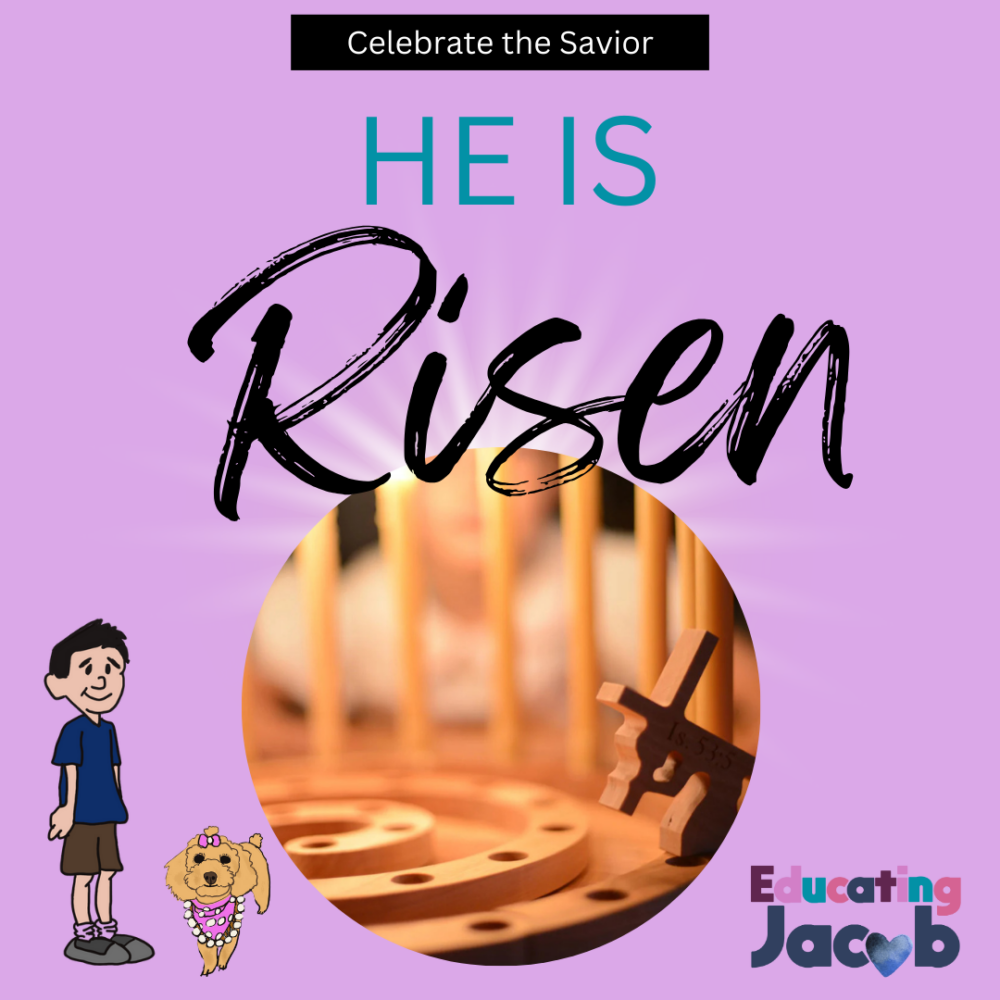
    • Our Lent calendar wreath from The Keeping Company helps track the Easter journey visually
    • Breaking down complex concepts into simpler parts
    • Using video resources designed for children with different learning styles

    Remember that understanding may develop gradually over many Easter seasons, and that’s perfectly okay.

    🌟 Building Easter Traditions That Foster Belonging 🏡

    One of the most beautiful aspects of teaching children with autism about Easter is creating traditions that foster a sense of belonging while respecting their unique needs.

    Consider establishing:

    • A quiet morning ritual before other activities begin
    • Designated calm spaces during family gatherings
    • Familiar foods alongside traditional Easter fare
    • A special sensory-friendly Easter basket tailored to your child’s interests

    In our home, Jacob’s Easter basket always includes fidget toys and sensory items alongside traditional treats. This simple customization helps him feel seen and understood.

    🤝 Connecting with Community While Honoring Boundaries 💫

    Easter often involves community engagement, whether through religious services, family gatherings, or neighborhood events. Finding the right balance between participation and honoring your child’s needs is essential.

    Consider these approaches:

    • Attend services during less crowded times, or watch livestreams
    • Practice Easter greetings and interactions beforehand
    • Set clear time limits for social gatherings
    • Have an exit strategy ready if needed
    • Educate family members about your child’s needs

    Many churches and community organizations now offer sensory-friendly Easter events specifically designed for children with diverse needs. Don’t hesitate to ask about accommodations or special sessions.

    🐣 Embracing the Journey: Easter as an Opportunity for Growth 🌱

    Each Easter brings new opportunities for connection, understanding, and growth. The strategies that work this year may evolve as your child develops. Remain flexible and celebrate small victories.

    Teaching children with autism about Easter isn’t just about a single holiday—it’s about building skills that transfer to other celebrations and life experiences. Each egg decorated, story understood, or tradition enjoyed represents meaningful progress.

    📲 Join Our Easter Support Community 💌

    Happy-Easter-@Educating-Jacob
    Teaching Children with Autism about Easter @EducatingJacob

    At Educating Jacob, we believe in the power of community. We’d love to hear your Easter success stories, challenges, and questions. What Easter adaptations have worked for your family? What challenges are you facing this season?

    Share your experiences in the comments below or join our private Facebook group where parents like you exchange ideas and support year-round.

    For personalized support with creating visual schedules, social stories, or other Easter resources, book a consultation through our website. Together, we can make this Easter a time of joy, meaning, and inclusion for all our exceptional children.

    Wishing you and your family a peaceful and joyful Easter celebration!


    Sign up for Autism Thrive Tribe, for more seasonal strategies, resources, and support for teaching children with autism about holidays throughout the year.

    Read More