schedules

  • Come on Autism Thrive Tribe, 3 Ways to ditch chaos and get Happy!

    Autism Parenting Strategies for a Happy Home!

    Parenting a child with autism is a journey filled with love, learning, and, let’s be real—chaos. But after 27 years with Jacob and 14 years in public schools, I’ve learned that chaos doesn’t have to rule our lives. With the right tools, we can create calm, structure, and a happier home for everyone! 💙✨

    When autism or a disability is involved, here are my top 3 autism parenting strategies for a happy home that help ditch chaos and bring more peace into your life:

    Visual-Schedules-Your-Secret-Weapon-for-Predictability-@educatingjacob
    Visual schedules are a game changer!

    1️⃣ Visual Schedules: Your Secret Weapon for Predictability 🖼️📅

    Imagine waking up every day and not knowing what’s next. Sounds stressful, right? That’s exactly how our kids feel without a clear, structured plan.

    📌 Why Visual Schedules Work: ✅ Reduce anxiety and meltdowns ✅ Help with transitions between tasks ✅ Provide a sense of control over the day ✅ Make changes less overwhelming

    💡 Pro Tip: Having a visual schedule in place makes life easier because when unexpected things happen, you can show your child that the day is getting back to normal soon.

    👀 How I Use Visual Schedules: ✔ I plan a simple daily schedule that Jacob can see ✔ If something unexpected comes up, I adjust the schedule and show him ✔ I use pictures, words, or even a small whiteboard on the go ✔ I remind him what’s coming next to redirect attention to something positive

    📖 Looking for more guidance? Check out my CALM Frameworks, where L = Learning to Create Schedules 📅 How to reduce chaos at home with an autistic child using my CALM frameworks.
    📌 How Redirection Helps: ✅ Moves attention away from frustration ✅ Eases transitions without power struggles ✅ Keeps moods light and positive ✅ Helps get back on track when things go sideways
    Redirection, get unstuck! #ParentingWithPurpose #AutismThriveTribe

    2️⃣ Redirection: The Power of the Pivot! 🔄✨

    Sometimes, despite our best efforts, our kids get stuck in frustration, repetitive behaviors, or sensory overload. That’s when redirection comes in!

    🔄 What is Redirection? It’s a gentle shift in focus to something more positive, engaging, or calming.

    📌 How Redirection Helps: ✅ Moves attention away from frustration ✅ Eases transitions without power struggles ✅ Keeps moods light and positive ✅ Helps get back on track when things go sideways

    💡 How I Use Redirection with Jacob:

    • 🎶 Music therapy: If Jacob is upset, I play his favorite songs to shift his mood.
    • 🏃 Movement breaks: If sitting still is hard, I guide him to a different task (jumping jacks, stretching, or a walk).
    • 📖 Exciting distractions: “Hey Jacob, after this, we get to watch your favorite movie!”

    🛑 Remember: Redirection is NOT bribery—it’s a tool to help your child focus on something positive instead of staying overwhelmed. Stop engaging in power struggles! Use redirection for your autistic child.
    Planning-ahead-and-Visual-schedule-examples-@educatingjacob
    ✔ The power of visual schedules to reduce anxiety & help transitions 📅

    3️⃣ Planning Ahead: Your Autism Parenting Survival Kit! 🎒🛠️

    🎬 Ever watch a spy movie where the hero has hidden bags full of money and supplies for emergencies? Well, as an autism parent, YOU should have a survival bag too! 😆💼

    📌 What to Pack in Your Autism Go-Bag: ✔ Sensory-friendly fidgets (putty, stretchy silicone, pop-its) ✔ Headphones or earplugs for noise reduction ✔ Favorite snacks & drinks ✔ Extra clothes (because sensory discomfort is real!) ✔ Small visual schedule to show what’s next

    👗 Pro Tip: Plan ahead for sensory needs. Choose soft, tag-free clothes that won’t trigger irritation or discomfort. A meltdown avoided = a win! 🏆

    👀 How I Plan Ahead in the Classroom: I always keep baskets of sensory items—even for students who aren’t high sensory seekers—because we all need breaks and fun! 🎉 Complete some work? Grab a fidget and take a break! Easy peasy! Love Teacch trainings: https://teacch.com/


    Ditch the Chaos with Autism Parenting Strategies for a Happy Home! 💙✨

    We all want a happy, thriving home—and the key to that is reducing chaos and creating structure. That’s why I always go back to my CALM Frameworks:

    C: Consistent Action Forward 🚀 ✔ A: Always Celebrate Wins 🎉 ✔ L: Learning to Create Schedules 📅 ✔ M: Mindset Shift 🧠

    Simple-things-that-make-me-Happy-@educatingjacob
    Grocery store finds that make me smile! Autism Parenting Strategy!

    👩‍👦 Remember: Your mindset and emotional regulation are just as important as your child’s. If your emotions are high, so will theirs be—guaranteed.

    💡 Which strategy do YOU use the most? Drop a comment and let’s chat! 👉And if you want to connect with parents who GET IT, join the Autism Thrive Tribe today! 💙

    #AutismParenting #AutismParentingStrategiesForAHappyHome #SpecialNeedsScheduling #AutismSupport #AutismMom #ParentingWithPurpose #AutismThriveTribe
    Read More

  • Come on Autism Thrive Tribe: 3 Autism Parenting Strategies for a Happy Home!

    Parenting a child with autism is a journey filled with love, learning, and, let’s be real—chaos. But after 27 years with Jacob and 14 years in public schools, I’ve learned that chaos doesn’t have to rule our lives. With the right tools, we can create calm, structure, and a happier home for everyone! 💙✨

    When autism or a disability is involved, here are my top 3 autism parenting strategies for a happy home that help ditch chaos and bring more peace into your life:

    1️⃣ Visual Schedules: Your Secret Weapon for Predictability 🖼️📅

    Imagine waking up every day and not knowing what’s next. Sounds stressful, right? That’s exactly how our kids feel without a clear, structured plan.

    📌 Why Visual Schedules Work: ✅ Reduce anxiety and meltdowns ✅ Help with transitions between tasks ✅ Provide a sense of control over the day ✅ Make changes less overwhelming

    💡 Pro Tip: Having a visual schedule in place makes life easier because when unexpected things happen, you can show your child that the day is getting back to normal soon.

    👀 How I Use Visual Schedules: ✔ I plan a simple daily schedule that Jacob can see ✔ If something unexpected comes up, I adjust the schedule and show him ✔ I use pictures, words, or even a small whiteboard on the go ✔ I remind him what’s coming next to redirect attention to something positive

    📖 Looking for more guidance? Check out my CALM Frameworks, where L = Learning to Create Schedules 📅

    2️⃣ Redirection: The Power of the Pivot! 🔄✨

    Sometimes, despite our best efforts, our kids get stuck in frustration, repetitive behaviors, or sensory overload. That’s when redirection comes in!

    🔄 What is Redirection? It’s a gentle shift in focus to something more positive, engaging, or calming.

    📌 How Redirection Helps: ✅ Moves attention away from frustration ✅ Eases transitions without power struggles ✅ Keeps moods light and positive ✅ Helps get back on track when things go sideways

    💡 How I Use Redirection with Jacob:

    • 🎶 Music therapy: If Jacob is upset, I play his favorite songs to shift his mood.
    • 🏃 Movement breaks: If sitting still is hard, I guide him to a different task (jumping jacks, stretching, or a walk).
    • 📖 Exciting distractions: “Hey Jacob, after this, we get to watch your favorite movie!”

    🛑 Remember: Redirection is NOT bribery—it’s a tool to help your child focus on something positive instead of staying overwhelmed.

    3️⃣ Planning Ahead: Your Autism Parenting Survival Kit! 🎒🛠️

    🎬 Ever watch a spy movie where the hero has hidden bags full of money and supplies for emergencies? Well, as an autism parent, YOU should have a survival bag too! 😆💼

    📌 What to Pack in Your Autism Go-Bag: ✔ Sensory-friendly fidgets (putty, stretchy silicone, pop-its) ✔ Headphones or earplugs for noise reduction ✔ Favorite snacks & drinks ✔ Extra clothes (because sensory discomfort is real!) ✔ Small visual schedule to show what’s next

    👗 Pro Tip: Plan ahead for sensory needs. Choose soft, tag-free clothes that won’t trigger irritation or discomfort. A meltdown avoided = a win! 🏆

    👀 How I Plan Ahead in the Classroom: I always keep baskets of sensory items—even for students who aren’t high sensory seekers—because we all need breaks and fun! 🎉 Complete some work? Grab a fidget and take a break! Easy peasy!

    Autism Parenting Strategies for a Happy Home! 💙✨

    We all want a happy, thriving home—and the key to that is reducing chaos and creating structure. That’s why I always go back to my CALM Frameworks:

    C: Consistent Action Forward 🚀 ✔ A: Always Celebrate Wins 🎉 ✔ L: Learning to Create Schedules 📅 ✔ M: Mindset Shift 🧠

    👩‍👦 Remember: Your mindset and emotional regulation are just as important as your child’s. If your emotions are high, so will theirs be—guaranteed.

    💡 Which strategy do YOU use the most? Drop a comment and let’s chat! And if you want to connect with parents who GET IT, join the Autism Thrive Tribe today! 💙

    #AutismParenting #AutismParentingStrategiesForAHappyHome #SpecialNeedsScheduling #AutismSupport #AutismMom #ParentingWithPurpose #AutismThriveTribe
    Read More

  • Beyond the Chaos: Scheduling 101 Class for Special Needs Children

    special needs scheduling strategies
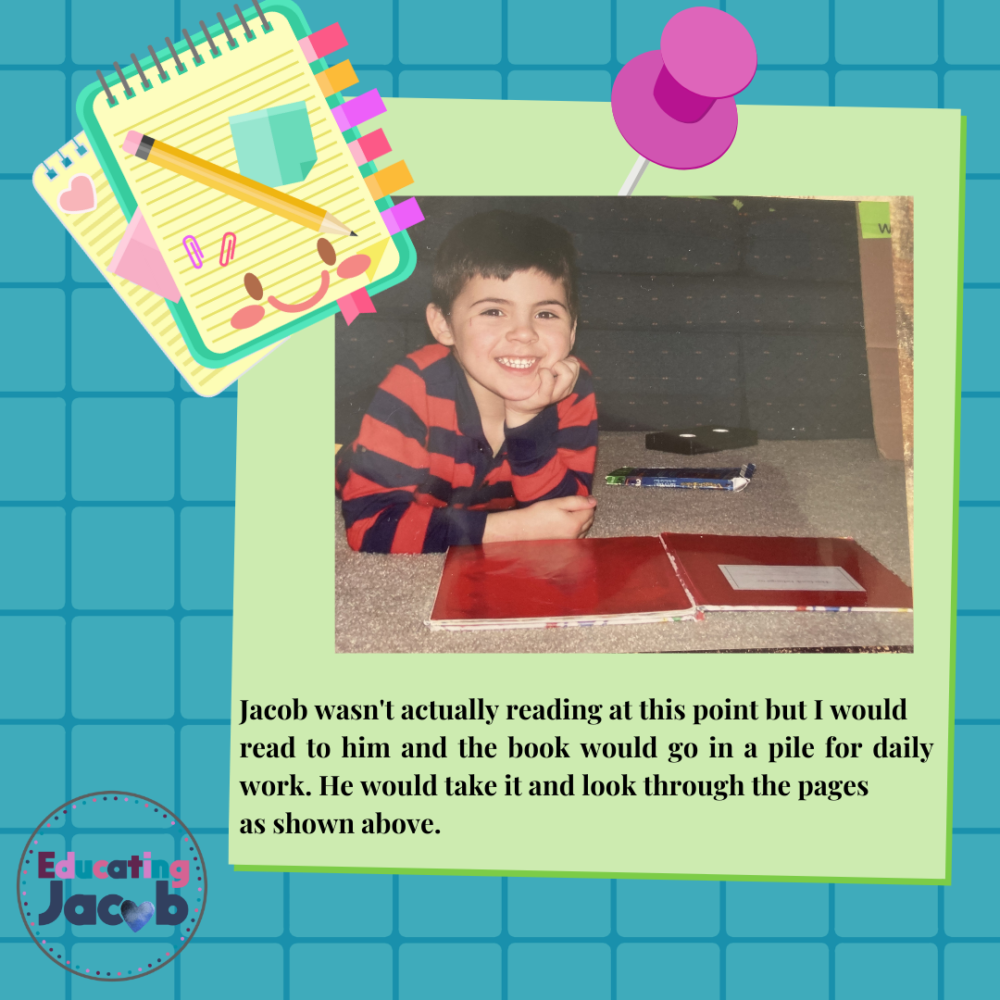
    This is Jacob reading a story book that was in his first_then work schedule!

    Special Needs Scheduling Strategies:

    🎢 Hold on Tight: The Rollercoaster Begins 🎢
    My son Jacob, bless his heart, decides it’s time for an emotional rollercoaster ride, and I’m just here, trying not to fall off the emotional ride myself! 🚀

    Our home, thanks to Jacob’s autism, sometimes resembles a tornado zone. Remember that joke about the first child being an angel, and then the second child coming along to prove that theory wrong? Well, autism walked into our lives and said, “Hold my juice box!” 🌀 🤪 We needed to ditch the chaos, and learn special needs scheduling strategies! And we did, read on for some helpful strategies.

    💡 Need help regaining your calm? Check out this previous post: 5 Ways to Regain My Calm

    The Colossal Challenges of Autism Parenting 🏗️

    These challenges are colossal—like trying to fit a giraffe into a Mini Cooper! 🦒 We face sensory challenges, communication barriers, meltdowns, and endless paperwork with doctors, therapists, and insurance companies. Here is a blog post that might help: 4 Things I Wish I Would Have Known After Getting the Autism Diagnosis

    Tame the Chaos: Battling Behaviors  🏊

    Some days, it feels like playing a never-ending game of whack-a-mole—except the moles are challenging behaviors, and the mallet is a pool noodle. And the worst part? The ticket to this game is exhaustion and anxiety. 🎟️ 😩 Planning ahead and visual schedules will help you win this game!

    Special Needs Scheduling Strategies:CALM 📅

    Thankfully, my superhero family and CALM strategies have saved me from perpetual pool noodle battles. The CALM Framework has helped us regain peace:

    C: Consistent Action Forward 🚀 ✔ A: Always Celebrate Wins 🎉 ✔ L: Learning to Create Schedules 📅 ✔ M: Mindset Shift 🧠

    💡 What I needed was the right mindset. I had to understand that scheduling wasn’t just for Jacob—it was for our whole family. It gave us predictability, peace, and progressStop Morning Chaos: How to start using Visual Schedule for Autism and CALM


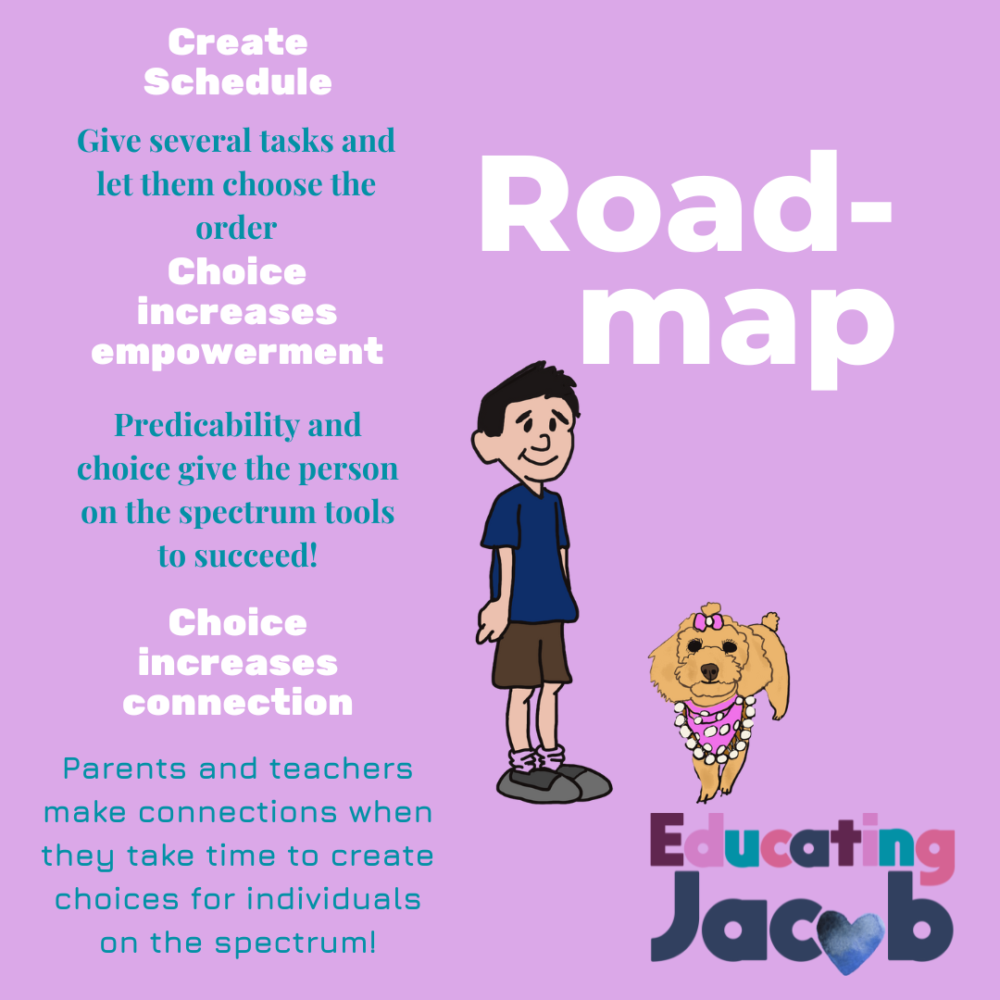
    Roadmap for choices,special needs scheduling strategies
    Use schedules with built in “choice” for connection and learning!
    schedules, special needs scheduling strategies
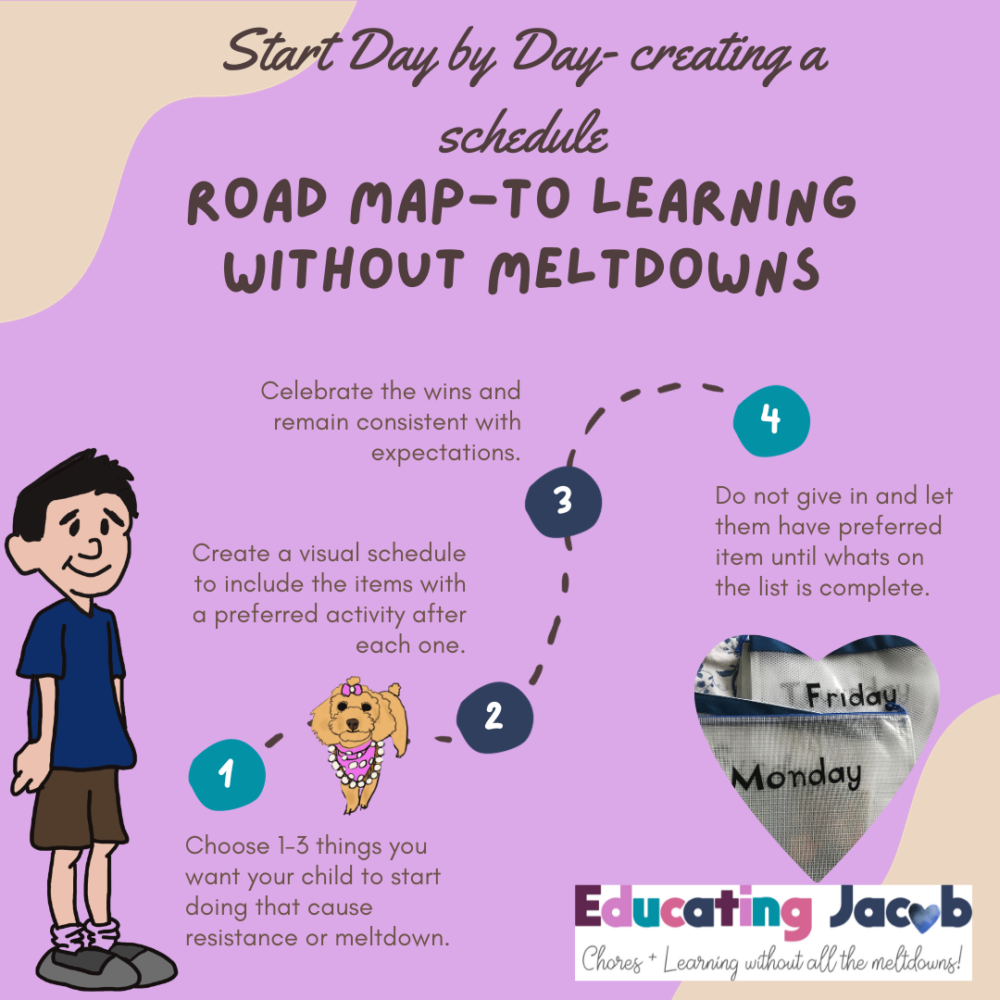
    Roadmap to success! Use a schedule, be consistent, and celebrate all wins!

    The Power of Visual Schedules: Your Parenting Cheat Code! 🛡️🗺️

    I used to feel like I was blindfolded, trying to solve a puzzle with shape-shifting pieces. 🧩 Then, I discovered visual schedules, and suddenly, it was like unlocking a parenting cheat code! 🎮

    Picture this: Jacob and I are now on an epic quest. His sensory challenges are our dragons, and our visual schedules are our treasure maps. 🏴‍☠️ And let’s not forget the rewards—stickers, high-fives, maybe even some chocolate. 🍫✨

    🏡 We turned chores into quests: Jacob became the Kitchen Crusader, conquering not just household tasks, but life itself. As parents, we’re the wizards, guiding our children through the magical world of responsibilities. Let the chore-adventures begin! 🎉

    📌 Why Schedules Work: ✅ Reduce meltdowns & anxiety ✅ Help with transitioning between activities ✅ Encourage independence ✅ Improve behavior management ✅ Incorporate special needs scheduling strategies to maintain stability and adaptability

    Creating Effective Schedules:

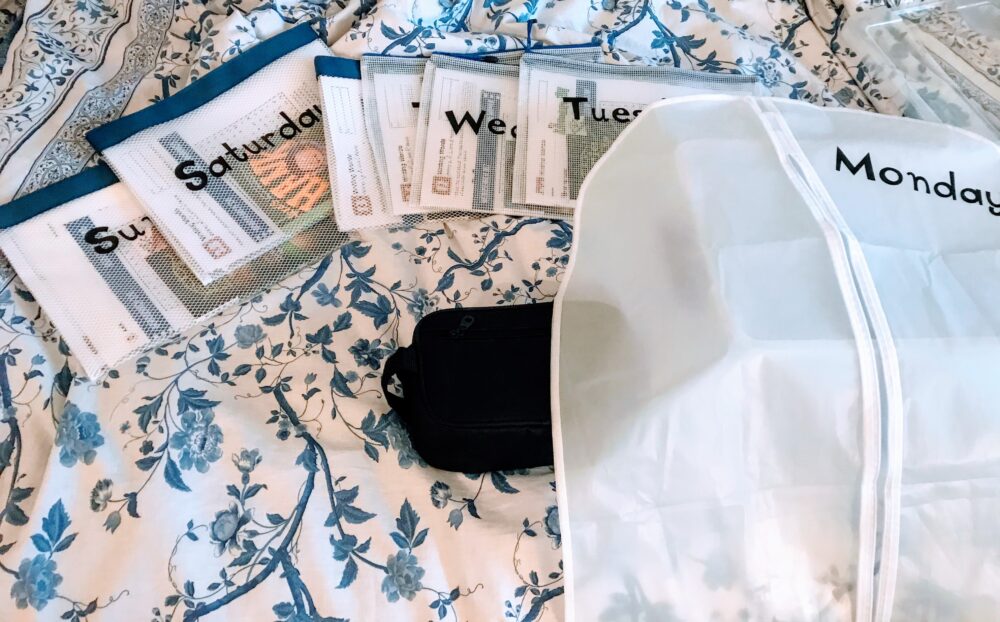
    The zippered bags contain school work and a short book to read.
    Jacob’s daily school bags for the week!

    Visual schedules are like vibrant canvases that promise adventure. It’s like our daily to-do list became a treasure map. For Jacob, chores turned into thrilling quests, and sensory sensitivities were banished like villains from a fairy tale.

    Unlocking the Mysteries of Zippered Bags & Clothes Schedules 🎒👕

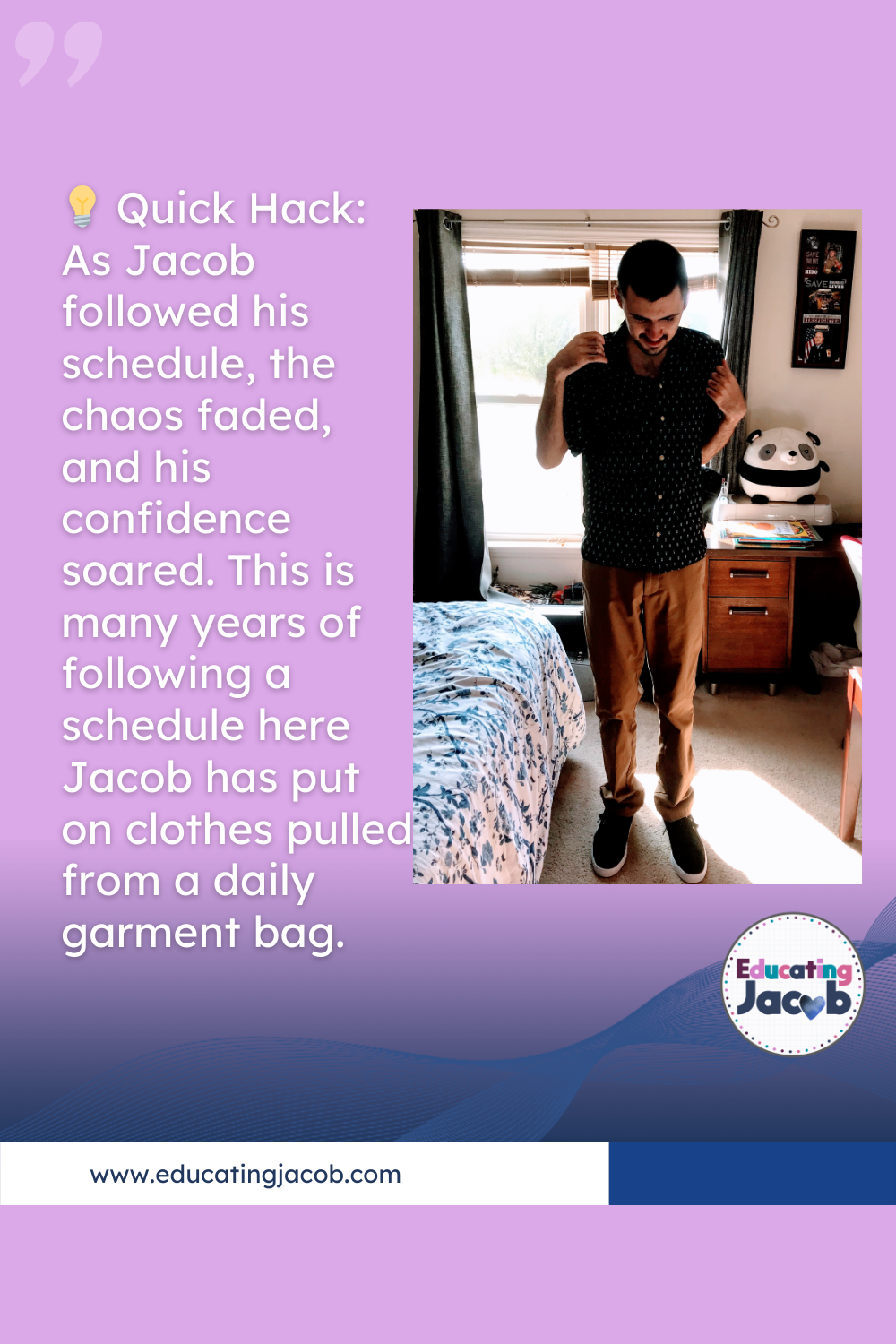
    Those zippered bags? They’re portals to another dimension! One holds schoolwork, another holds chapter books, and the garment bags? They contain Jacob’s weekly wardrobe, planned in advance—just like a knight’s armor, ready for battle. 🏰

    Why Clothes Schedules Matter:

    ✔ Helps Jacob avoid sensory discomfort 👕 ✔ Reduces morning decision fatigue ⏳ ✔ Keeps him comfortable & confident 💪 ✔ Uses special needs scheduling strategies to streamline daily routines

    A Week in Advance: Why Pre-Planning Works! 📅

    Planning a week ahead is critical because without a plan, Jacob’s anxiety skyrockets. Imagine interrupting a grand quest to slay dragons—bad idea! 🐉

    With his visual schedule, Jacob:

    • Knows what’s coming
    • Feels secure in his routine
    • Handles transitions with less stress

    💡 Processing delays make sudden changes overwhelming—think of it like trying to decipher ancient runes on the fly. 🏺 That’s why special needs scheduling strategies are a must for keeping routines predictable and manageable.

    Ready for Life’s Twists & Turns 🛤️

    Life is unpredictable. But with a structured schedule, our kids become seasoned adventurers—navigating unexpected changes with confidence. 🌟

    Need to adjust? No problem! Adjusting a schedule is like redirecting a GPS—it’s not about stopping the journey, just finding a new route. 🔄

    📌 With a strong routine in place, transitions become easier, meltdowns decrease, and peace replaces chaos.

    Embracing the Future with Confidence! 🔮

    With schedules as our guide, the future looks bright! When new challenges arise, our kids won’t be caught off guard. Instead, they’ll be equipped, confident, and ready to adapt. 💪✨

    📌 Want to build a schedule that works for your child? 🔹 Start simple. Choose 3 core daily activities and build from there. 🔹 Use visuals. Pictures and charts make transitions smoother. 🔹 Adjust as needed. Life happens—tweak the plan when necessary!

    💡 Looking for local autism-friendly events? Check out Autism Society programs near you! 🌍 📌 If you’re in North Carolina, check out upcoming events here: Autism Society of NC

    You Are Not Alone! 💙

    Parenting a child with autism can feel isolating, but you don’t have to do this alone. Educating Jacob is here for autism awareness, support, and community—not judgment. 💙

    📢 Join the Autism Thrive Tribe! ✔ Get real-life strategies that work ✔ Find a support system that understands ✔ Learn how to reduce chaos & create peace

    📌 Click here to join: Autism Thrive Tribe!

    🚀 Together, we’ll turn the chaos into clarity—one schedule at a time!

    Read More

  • Teaching Chores: Building Life Skills with Patience and Support for Autism

    Building Life Skills with Patience 🎉

    Every-Chore-is-a-Learning-Opportunity-@educatingjacob
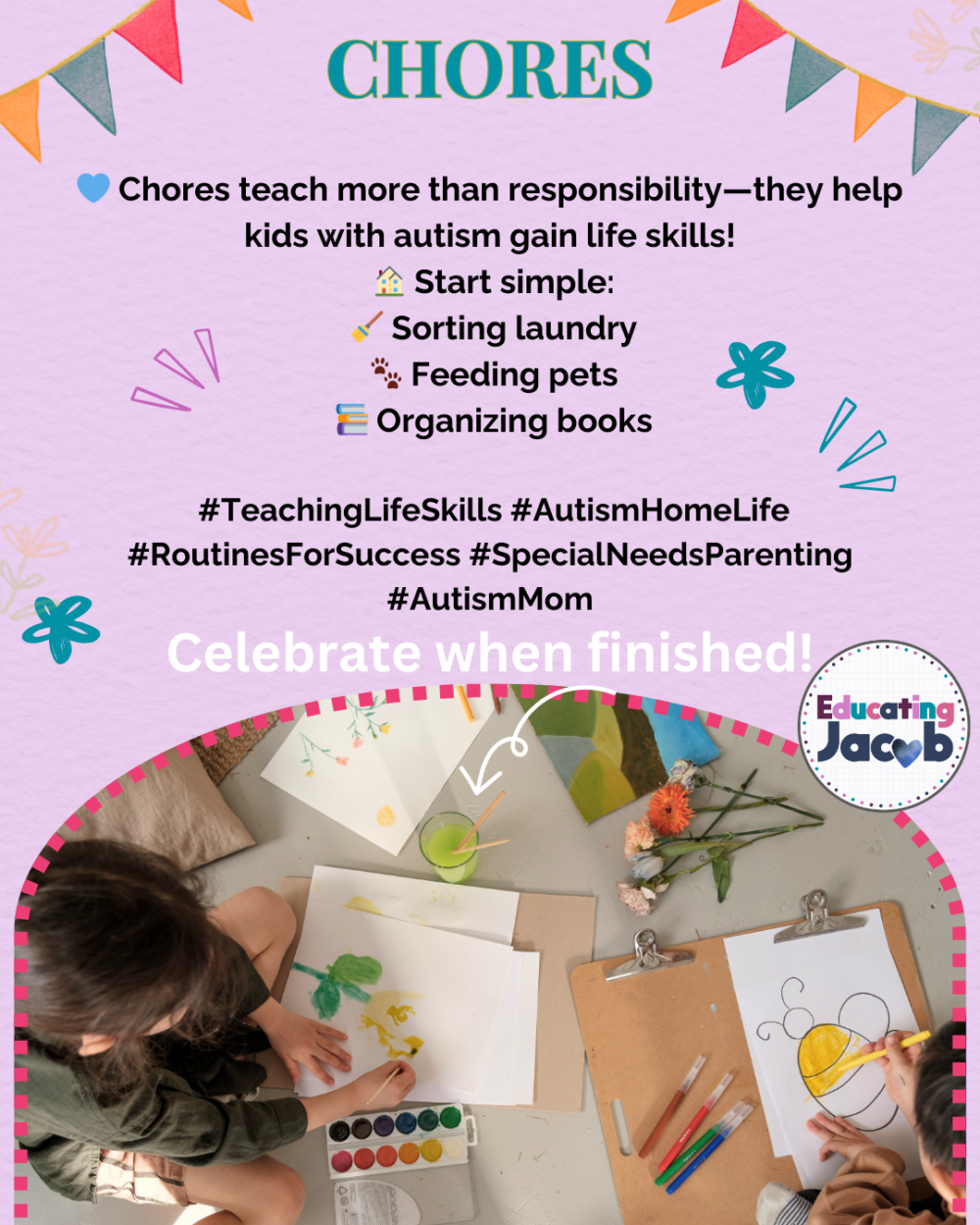
    Be consistent, start simple and celebrate when complete!

    This post is about support and resources for autism families. As parents, we want to raise responsible and independent children who can care for themselves and contribute to their households. This goal applies to all children, including those with autism or learning disabilities. Teaching chores isn’t just about helping out—it’s about building life skills, boosting confidence, and fostering independence. 💙

    When my son Jacob was younger, even simple tasks felt overwhelming. At first, he resisted, and honestly, I did too. I wasn’t sure how to teach him without frustration. But through patience, consistency, and visual schedules, he learned step by step. Now, at 27, Jacob can manage many daily tasks independently, and I’m here to share what I’ve learned so your child can too!


    Understanding Your Child’s Abilities and Challenges 🧩

    Before diving into chores, it’s important to assess your child’s abilities and challenges. So we have to support and have resources for autism families and share with each other! Every child on the autism spectrum has unique strengths and struggles, whether in: ✅ Fine motor skills (e.g., difficulty folding laundry) ✅ Attention span (e.g., easily distracted during tasks) ✅ Sensory sensitivities (e.g., textures of cleaning cloths feeling uncomfortable)

    📌 Tip: Start with tasks that align with their strengths! For Jacob, organizing books by color was easier than folding clothes, so that’s where we began. He does well hanging up clothes but not folding.


    Choosing Autism-Friendly Chores 🏠

    Not all chores are created equal—especially when considering sensory needs and executive functioning challenges. Here are some beginner-friendly chores for children with autism:

    🧹 Sorting & Organizing:

    • Putting books or toys in bins 🏗️
    • Sorting laundry by color 👕
    • Arranging groceries on shelves 🛒

    🧼 Cleaning Tasks:

    • Wiping tables with a damp cloth 🌟
    • Sweeping or using a handheld vacuum 🧹
    • Spraying plants with water 💦

    🧺 Personal Responsibility:

    • Putting dirty clothes in a hamper 🏗️
    • Helping set the table 🍽️
    • Feeding pets 🐾

    📌 Tip: Start with ONE simple task and make it part of their daily routine before adding more.


    Breaking Tasks into Small Steps ✂️

    Children with autism thrive on clear, step-by-step instructions. Instead of saying, “Clean your room,” try breaking it into manageable steps: 1️⃣ Pick up all the toys. 🧸 2️⃣ Put dirty clothes in the laundry basket. 👕 3️⃣ Wipe the table with a cloth. 🧼 4️⃣ Put books on the shelf. 📚

    📌 Tip: Use visual schedules to help your child see each step in order. We used pictures of Jacob doing each task, and it transformed how he followed through!


    Using Visual Aids and Schedules 🖼️

    Visual schedules and checklists are game-changers when teaching chores! They provide predictability and help reduce frustration.

    Picture checklists with step-by-step images 🎨 ✅ Magnet boards where kids move tasks from “To Do” to “Done” ✔️ ✅ Timers to set expectations for how long a task should take ⏳

    For Jacob, we started with a simple, laminated chart that he could check off after each task. Over time, he became more independent! Stop Morning Chaos: How to start using Visual Schedule for Autism and CALM


    Tailoring Instructions & Communication 🗣️

    When giving instructions, use clear, simple language that matches your child’s comprehension level. Try: ❌ “Go clean the kitchen.” (Too vague) ✅ “Please put the dishes in the sink.” (Clear & specific)

    📌 Tip: If verbal instructions don’t work well, use modeling—show them how to do it first, then let them copy you! 👫 Better yet, use a visual schedule! No words needed just pictures or just one- two words written for something they already know how to do! 


    Providing Positive Reinforcement 🎉

    Positive-Reinforcement-for-the-Win-@educatingjacob
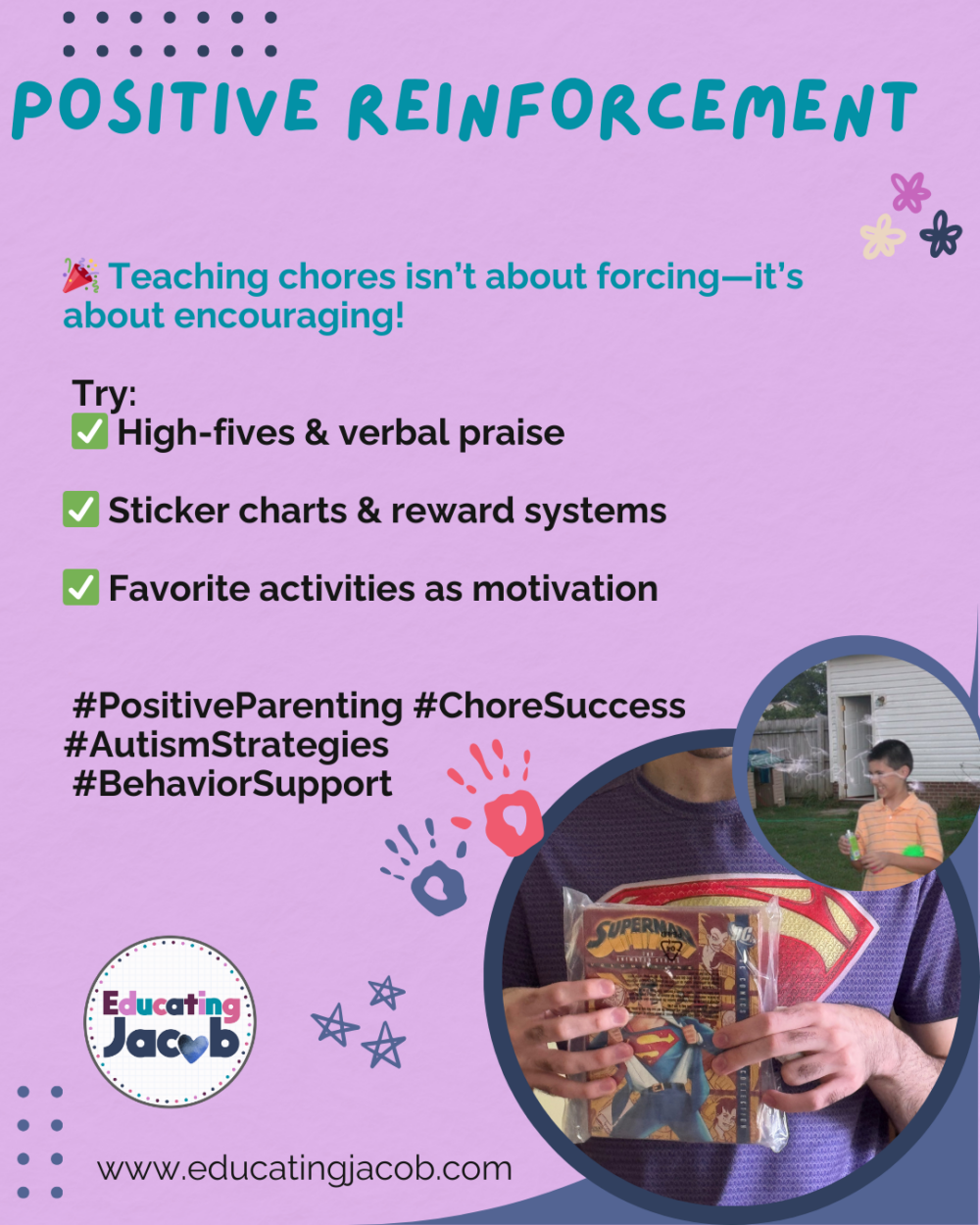
    Use positive reinforcement often! Have fun.

    Encouragement goes a long way! Use positive reinforcement to motivate your child:

    🎊 Verbal praise – “Great job putting your books away!” 🎊 Token system – Earn stickers or stars for completing chores ⭐ 🎊 Preferred activities – Extra time with their favorite activity 🎮

    Jacob loves earning a small reward at the end of the week, like choosing a favorite snack or movie. Over time, chores became part of his routine—not just something for a reward! 💙


    Creating a Sensory-Friendly Chore Environment 🌿

    Sensory sensitivities can make or break a child’s success with chores. Adapt their environment by: ✅ Using soft gloves if they dislike certain textures 🧤 ✅ Offering noise-canceling headphones for loud vacuuming 🎧 ✅ Choosing unscented cleaners for smell sensitivities 🌿

    📌 Tip: Always observe and adjust chores to make them comfortable yet achievableHelp! 3 Ways a schedule can help sensory issues and communication barriers? #Autism Challenges🧩


    Knowing When to Seek Support 🤝

    Support-services-and-Autism-Thrive-Tribe-@educatingjacob
    Support and resources for autism families: Autism Thrive Tribe! link at the end.

    If certain chores feel impossible, it’s okay to seek help from: 👩‍🏫 Teachers & Therapists – Occupational therapists can suggest fine motor skill-friendly tasks 👨‍⚕️ Behavioral Therapists – They can help break tasks into manageable steps 👥 Parent Support Groups – Learn what works for other families! Other parents on the same journey (Autism Thrive Tribe at the end!)

    Jacob struggled with using utensils and buttons, so we worked with an OT to improve his fine motor skills. That small intervention made daily tasks easier! 🛠️


    Final Thoughts: Teaching Life Skills with Love 💙

    Teaching chores to a child with autism isn’t just about keeping the house tidy—it’s about building their confidence, independence, and ability to contribute. 🌟 We need support and resources for autism families, lets share what we learn.

    By using visual schedules, breaking tasks into steps, adapting for sensory needs, and celebrating small wins, you can create a supportive learning environment. And most importantly, remember progress over perfection! 💙

    P.S. 🔥 Want more strategies like this? 📢 Join the Autism Thrive Tribe and connect with other parents learning how to create a structured, peaceful home. [📢 Join the Autism Thrive Tribe]

    With patience and the right approach, your child CAN learn new skills—and thrive! 🚀

    P.S.S. If you’re seeking disability advice, you should primarily contact the Social Security Administration (SSA) to understand your eligibility for Social Security Disability Insurance (SSDI) or Supplemental Security Income (SSI) benefits based on your medical condition, work history, and income level; you can apply online or at a local SSA office, and should gather comprehensive medical documentation to support your claim.

    Outreach Director sent this brochure to me for you to check out if you need additional help outside of the normal route: https://disabilityadvice.org/child-disability/

    Read More