schedules

  • Why I Started Educating Jacob: Support and Resources for Autism Families

    Educating Jacob: Support and Resources for Autism Families

    birthday-reflections-on-autism-blog-post@educatingjacob
    šŸ’™ To the parent feeling overwhelmed, exhausted, and lost—I see you.

    šŸŽ‰ Today is a big milestone for me—my 60th birthday! šŸŽ‚ As I reflect on my journey, I feel called to share my story and why I started Educating Jacob. Being vulnerable isn’t always easy, but if my experiences can help even one struggling parent, then it’s worth it. Because I’ve been there—I’ve lived that fear, uncertainty, and overwhelming sense of not knowing what to do when my son Jacob was first diagnosed with autism. šŸ’™Ā Visual Schedule Hacks for autism parents, Starting 2025 CALM!

    The Early Years: Fear, Confusion, and the Search for Answers 🧩
    Fear-and-Confusion-took-over-autism-diagnosis
    #ParentingWithPurpose #AutismSupportCommunity #AutismLife

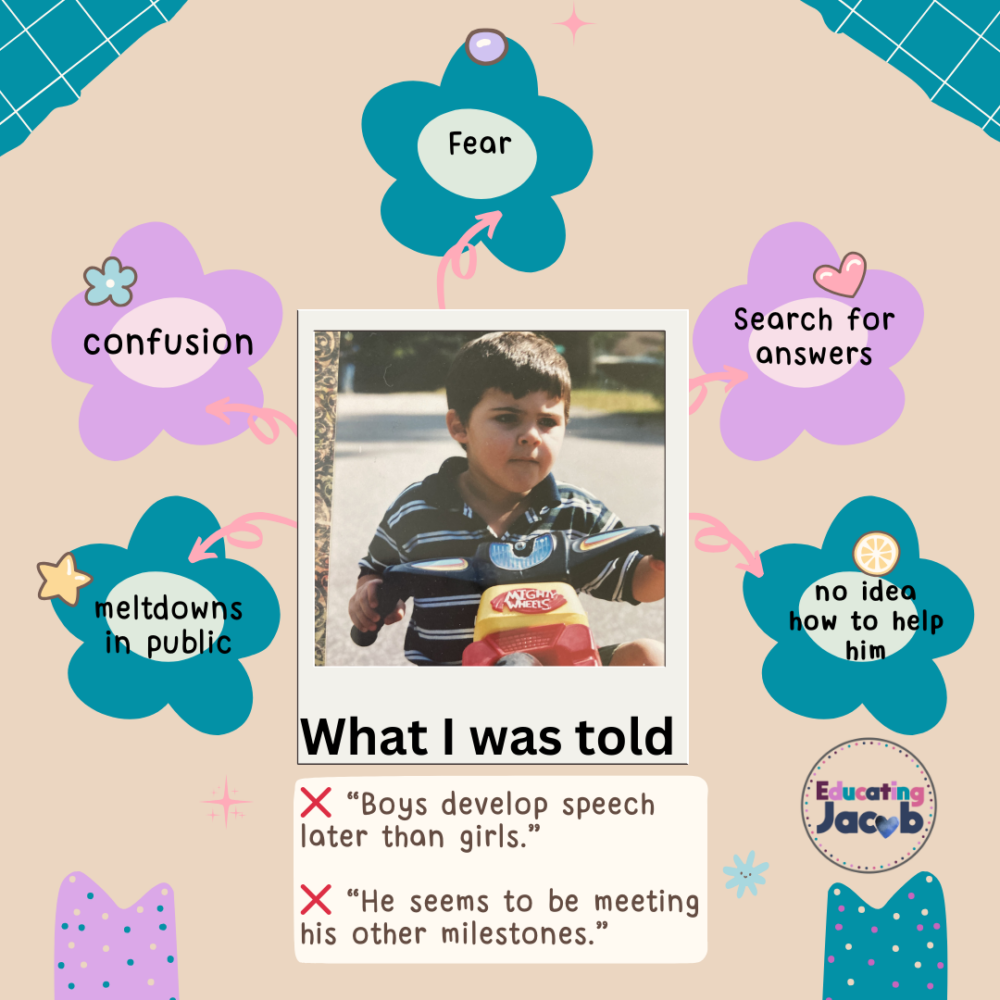
    When we first received Jacob’s diagnosis, I was terrified. I had no idea how to help him. He would have meltdowns in public, struggle with changes, and his speech wasn’t developing the way his older brother Nicholas’s had. šŸ˜ž

    I received hugs and kisses, but no ā€œMama.ā€ The milestones I had celebrated so naturally with my first child weren’t happening. I started pushing doctors for answers, but I kept hearing:

    āŒ ā€œBoys develop speech later than girls.ā€ āŒ ā€œHe seems to be meeting his other milestones.ā€

    But deep down, I knew something was different. And so began the long waitlists, endless evaluations, and finally—the autism diagnosis.

    Now, I had an answer. But I still had no clue how to help my child. šŸ¤·ā€ā™€ļøĀ 4 Things I Wish I Would Have Known After Getting the Autism Diagnosis

    A Lack of Guidance, a Desire to Learn, and an Unexpected Truth šŸ“š

    At the time, I had no mentors to guide me. I had wonderful women in my life—my mom, aunts, and friends—but none of them had experience raising a child with autism. There was no one to say, ā€œTry this. This worked for my child.ā€ I felt alone, desperate for support and resources for autism families.

    So, I made a big decision: āœ… I went back to school and earned a graduate degree in special education.

    I thought it would give me all the answers I needed to help Jacob. But here’s the truth:

    šŸ’ø Save your money.

    A degree didn’t give me the magic solution—because autism is a spectrum. No textbook could tell me exactly what would work for Jacob. I learned useful tools, but when it came to real life, it was still trial and error.

    Finding What Works: The Birth of Educating Jacob 🌱

    Over time, I started figuring out what worked—not just for Jacob, but for our family as a whole. I learned how to reduce anxiety, minimize meltdowns, and create a home environment that was calm instead of chaotic. šŸ”āœØ

    Now, at 27 years old, Jacob’s life looks very different than it did back then. We still have challenges, but now we have a toolkit, a structure, and a way of doing things that brings peace instead of frustration.

    This is why I started Educating Jacob.

    I never want another parent to feel as lost, helpless, or alone as I did. If I can take everything I’ve learned—from raising Jacob, teaching other children with autism, and even homeschooling my own son—and pass that knowledge on, then I know I’m making a difference.

    My Mission: Helping Families Thrive, Not Just Survive šŸ’™

    Join-Autism-Thrive-Tribe
    Raising a child with autism is challenging—but you don’t have to do it alone.

    I want to be the mentor I never had—for parents who are still struggling, still looking for support and resources for autism families, still searching for answers and guidance in the chaos of autism parenting.

    I want to tell parents: ✨ It gets better. ✨ You can do this. ✨ You don’t have to figure it out alone.

    And most importantly, I want to help families find what works. Because when life starts going wrong and nothing seems to be working, we have two choices:

    1ļøāƒ£ Keep doing the same thing and hope for different results. 2ļøāƒ£ Try something new.

    And trying something new is what led me to create the CALM Framework—the foundation of Educating Jacob: āœ” C: Consistent Action Forward āœ” A: Always Celebrate Wins āœ” L: Learning to Create Schedules āœ” M: Mindset

    These four pillars help guide families toward a life that is structured, peaceful, and full of hope. 🌟

    The Autism Thrive Tribe: A Community of Support šŸ¤

    One of the best things to come from this journey has been creating a community. I started the Autism Thrive Tribe to bring parents together—to support one another, share wins and struggles, and learn from each other’s experiences.

    If you’re an autism parent or a teacher trying to support a child with autism, I invite you to join us. Because no one should have to figure this out alone. šŸ’™

    šŸ“¢ Join here: [AUTISM THRIVE TRIBE]

    A Birthday Reflection: Gratitude, Hope, and Looking Ahead šŸŽ‚

    Today, as I turn 60, I look back on the years of struggle, learning, and growth—and I feel grateful. šŸ™

    šŸ’™ Grateful for my son, for the lessons he’s taught me, and for the opportunity to share those lessons with others. šŸ’™ Grateful that our home is no longer filled with anxiety and constant meltdowns—but instead, with structure, peace, and love. šŸ’™ Grateful that I have the chance to help other families find that same hope.

    I won’t pretend that every day is easy. Autism parenting is a journey, and it comes with ups and downs. But I can tell you this—

    āœ… It is possible to find joy again. āœ… It is possible to go from surviving to thriving. āœ… And if you’re feeling lost right now, you’re not alone.

    I see you. I’ve been you. And I’m here to help. šŸ’™

    Let’s Connect! šŸŒ

    If my story resonates with you, I’d love for you to join me: šŸ‘‰ Join the Autism Thrive Tribe – A supportive group for parents navigating autism. šŸ‘‰ Follow Educating Jacob – For tips, encouragement, and practical strategies. šŸ‘‰ Explore the CALM Frameworks – Learn how to create a structured, peaceful life for your child and your family.

    On this special birthday, my wish is to bless someone else with what I’ve learned. Because together, we can make this journey so much easier. šŸ’™

    With love and gratitude,
    Melissa Garcia
    Founder, Educating Jacob
    Read More

  • Mastering Autism Behavior Management: 3 Strategies for Success

    Behavior-management
    Let’s use proactive strategies for behaviors and ditch the Chaos!

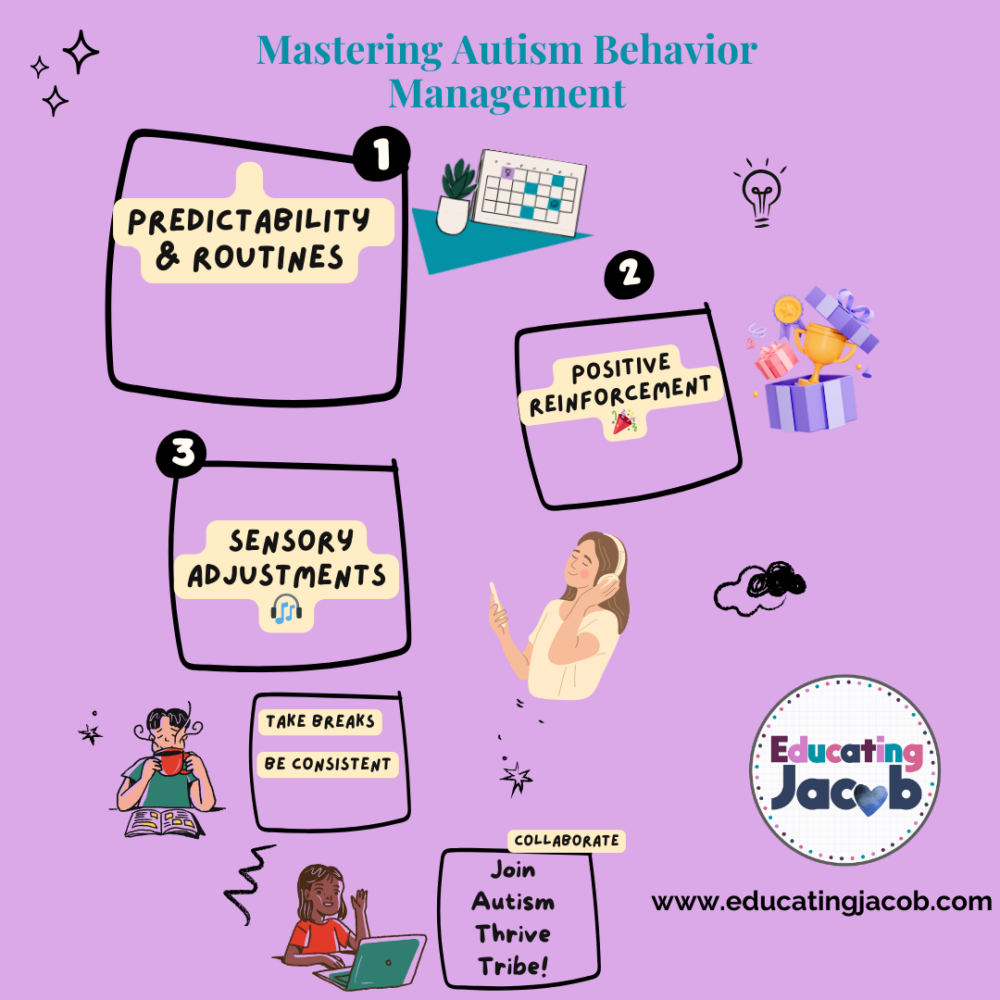
    Mastering Autism Behavior Management

    🚨 Parenting a child on the autism spectrum comes with unique challenges, especially when you feel you need a class in Mastering Autism Behavior Management. If you feel like your home is constantly on the edge of chaos, you’re not alone. But here on Autism Island, we believe that every challenge is an opportunity to learn, adapt, and grow. 🌟

    Finding effective behavior management strategies isn’t just about reducing stress for parents; it’s about giving children with autism the tools they need to thrive. A structured, supportive environment can minimize anxiety, promote independence, and create a sense of security—all of which are crucial for their success.Ā Stop Morning Chaos: How to start using Visual Schedule for Autism and CALM

    Through my experiences as both a special education teacher and Jacob’s mom, I’ve learned that behavior management isn’t about control—it’s about understanding, structure, and support. That’s where my CALM Framework comes in. These three essential strategies will help reduce negative behaviors, promote positive ones, and create a more peaceful home environment. šŸ”šŸ’™

    Let’s talk—you don’t need a master’s degree in special education, but a heart full of love and consistent action forward! Celebrating each step!! šŸŽ‰ From unpredictable meltdowns to struggling with transitions, every day can feel overwhelming. If you feel like your home is constantly on the edge of chaos, you’re not alone. But here on Autism Island, we believe that every challenge is an opportunity to learn, adapt, and grow. 🌟

    Finding effective behavior management strategies isn’t just about reducing stress for parents; it’s about giving children with autism the tools they need to thrive. A structured, supportive environment can minimize anxiety, promote independence, and create a sense of security—all of which are crucial for their success.


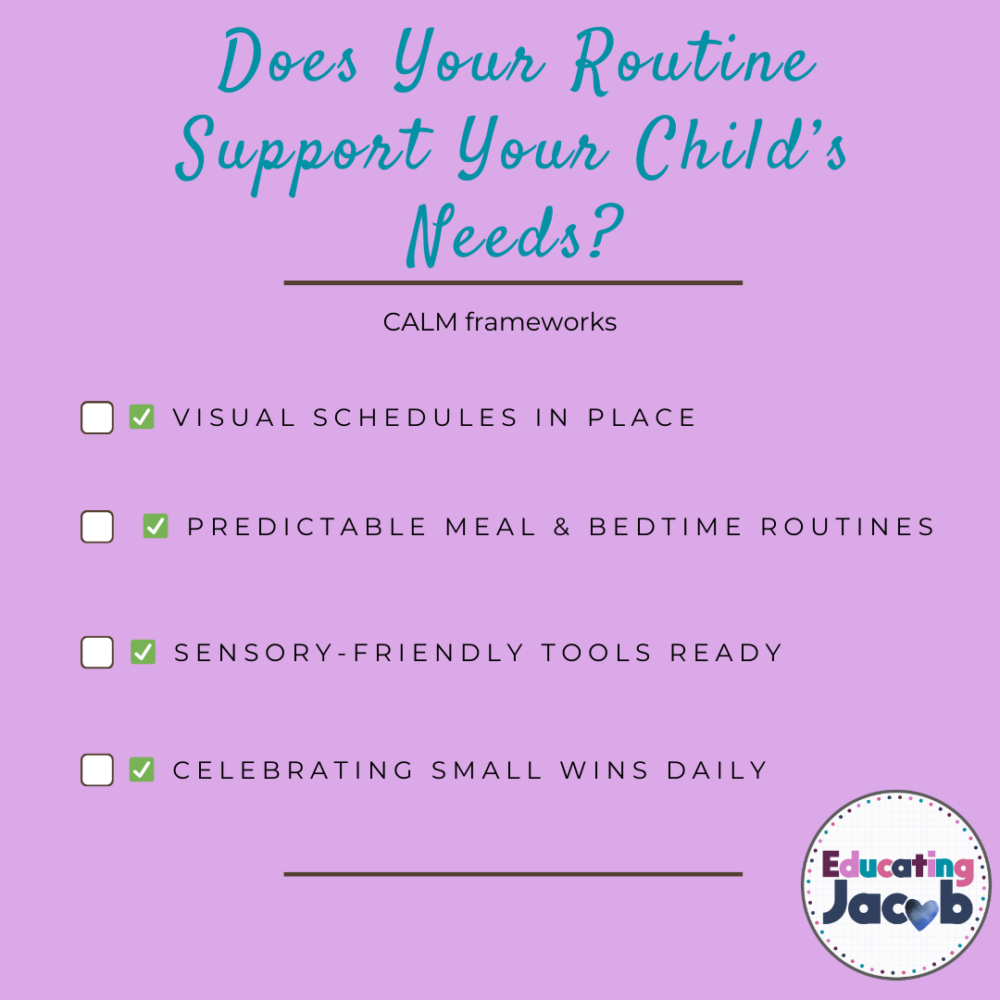
    Does Your Routine Support Your Child’s Needs?
    Create Structured Environments that feel safe!

    1. Create Predictability with Consistent Routines ā³

    Children with autism thrive on predictability. When they know what to expect, their anxiety decreases, making transitions smoother and reducing meltdowns. 😌 How to achieve CALM on Autism Island, daily life on the spectrum.

    How to Implement It:

    • šŸ“Œ Use Visual Schedules – A picture-based or written schedule can help your child anticipate daily activities.
    • šŸ•’ Follow a Routine – Keep meal times, bedtime, and transitions consistent each day.
    • šŸ”„ Prepare for Changes – When disruptions to the routine occur, use social stories or visual cues to explain the change.

    šŸ”¹ Example: Mornings used to be tough for Jacob. But once we introduced a visual schedule, he knew what to expect each morning: wake up, brush teeth, get dressed, eat breakfast. Over time, his anxiety lessened, and mornings became much smoother. šŸŒ…

    šŸ“ Pro Tip: Start small—choose the most stressful part of your day and create a predictable routine for it. āœ…

    2. Encourage Positive Behaviors with Reinforcement šŸŽ‰

    Too often, we focus on stopping negative behaviors rather than encouraging positive ones. Positive reinforcement is one of the most effective tools for shaping behavior. šŸ‘āœØ

    How to Implement It:

    • šŸŽŠ Celebrate Small Wins – Recognize and praise your child for even small successes.
    • šŸŽ Use Preferred Rewards – Whether it’s extra screen time, a favorite snack, or a special activity, make the reinforcement meaningful.
    • šŸ” Stay Consistent – Reinforce behaviors immediately so your child can make the connection.

    šŸ”¹ Example: Jacob used to resist following his schedule. At first, I rewarded him with a small treat each time he completed a step. Now that he understands the process, he works towards a weekly reward—choosing a new movie to order on Amazon. šŸŽ¬

    šŸ“ Pro Tip: If you’re just starting with reinforcement, reward frequently to build momentum. Over time, space out rewards to encourage intrinsic motivation. šŸ†Ā https://www.autismsociety-nc.org/healthy-habits-conference-2/

    3. Adjust the Environment for Sensory Needs šŸŽ§

    Many behavioral challenges stem from sensory sensitivities. Identifying and accommodating these needs can help prevent meltdowns before they start. 🌈

    How to Implement It:

    • šŸ” Create a Sensory-Friendly Space – A quiet, calming area can serve as a retreat when your child feels overwhelmed.
    • šŸ›‘ Use Sensory Tools – Noise-canceling headphones, weighted blankets, or fidget tools can help with self-regulation.
    • šŸ’” Modify the Environment – Pay attention to lighting, noise levels, and clothing textures that might be triggering.

    šŸ”¹ Example: Jacob becomes overwhelmed in loud, crowded spaces. Now, before we go out, we bring noise-canceling headphones and let him know what to expect. This small adjustment has made a huge difference in his comfort level. šŸ˜ŒšŸŽ§

    šŸ“ Pro Tip: Observe your child’s reactions to different sensory inputs and adjust their environment accordingly to reduce stress triggers. 🧩

    mastering-autism-behavior-graphic
    Join Autism Thrive Tribe to learn more!

    Take the First Step Toward a Calmer Home šŸ 

    Behavior management isn’t about perfection—it’s about progress. šŸš€ By implementing consistent routines, reinforcing positive behaviors, and adjusting the environment for sensory needs, you can transform daily challenges into opportunities for growth. 🌟

    If you’re looking for ongoing support, I invite you to join the Autism Thrive Tribe—a community designed to help parents like you implement these strategies with confidence. šŸ’™

    šŸ“¢ Spots for founding members are limited! Click below to learn more and sign up today. ā¬‡ļø šŸ‘‰ Join the Autism Thrive Tribe Today!

    Read More

  • How can I prevent meltdowns during unexpected changes? šŸ˜” Ditch the chaos.

    Prevent-Autism-Meltdowns-During-Unforeseen-Change
    Validate Emotions and Offer Choices šŸ¤

    Prevent Autism Meltdowns During Unforeseen Changes

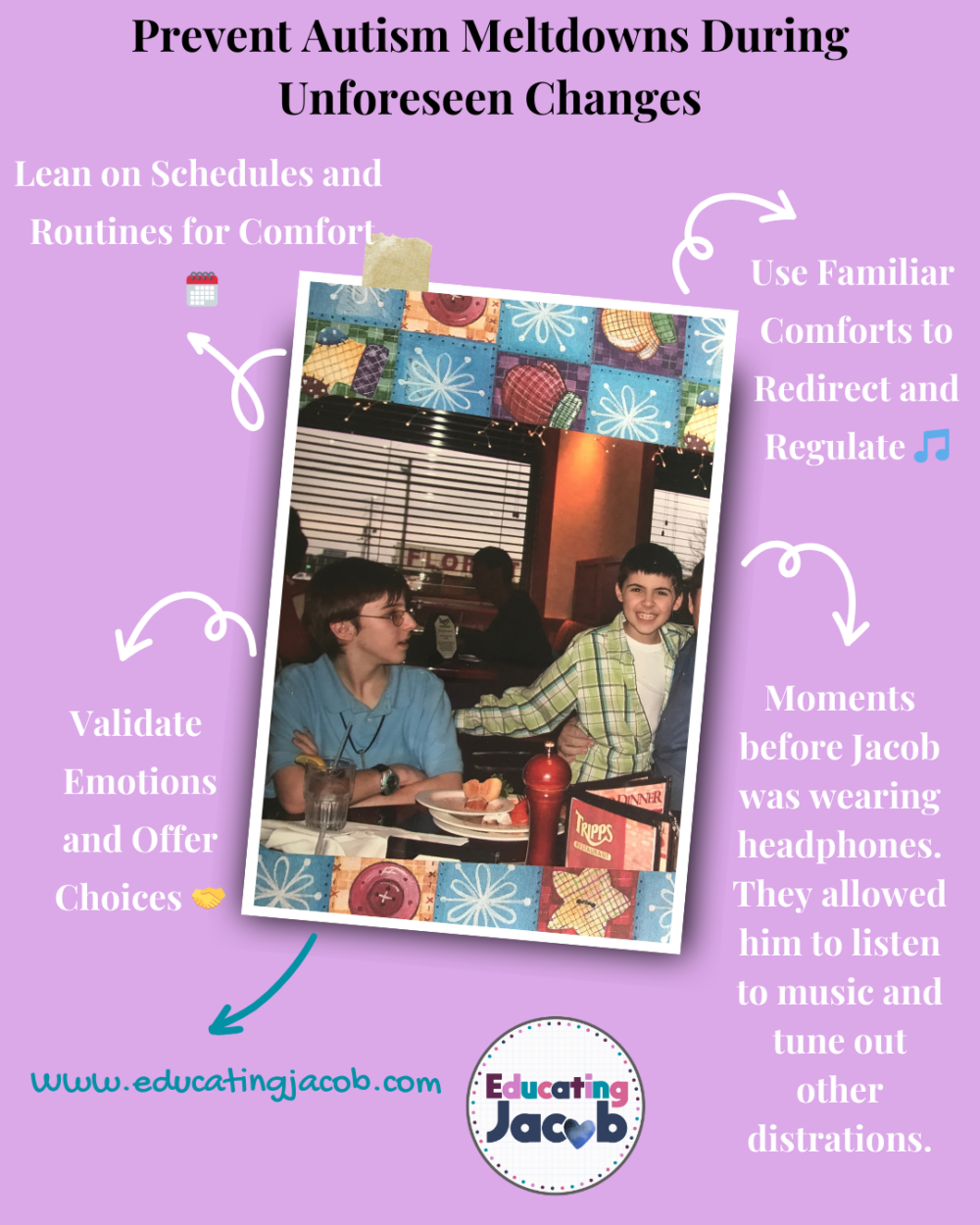
    So, how to prevent autism meltdowns during unforeseen changes? šŸ“…Mornings like today remind me just how challenging unforeseen changes can be for children with autism—and for us as parents. Just this morning, Jacob, my son who thrives on routine, struggled when his worker couldn’t come because she was sick. Before I could even tell him, Jacob had already jumped in the shower, stripped his bed, and prepared for their usual routine of washing his sheets and clothes.Ā Tired and Frustrated Mom! Sensory Challenges for the Autism Spectrum

    But when she didn’t show, he started to feel it. šŸ˜” He kept asking about her and eventually lay on his bed, visibly upset. After a while, he came out and told me and his dad that he was angry. Through short questions, we clarified why—he was upset because Ms. Gwen didn’t come as expected.

    Jacob’s frustration lingered for a while. He even turned down his favorite activity: going out to lunch. 🄪 But we turned to what always helps—the schedule and routine. We validated his feelings, redirected him back to his visual schedule, and used our tools (like offering choices and playing calming music) to help him move forward. Jacob wasn’t bribed—bribing does not work and can undo the positive habits and independence we’re building. Instead, we leaned on structure and support to get him through.

    By the end of the day, he was back on track, had completed his scheduled work, enjoyed his favorite meal from Panera, and even found joy in the music his dad played for him. šŸŽ¶ This experience reminded me why tools like schedules and routines are critical for children with autism.

    This is a perfect example of how preventing autism meltdowns during unforeseen changesĀ relies on practical, foundational strategies. Let’s explore how you can apply these steps to bring calm to your child’s day and ditch the chaos.

    Why Unforeseen Changes Cause Chaos in Autism Families

    If you’re parenting a child with autism, you know how deeply they rely on predictability. Routine isn’t just about structure; it’s about security. When something unexpected happens, it can feel like their whole world has been turned upside down. 😩

    Children with autism often process changes differently. They may not have the words to express what they’re feeling, leading to behaviors that seem out of control but are really expressions of overwhelm. This is why meltdowns are so common when routines are disrupted.

    The key to preventing autism meltdowns during unforeseen changesĀ is to have strategies in place that provide comfort, predictability, and tools for emotional regulation—even in moments of uncertainty.

    1. Lean on Schedules and Routines for Comfort šŸ—“ļø

    Schedules are more than just a way to structure your child’s day—they’re a tool that helps them understand what’s happening next. When Jacob’s day is disrupted, returning to his visual schedule gives him something to hold onto, even when everything else feels uncertain.

    Here’s how schedules helped Jacob today:

    • He went back to his visual schedule and completed tasks like his work and chores.
    • The routine gave him a sense of independence, allowing him to regain control of his day.
    • The consistency helped him regulate his emotions and decrease anxiety.

    šŸ’” Practical Tip: Create a simple visual schedule that reflects your child’s regular activities. When changes arise, adapt the schedule in a way that provides continuity, such as adding a calming activity or favorite meal as a substitute.Ā How are using schedules improving our autistic child’s daily life?

    2. Validate Emotions and Offer Choices šŸ¤

    When Jacob told us he was angry, it was a breakthrough. He was able to communicate what he was feeling instead of bottling it up or having a meltdown. Validating those feelings was crucial.

    Rather than pushing him to follow the original plan, we adjusted. He didn’t want to go out, so we offered a choice: pick up Panera instead. This small shift respected his emotions while keeping some structure intact.

    šŸ’” Practical Tip: Start by acknowledging your child’s feelings. For example, ā€œI can see you’re upset that we had to change plans today.ā€ Then, offer choices that give them some control, like an alternative activity or favorite food.Ā https://www.autismsociety-nc.org/social-supports-for-families-with-autism-2/

    3. Use Familiar Comforts to Redirect and Regulate šŸŽµ

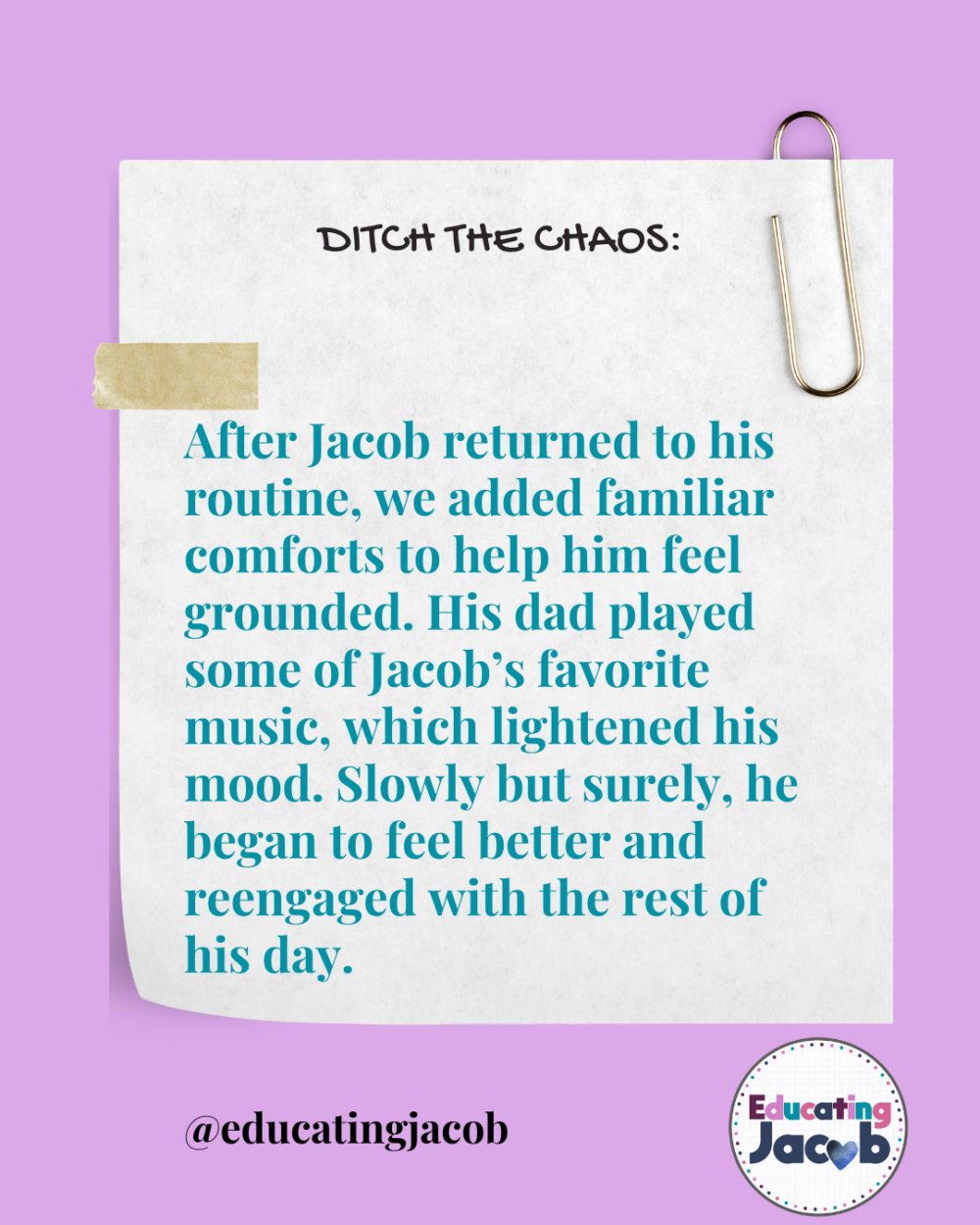
    After Jacob returned to his routine, we added familiar comforts to help him feel grounded. His dad played some of Jacob’s favorite music, which lightened his mood. Slowly but surely, he began to feel better and reengaged with the rest of his day.

    šŸ’” Practical Tip: Keep a ā€œcomfort toolkitā€ ready for moments like these. This might include sensory toys, calming music, or even just extra time in a quiet space. Pairing these comforts with a routine can help your child self-regulate.Ā How my husband changes Jacob’s bad mood with music! #musicandautism.

    Ditch-the-Chaos
    Prevent autism meltdowns during unforeseen changes.

    Ditch the Chaos: What Jacob Taught Me Today

    Jacob’s ability to work through his frustration today was a reminder that preventing autism meltdowns during unforeseen changesĀ doesn’t mean avoiding change altogether—it means building the tools to handle it.

    By validating his emotions, redirecting him back to his schedule, and using familiar comforts, we helped Jacob work through the disruption. Bribing wasn’t part of the process—our goal isn’t to distract or pacify but to teach independence and emotional regulation. When we lean on structure and routines, we’re giving our kids the tools to thrive, even when life feels unpredictable.

    Your Turn Take the First Step šŸš€ @educatingjacob
    This was a very simple way to ditch the chaos of dressing!

    Your Turn: Take the First Step šŸš€

    If you’re feeling overwhelmed by the chaos of unforeseen changes, know that you’re not alone. Start small—create a visual schedule, validate your child’s feelings, and find those small comforts that help them reset.

    For more strategies like these, I’d love to invite you to join the Autism Thrive Tribe. This is a supportive community where parents share resources, celebrate wins, and tackle the challenges of autism together.

    šŸ‘‰ Click Here to Join the Autism Thrive Tribe

    P.S. Don’t forget, change is hard for all of us, but with the right tools and mindset, it doesn’t have to disrupt your entire day. By leaning on schedules, validating emotions, and teaching independence, you can ditch the chaos and create calm in your family’s life. šŸ’™

    With love and encouragement,
    Melissa Garcia
    Founder, Educating Jacob
    P.S.S. If you’re seeking disability advice, you should primarily contact the Social Security Administration (SSA) to understand your eligibility for Social Security Disability Insurance (SSDI) or Supplemental Security Income (SSI) benefits based on your medical condition, work history, and income level;Ā you can apply online or at a local SSA office, and should gather comprehensive medical documentation to support your claim.

    Outreach Director sent this brochure to me for you to check out if you need additional help outside of the normal route: https://disabilityadvice.org/child-disability/

    Read More

  • Stop Morning Chaos: How to start using Visual Schedule for Autism and CALM

    CALM-autism-strategies@educatingjacob
    Visual Schedules, Routine and Consistency gave Jacob Calm in the Chaos!

    Morning Visual Schedule Hacks for Autism Parents

    Mornings used to be the most chaotic part of our day. šŸ•— Then I learned the morning visual schedule hacks for autism parents! The struggle was real.
    The rush to get everyone dressed, fed, and out the door was a recipe for meltdowns, frustration, and tears—both for Jacob and me. It felt like I was running a marathon before the day even started.Ā Stop talking so much! 3 reasons using visual schedules for your autistic child is best!

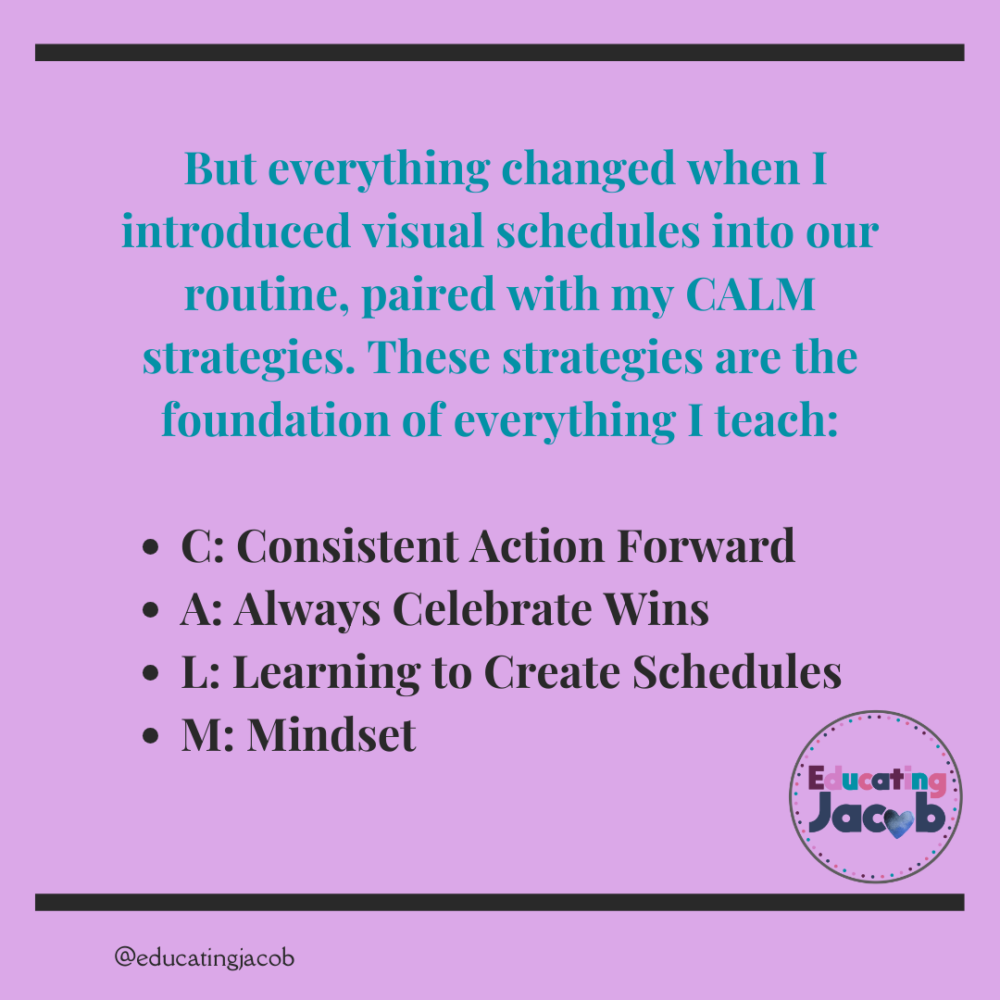
    But everything changed when I introduced visual schedules into our routine, paired with my CALM strategies. These strategies are the foundation of everything I teach:

    • C: Consistent Action Forward
    • A: Always Celebrate Wins
    • L: Learning to Create Schedules
    • M: Mindset

    By applying these principles to visual schedules, I was able to bring structure, independence, and calm into our home. In this post, I’ll share visual schedule hacks for autism parents 2025 to help you follow these steps and transform your mornings.

    Autism-parenting-hacks-@educatingjacob
    Start small, tiny changes and celebrate all wins!

    1. Start Small: Build One Routine at a Time

    C: Consistent Action Forward
    When I started with Jacob, I focused on just one part of his morning routine: getting dressed. I created a simple visual schedule with pictures of each step—pants, shirt, socks, shoes. These were laminated and Velcroed, with a ā€œdoneā€ pocket for completed tasks.

    This consistent process helped Jacob see what was expected, giving him the confidence to move through each task independently. For school, his visual schedule even included a picture of me as the final task to signal pickup time—a clever tool he sometimes tried to move up in the day!

    šŸ’” Quick Hack: Choose one chaotic part of your morning—dressing, breakfast, or brushing teeth—and start there. Consistency is key, so use the same schedule daily to build a habit your child can rely on.

    2. Celebrate the Small Wins

    A: Always Celebrate Wins
    Every small step Jacob completed was met with celebration—whether it was a high-five, a sticker, or his favorite phrase, ā€œWhat in the World!ā€ šŸŽ‰ Positive reinforcement helped him feel proud of his accomplishments and motivated him to keep going.

    As he grew more comfortable with routines, we transitioned to celebrating weekly wins. But in the beginning, every small success mattered and deserved acknowledgment.

    šŸ’” Quick Hack: Incorporate rewards that excite your child, like stickers, favorite snacks, or extra playtime. Remember to celebrate the effort, not just the outcome!

    3. Create Schedules that fit your Child

    L: Learning to Create Schedules
    Creating schedules that fit Jacob’s needs was a learning process for both of us. I started simple, using pictures of him completing tasks. This gave him clarity and ownership of the routine.Ā https://www.merakilane.com/indoor-activities-for-kids-with-autism/

    For example, Jacob’s mornings began with a color-coded card signaling it was time for his schedule. Tasks like breakfast, dressing, and brushing teeth were represented by photos he could move to the ā€œdoneā€ pocket after completion.

    šŸ’” Quick Hack: Start with just a few tasks, keeping them simple and sensory-friendly. As your child gains confidence, you can expand the schedule to include more steps or even activities they love.

    Calm Mornings for Autism Families Begins with Mindset

    M: Mindset
    Building visual schedules—and sticking to them—requires a mindset shift for both parent and child. I’ll admit, there were mornings when I felt like giving up. But I reminded myself that consistency and patience were key.

    Over time, Jacob began to thrive with his schedule, and mornings became a source of calm rather than chaos. Even now, at 27, he still enjoys the structure and rewards of a well-planned routine.

    šŸ’” Quick Hack: Be patient with yourself and your child. Progress takes time, and flexibility is part of the journey. If something isn’t working, tweak it and try again.Ā Stop engaging in power struggles! Use redirection for your autistic child.

    Visual-schedule-examples-@educatingjacob
    Jacob is older now and still needs routine and schedules to create calm in his world.

    Jacob’s Morning Story

    Jacob’s first visual schedule was inspired by TEACCH at Chapel Hill, NC, where he was first diagnosed. They taught me how to create interactive activities tailored to his needs.

    One morning, I handed Jacob his color-coded card, signaling it was time to start:

    1. He pulled off the breakfast picture and ate his meal.
    2. Next was the clothing picture, and he dressed in the clothes I’d laid out.
    3. Then came brushing teeth and hair.
    4. Finally, the car and school picture wrapped up the routine.

    As Jacob followed his schedule, the chaos faded, and his confidence soared. Over time, I mirrored his school schedule at home to provide consistency, but I added fun touches—characters and colors he loved. Now, as an adult, Jacob still thrives on structure, and his rewards have grown with him (Amazon or eBay treats are his favorite!).

    Your Turn: Take the First Step

    You don’t need to overhaul your entire morning overnight. Start small, follow the CALM strategies, and adapt your visual schedules to your child’s needs. By building consistent habits, celebrating wins, and fostering the right mindset, you’ll see mornings transform into a calm, productive time for your family.

    If you’re ready to dive deeper or want support from other autism parents, join the Autism Thrive Tribe! Together, we’ll explore these strategies, celebrate progress, and move forward—one calm morning at a time.

    šŸ‘‰ Click Here to Join the Autism Thrive Tribe

    With love and encouragement,
    Melissa Garcia
    Founder, Educating Jacob
    If you’re seeking disability advice, you should primarilyĀ contact the Social Security Administration (SSA) to understand your eligibility for Social Security Disability Insurance (SSDI) or Supplemental Security Income (SSI) benefits based on your medical condition, work history, and income level;Ā you can apply online or at a local SSA office, and should gather comprehensive medical documentation to support your claim.

    Outreach Director sent this brochure to me for you to check out if you need additional help outside of the normal route: https://disabilityadvice.org/child-disability/

    Read More